PO Matching Automation for Finance Teams | FinanceCopilotHQ
PO matching automation is the AP control that validates every vendor invoice against its corresponding purchase order before payment is authorized. For finance teams processing significant volumes of PO-backed spend, automating this comparison eliminates the manual document-pulling and field comparison that creates AP backlogs — while simultaneously strengthening the audit trail that proves each payment was properly authorized. This guide covers what PO matching automation involves, which tools do it best, and what finance teams need to know before deploying a solution. For a full platform comparison, see our Best AP Automation Software guide.
What it is: Software that automatically compares incoming invoices against open purchase orders — validating vendor identity, quantities, and prices within defined tolerance rules — to clear matched invoices for payment without manual review.
Top tool for this use case: Stampli for mid-market teams where ERP integration depth and exception resolution UX are the priority; Tipalti for organizations requiring matching as part of an end-to-end global payment platform.
Ideal company profile: Organizations with formal procurement processes issuing 100+ purchase orders per month, particularly in manufacturing, distribution, construction, and any sector with significant goods-based spend.
What Is PO Matching Automation?
PO matching automation is the use of software to compare vendor invoices against open purchase orders automatically, without manual document retrieval or field comparison by AP staff. In a two-way match, the system compares the invoice against the PO only — validating vendor, quantities, and unit prices. In a three-way match (the most common standard in mid-market and enterprise AP environments), the system also validates against a goods receipt confirmation, verifying that what was ordered was actually delivered before the invoice is cleared for payment. In a four-way match, an inspection or quality acceptance record is added as a fourth validation document.
When an invoice matches its PO within configured tolerance rules, the system clears it for straight-through processing — routing it directly to the payment queue without requiring approver intervention. When the invoice falls outside tolerance on any dimension, the system creates a structured exception with the relevant documents, variance details, and routing information assembled automatically, and routes it to the designated exception owner for investigation.
PO matching automation is distinct from but closely related to three-way matching automation — the latter refers specifically to the three-document validation standard, while PO matching automation encompasses the broader workflow of automated comparison regardless of matching depth. The two terms are often used interchangeably in practice.
The Business Case
The efficiency case for PO matching automation is driven by straight-through processing rates. IOFM benchmarking data shows that top-quartile AP organizations achieve straight-through processing rates of 70% or higher on PO-backed invoices — meaning the majority of matched invoices move from receipt to payment queue without any human touchpoint. Median performers achieve 30–40%. The difference is almost entirely attributable to automated matching with well-calibrated tolerance rules versus manual comparison by AP staff.
The cost impact is direct. APQC’s process cost benchmarking shows that organizations with high straight-through processing rates on PO invoices process those invoices at a fraction of the cost of manually matched invoices. At scale — 500 or more PO-backed invoices per month — the labor cost difference between manual and automated matching is the primary driver of cost-per-invoice variation across organizations.
The compliance case is equally strong. Gartner identifies PO matching as a core AP internal control in its procure-to-pay frameworks, and auditors treat documented, systematically operating matching controls as evidence of a mature AP environment. Organizations that can demonstrate automated matching with documented tolerance rules and exception audit trails close audit findings faster and with less management time than those relying on manual matching documentation. See our Three-Way Matching Automation guide for a deeper look at the matching workflow specifically.
Common Challenges
Late PO creation. Purchasers who create POs after goods are received — to retroactively document a purchase — undermine matching automation by creating POs that cannot be meaningfully compared against invoices for receipt validation. This is one of the most common reasons matching automation generates excessive exceptions on otherwise clean invoices.
Price and quantity tolerance calibration. A single global tolerance threshold applied to all invoice types will either block too many legitimate invoices (if set too tight) or pass too many exceptions through automatically (if set too loose). The right tolerance structure varies by vendor relationship, commodity category, and contract type.
Partial deliveries and multi-PO invoices. Vendors sometimes invoice against multiple POs in a single document, or invoice for partial quantities against a single PO. Matching systems that cannot handle these scenarios generate exceptions on invoices that are commercially correct.
PO closure and amendment lag. When POs are amended after an invoice has been submitted — to reflect a change order, price adjustment, or quantity revision — matching systems that do not pull real-time PO data from the ERP will compare the invoice against a stale PO version and generate a false exception.
Non-PO invoice volume masking PO matching ROI. Organizations with high proportions of non-PO spend (services, subscriptions, utilities) will see limited benefit from PO matching automation on the non-PO portion of their AP volume, which requires a separate non-PO invoice processing workflow.
How Software Solves It
Best-in-class PO matching platforms solve the data currency problem through real-time, bi-directional ERP integration that pulls current PO data — including mid-cycle amendments and partial receipt accumulations — at the moment each invoice is processed. This eliminates the stale-data exceptions that plague batch-sync matching systems and ensures that the matching engine always evaluates invoices against the current state of each PO.
Tolerance rule engines allow tolerance to be configured by vendor, commodity, cost center, and invoice amount band — so a 3% price variance on a commodity PO routes differently than a 3% variance on a fixed-price contract. Combined with AI-assisted exception scoring (offered by platforms including Vic.ai and Stampli), these systems prioritize exceptions by likely root cause and resolution complexity, allowing AP staff to work the highest-value exceptions first rather than processing a flat queue.
Multi-PO and partial delivery handling is addressed through cumulative matching logic that tracks receipt quantities across multiple GRN records and allows invoices to be matched against combined PO values when vendors consolidate billing across multiple orders.
Best Tools For PO Matching Automation
Stampli delivers the strongest combination of real-time ERP sync (70+ ERP integrations) and exception resolution UX for PO matching. Its invoice communication thread means that when a matching exception requires procurement input, the conversation happens directly on the invoice rather than in a separate email chain — reducing resolution time significantly.
Limitation for this use case: Stampli’s payment capabilities are more limited than Tipalti’s. For organizations that need PO matching integrated with global payment execution, Stampli requires additional platform components to complete the full AP cycle.
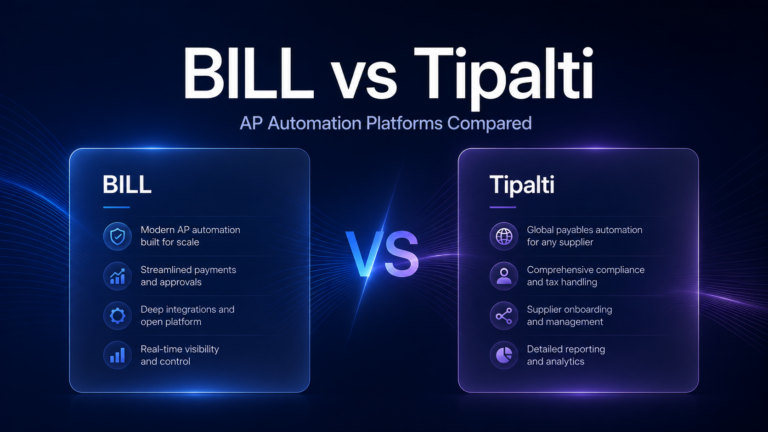
Tipalti provides strong PO matching as part of its end-to-end AP-to-payment platform, with real-time ERP sync and multi-entity matching capabilities that extend across complex organizational structures. Detailed in our AP Automation Buyer Guide.
Limitation for this use case: Tipalti’s exception resolution interface is functional but less intuitive than Stampli’s for AP staff working high exception volumes daily, which can slow resolution throughput in exception-heavy environments.
Vic.ai applies machine learning to the matching process, using historical patterns to improve tolerance calibration over time and surface exceptions that are most likely genuine discrepancies rather than format mismatches. Best for high-volume environments where false-positive exception rates are a persistent problem.
Limitation for this use case: Vic.ai functions best as an intelligence layer on top of matching logic rather than a comprehensive procure-to-pay workflow. Organizations needing PO management, receipt tracking, and supplier collaboration in the same platform will need to integrate Vic.ai with their ERP or a procurement system.
Yooz handles PO matching with strong document intelligence across 250+ ERP connectors, making it particularly valuable for organizations with legacy or non-standard ERP environments where other platforms’ native integrations are unavailable.
Limitation for this use case: Yooz’s ERP sync mode varies by connector — not all 250+ connectors provide real-time sync. For environments where PO amendments are frequent, verify real-time sync availability for your specific ERP before relying on Yooz for time-sensitive PO matching.
BILL provides basic two-way PO matching for small businesses, adequate for organizations with stable vendor relationships and straightforward PO structures. See the BILL Review 2026 for details.
Limitation for this use case: BILL does not support full three-way matching with goods receipt confirmation. For organizations where receipt validation is a controls requirement — particularly those under SOX or formal audit — BILL’s matching depth is insufficient.
Comparison Table
| Platform | Match Depth | Real-Time ERP Sync | Tolerance Rule Flexibility | Multi-PO / Partial Receipt | Exception UX |
|---|---|---|---|---|---|
| Stampli | 2-way + 3-way | Yes (70+ ERPs) | Strong | Strong | Best-in-class |
| Tipalti | 2-way + 3-way | Yes (native ERPs) | Strong | Strong | Strong |
| Vic.ai | 2-way + 3-way | Yes (major ERPs) | ML-assisted | Strong | Strong |
| Yooz | 2-way + 3-way | Varies by connector | Moderate | Moderate | Moderate |
| BILL | 2-way only | Batch | Limited | Basic | Basic |
Implementation Considerations
The most critical prerequisite for PO matching automation is procurement process discipline — specifically, POs must be created and approved before goods are received, and goods receipts must be entered in the ERP at the time of delivery. Matching automation cannot compensate for a procurement culture where these steps are routinely skipped or backdated. Conducting a procurement process audit before implementation, and closing any gaps, will substantially reduce false exception rates post-go-live.
Tolerance rule design should involve procurement, AP, and finance leadership jointly — not be delegated to the AP team alone. The tolerance framework determines what the system treats as an acceptable variance versus a genuine exception, and getting it wrong in either direction creates problems: too tight generates AP bottlenecks from false positives; too loose passes genuine discrepancies through to payment unchallenged. Calibrate against 90 days of historical PO invoice data before going live.
Exception ownership must be defined before go-live. Determine which exception types are owned by AP, which require procurement department involvement, and which escalate to the Controller or CFO. Build these routing rules into the system configuration. Teams that go live without defined exception ownership find that exceptions age unresolved, creating payment backlogs worse than the pre-automation state.
Which Companies Need This?
PO matching automation is essential for any organization with a formal procurement process issuing 100 or more purchase orders per month. Below that threshold, manual matching is manageable with disciplined process. Above it, the time cost of manual PO-to-invoice comparison grows faster than AP headcount can absorb.
Manufacturing, distribution, construction, and retail organizations — where goods-based procurement with formal PO issuance is the norm — benefit most directly. Professional services and SaaS companies with predominantly service-based and subscription spend will find that non-PO invoice processing workflows are more relevant to their AP volume.
Organizations under SOX compliance have a specific requirement: matching controls must be documented, consistently applied, and demonstrably operating. Automated PO matching with documented tolerance rules and exception audit trails satisfies this requirement in ways that manual matching documentation cannot.
Frequently Asked Questions
What is the difference between two-way and three-way PO matching?
Two-way matching compares the invoice against the PO only — validating vendor, quantities, and price. Three-way matching adds the goods receipt confirmation, verifying that what was ordered was actually delivered. Three-way matching is the standard for goods-based procurement; two-way matching is used where goods receipt tracking is not practical, such as for recurring service purchases.
What happens to invoices that fail the PO match?
Failed matches create structured exceptions that are routed to designated reviewers based on exception type and severity. The reviewer investigates the variance, contacts the vendor or procurement team as needed, and either approves the exception (creating an audit record of the override) or rejects the invoice. The best platforms present all relevant documents alongside the exception to minimize investigation time.
Can PO matching work when a vendor invoices against multiple POs?
Yes, if the matching system supports multi-PO invoice handling. This requires the system to identify all relevant POs, aggregate the expected values, and compare the invoice total against the combined PO value. Not all platforms handle this equally — validate multi-PO capability specifically if consolidated vendor billing is common in your procurement environment.
How do tolerance rules affect straight-through processing rates?
Tolerance rules directly determine which invoices clear automatically versus generate exceptions. Tighter tolerances produce more exceptions and lower straight-through rates; looser tolerances produce fewer exceptions but may pass genuine discrepancies through. The optimal calibration depends on your vendor base’s invoicing accuracy and your organization’s risk appetite for unreviewed variances — and should be tested against historical data before go-live.
Final Recommendation
Stampli and Tipalti are the strongest complete platforms for PO matching automation in the mid-market. Vic.ai is the best choice for high-volume environments where AI-assisted tolerance calibration and exception prioritization are needed. Yooz is the right fit for organizations with legacy ERP environments. In all cases, procurement process discipline is the prerequisite — matching automation delivers its ROI only when the PO and receipt data it depends on is accurate and timely. See our Best AP Automation Software guide for complete platform evaluations.
Related Guides
- Best AP Automation Software in 2026
- Three-Way Matching Automation for Finance Teams
- Non-PO Invoice Processing for Finance Teams
- Invoice Exception Handling for Finance Teams
- BILL vs Tipalti (2026): AP Platform Comparison
- AI for Accounts Payable Automation: Best Tools Compared
- AP Automation Software: Category Guide
- Finance Software Categories