Payment Automation for Finance Teams | FinanceCopilotHQ
Payment automation is the final step in the accounts payable cycle and the one with the most direct financial exposure. Manual payment processes — printing and signing checks, manually initiating wire transfers, or managing ACH batches through spreadsheets — are slow, error-prone, and create fraud vulnerabilities that automated payment systems are specifically designed to close. For finance teams that have already automated invoice capture and approval, extending automation to the payment step completes the straight-through processing model and maximizes the ROI of the broader AP automation investment. For a full platform comparison, see our Best AP Automation Software guide.
What it is: Software that automates the execution of vendor payments — ACH, wire, check, virtual card, and international payment rails — with approval controls, payment scheduling, fraud prevention, and reconciliation built into the workflow.
Top tool for this use case: Tipalti for global payment complexity and compliance; Ramp for fast-growth domestic companies consolidating AP and card spend; BILL for small businesses needing accessible ACH and check payment automation.
Ideal company profile: Any organization processing more than 50 vendor payments per month manually, or any team where payment execution is a bottleneck in the AP close cycle.
What Is Payment Automation?
Payment automation is the use of software to execute vendor payments automatically — or with minimal manual intervention — after invoices have been approved through the AP workflow. Rather than AP staff manually initiating each payment through a bank portal, printing check batches, or managing wire transfer instructions by spreadsheet, an automated payment system batches approved invoices into payment runs based on due date, payment method preference, and payment terms, and executes them through the appropriate payment rails with configured approval controls.
Modern payment automation platforms support multiple payment methods — ACH, wire transfer, virtual card, check, and international payment networks — and allow vendors to specify their preferred payment method through the supplier portal. The platform then routes each payment through the appropriate rail automatically, handling currency conversion for international payments, applying the correct payment terms, and generating remittance advice that is sent to the vendor and recorded in the AP system and ERP.
Payment automation is the downstream endpoint of the full AP automation chain: invoice capture feeds into approval workflows, which feed into payment approval workflows, which feed into payment execution. Each upstream automation step increases the proportion of payments that can be executed with minimal manual touch.
The Business Case
The cost of manual payment processing is material and often underestimated. APQC’s benchmarking data shows that check payments cost organizations between $4 and $20 per transaction to process — inclusive of printing, postage, bank handling fees, and AP staff time. ACH and virtual card payments cost a fraction of that at scale. Organizations still running significant check volumes have a direct cost reduction opportunity that payment method automation captures systematically.
Payment timing optimization provides a separate ROI stream. IOFM research shows that top-performing AP organizations capture early payment discounts on 15–25% of eligible invoices, while median performers capture fewer than 5%. The difference is almost entirely attributable to payment cycle time — organizations with automated payment workflows can execute within early discount windows; those with manual approval and payment execution cannot. A 2/10 net 30 discount on $100,000 of monthly payables represents $24,000 in annual savings that manual processes systematically miss.
Payment fraud prevention is the third dimension. Deloitte’s financial crime research identifies AP payment fraud — particularly business email compromise targeting wire transfer and ACH payment instructions — as one of the highest-dollar fraud categories affecting mid-market organizations. Automated payment systems with dual-approval controls, OFAC screening on payment execution, and anomaly detection on payment instruction changes provide systematic fraud defenses that manual payment processes cannot match. Our AP Fraud Detection guide covers the full fraud control landscape.
Common Challenges
Payment method fragmentation. Organizations that pay some vendors by check, others by ACH, and others by wire — managed in separate systems or bank portals — have no unified visibility into payment status, no consistent approval workflow across payment types, and no aggregated payment analytics.
Approval bottlenecks at payment execution. Even organizations with good invoice approval workflows often have manual, informal approval steps at the payment execution stage — a separate bank portal login, a phone-based authorization, or a physical signature on a payment batch. These manual steps add cycle time and create approval gaps that automated payment approval workflows eliminate.
International payment complexity. Cross-border payments require currency conversion, local payment network routing, compliance screening, and tax withholding handling that most mid-market payment systems are not equipped to manage at scale without significant manual overhead.
Reconciliation between payment system and ERP. When payments are executed through a bank portal and then manually recorded in the ERP, reconciliation errors accumulate. Automated payment systems with real-time ERP sync eliminate this reconciliation step.
How Software Solves It
Best-in-class payment automation platforms consolidate all payment methods — ACH, wire, check, virtual card, and international rails — into a single workflow with unified approval controls, payment scheduling, and reporting. This consolidation eliminates the fragmentation problem and provides the AP team with a single view of all outstanding payment obligations and their status.
Payment approval workflows enforce dual-approval controls, dollar-threshold escalation, and real-time OFAC screening at the payment execution stage — providing a final fraud control layer that operates independently of the invoice approval workflow. For organizations using Tipalti or Ramp, these controls are configured directly in the payment platform and do not require AP staff to manage separate bank portal approvals.
Best Tools For Payment Automation
Tipalti is the strongest payment automation platform for mid-market and enterprise companies with global payment complexity. Its 196-country payment coverage, multi-currency support, OFAC screening, and tax withholding automation make it the complete solution for organizations with international supplier bases. Read our AP Automation Buyer Guide.
Limitation for this use case: Tipalti’s pricing scales with payment volume, and FX conversion margins add to effective cost for high international payment volumes. Organizations should model their total payment cost — including volume tiers and FX margins — carefully before committing to Tipalti at scale.
Ramp provides strong payment automation for domestic fast-growth companies, with bill pay, ACH, and virtual card payment in a single platform alongside card spend management. Its modern UX and competitive pricing make it compelling for Series A–C companies. See the Ramp Review 2026.
Limitation for this use case: Ramp’s international payment capabilities are more limited than Tipalti’s. For organizations with significant cross-border payment volume, Ramp’s payment rails and currency coverage are insufficient for the global payment automation use case.
BILL is the most accessible payment automation platform for small businesses, with ACH, check, and international payment capabilities alongside its AP workflow. Its vendor network reach means many suppliers can receive same-day ACH. See the BILL Review 2026.
Limitation for this use case: BILL’s per-transaction payment fees can accumulate at higher volumes, making its total cost of payment execution less competitive than Tipalti at mid-market scale. Model per-transaction fees explicitly at your expected monthly payment volume before selecting BILL for payment automation.
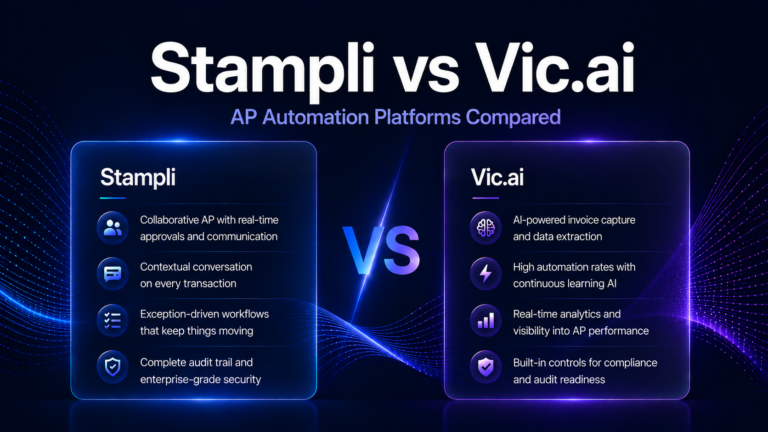
Stampli provides payment execution capabilities through its Billy the Bot payment module, with integration to ACH and check payment rails. Best for organizations that want payment automation tightly integrated with Stampli’s AP workflow and ERP sync.
Limitation for this use case: Stampli’s payment capabilities are less comprehensive than Tipalti’s, particularly for international payments. Organizations with global supplier bases will need to supplement Stampli’s payment functionality for non-domestic payment requirements.
Comparison Table
| Platform | Domestic ACH/Check | International Payments | Payment Approval Controls | OFAC Screening | ERP Reconciliation |
|---|---|---|---|---|---|
| Tipalti | Strong | Best-in-class (196 countries) | Best-in-class | Automatic | Real-time |
| Ramp | Strong | Moderate (US primary) | Strong | Moderate | Real-time |
| BILL | Strong (network) | Moderate | Strong | Basic | Real-time |
| Stampli | Strong | Limited | Strong | Via partners | Real-time |
Implementation Considerations
Payment automation implementation has a higher security stakes than invoice processing automation — a misconfigured payment control can result in unauthorized payments, not just processing errors. Before go-live, have your Controller or CFO review and formally approve all payment approval threshold rules, dual-control requirements, and OFAC screening configurations. Document this review in writing as part of your control environment documentation.
Run parallel payment processing — the old manual process alongside the new automated system — for at least two payment cycles before full cutover. This allows you to identify any discrepancies between what the automated system is executing and what the manual process would have executed, catching configuration errors before they result in incorrect payments.
Establish a payment anomaly review process from day one. Define the criteria that should trigger a manual review of a payment before execution — unusually large amounts, new banking details not yet 72 hours old, vendors added within the last 30 days — and configure the system to flag these payments for pre-execution review rather than processing them automatically.
Which Companies Need This?
Any organization processing more than 50 vendor payments per month manually has sufficient volume to justify payment automation. The ROI case is clearest for organizations with significant check payment volumes (where per-payment cost is highest), organizations missing early payment discounts due to slow payment cycles, and organizations that have experienced payment fraud or near-misses due to manual approval gaps.
Frequently Asked Questions
What payment methods should AP automation support?
At minimum: ACH (domestic), wire transfer, and virtual card. Check printing capability is still necessary for vendors who cannot receive electronic payments. For global operations, the platform should support local payment network rails in major geographies (SEPA in Europe, BACS in the UK, etc.) and multi-currency wire capability. The right payment method mix depends on your vendor base’s preferences and geographic distribution.
How does payment automation reduce fraud risk?
Automated payment platforms reduce fraud risk through dual-approval controls (requiring two authorized individuals to approve payments above defined thresholds), OFAC screening at payment execution, anomaly detection on new banking details and unusual payment patterns, and complete audit trails for every payment authorization. These controls operate systematically on every payment rather than depending on individual vigilance.
Final Recommendation
Tipalti is the most complete payment automation platform for organizations with global payment complexity. Ramp is the best choice for fast-growth domestic companies consolidating AP and card spend. BILL serves small businesses with accessible, network-enabled payment automation. Whatever platform you choose, treat payment control configuration as a security design exercise — the controls you build in at implementation are your primary defense against payment fraud. See our Best AP Automation Software guide for complete platform evaluations.