Vendor Master Data Management for Finance Teams | FinanceCopilotHQ
Vendor master data management is the foundation on which every other AP automation investment depends. Without accurate, complete, and deduplicated vendor master records — correct legal names, verified banking details, current tax identification numbers, appropriate payment terms, and correct entity assignments — AP automation systems generate exceptions, misdirect payments, produce unreliable spend analytics, and fail compliance controls. Finance teams that invest in capture, matching, and payment automation without first establishing vendor master data quality are building on an unreliable foundation. For a full platform comparison, see our Best AP Automation Software guide.
What it is: The systematic processes and tools for ensuring that vendor records in the AP system are accurate, complete, deduplicated, and compliant — covering legal entity data, banking details, tax identification, payment terms, and ongoing change management.
Top tool for this use case: Tipalti for organizations with global, compliance-sensitive vendor bases needing systematic data quality controls; Stampli for domestic mid-market companies prioritizing ERP vendor master accuracy and sync reliability.
Ideal company profile: Any organization with 100+ active vendors, multi-entity structures, international supplier relationships, or a history of duplicate payments or audit findings related to vendor master data quality.
What Is Vendor Master Data Management?
Vendor master data management (VMDM) is the discipline of maintaining accurate, complete, and consistent vendor records across all systems that reference them — including the ERP, the AP automation platform, the procurement system, and any analytics or reporting tools that draw on vendor data. A vendor master record typically contains the vendor’s legal name and entity type, registered address, tax identification number, banking details for payment, payment terms, currency, contact information, and GL and cost center assignments for default coding.
In most organizations, vendor master data degrades over time without active management. Vendors change their banking details and do not notify AP. Legal entity names change through mergers and acquisitions. Tax documentation expires or becomes incorrect. Duplicate vendor records accumulate when new vendors are set up without checking for existing records. Contact information becomes stale as vendor staff turn over. Each of these data quality issues creates downstream problems — payment exceptions, 1099 errors, duplicate payments, incorrect spend reporting — that cost more to resolve than they would have cost to prevent.
VMDM is closely related to vendor onboarding automation (which establishes initial data quality) and supplier portal software (which gives vendors a self-service channel to maintain their own records). Together, these three use cases form the complete vendor data lifecycle.
The Business Case
Ardent Partners’ AP research identifies vendor master data quality as a top-five root cause of AP exceptions. Every exception triggered by a vendor master data issue — a name mismatch, an expired tax form, a stale banking detail — costs between three and five times more to resolve than a straight-through invoice, per IOFM benchmarking. Across a vendor base of 500+ records, the cumulative exception cost attributable to vendor master data quality can represent a material and avoidable AP operating cost.
The fraud risk dimension is significant. Gartner’s AP fraud control research consistently identifies the vendor master as the highest-risk data set in the AP environment — because unauthorized changes to vendor banking details are the mechanism through which payment diversion fraud occurs. Organizations without systematic controls around vendor master changes (approval workflows, audit trails, change notifications) are structurally vulnerable to both external fraud and internal control failures.
1099 compliance is the third dimension. Incorrect or missing tax identification numbers in the vendor master create IRS filing problems that can result in penalties and back-up withholding requirements. APQC benchmarking shows that organizations with systematic tax form collection and renewal processes in their vendor master management programs have significantly lower 1099 correction rates at year-end than those managing tax documentation informally.
Common Challenges
Duplicate vendor records. The same supplier added under multiple names, addresses, or entity variants creates fragmented payment history, makes spend analysis unreliable, and creates conditions for duplicate payments.
Uncontrolled vendor master changes. When any AP staff member can modify vendor records without an approval workflow or audit trail, the vendor master becomes a fraud vulnerability and an audit finding waiting to happen.
Stale banking details. Vendors change their banking information more frequently than most AP teams realize. Without a proactive renewal process, stale banking records create payment failures and necessitate manual recovery processes.
Tax documentation expiration. W-8 forms, in particular, expire every three years and must be renewed. Without systematic expiration tracking, AP teams discover expired tax forms during 1099 season — creating urgent, disruptive renewal campaigns under time pressure.
Multi-system consistency. Organizations where vendor data lives in both an ERP and an AP automation platform need bi-directional sync to maintain consistency. When the two systems diverge — a vendor updated in the ERP but not in the AP platform, or vice versa — matching and payment exceptions multiply.
How Software Solves It
Best-in-class VMDM capabilities combine three layers of control: systematic data collection (structured onboarding forms that enforce completeness at entry), ongoing data maintenance (supplier self-service portals that give vendors a channel to update their own records), and data governance (approval workflows and audit trails for all vendor master changes). Together, these layers address both the initial data quality problem and the ongoing degradation problem.
Automated deduplication logic compares new vendor submissions against existing records using fuzzy matching on legal name, address, tax ID, and banking details — flagging potential duplicates for human review before a new record is created. Tipalti’s deduplication capability is particularly strong for multi-entity environments where the same vendor may legitimately need separate records for different legal entities.
Tax documentation expiration tracking alerts AP teams when W-9 or W-8 forms approach their expiration dates — typically 60–90 days in advance — and triggers a renewal workflow through the supplier portal. This proactive approach eliminates the year-end compliance scramble that characterizes informal tax documentation management.
Best Tools For Vendor Master Data Management
Tipalti provides the most comprehensive VMDM capabilities in this comparison, with structured onboarding, OFAC screening, W-9/W-8 collection and renewal tracking, banking detail verification, deduplication logic, and multi-entity provisioning. For global, compliance-intensive vendor bases, Tipalti is the clear leader. See our AP Automation Buyer Guide.
Limitation for this use case: Tipalti’s vendor master capabilities are most fully realized for organizations using Tipalti for end-to-end AP. Organizations using Tipalti only as a vendor data management layer — feeding records back to a separate ERP — will need to validate integration depth for their specific ERP to ensure bi-directional sync reliability.
Stampli maintains vendor master data in tight sync with the source ERP — its ERP-native architecture means that vendor record changes in the ERP propagate to Stampli automatically, and the reverse. This sync reliability makes it the right choice for organizations where ERP vendor master accuracy is the primary concern.
Limitation for this use case: Stampli’s VMDM capabilities are ERP-sync focused rather than independently comprehensive. Tax form collection, OFAC screening, and banking detail verification are more limited than Tipalti’s — meaning organizations with compliance-driven VMDM requirements will need supplemental capabilities.
Airbase manages vendor data within its unified spend platform, with approval workflows for vendor record changes and self-service update capabilities for vendors. Good for organizations using Airbase as their primary spend management platform.
Limitation for this use case: Airbase’s VMDM is designed around its domestic, technology-company customer base. International tax form management and multi-currency payment configuration are less developed than Tipalti’s, limiting its applicability for globally diverse vendor bases.
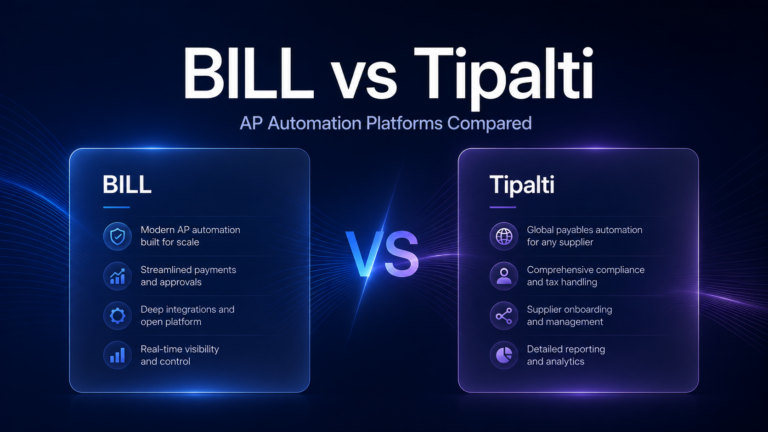
BILL maintains basic vendor records within its AP platform. See the BILL Review 2026.
Limitation for this use case: BILL does not provide the governance controls — approval workflows for vendor changes, audit trails, OFAC screening, or systematic tax documentation renewal tracking — needed for VMDM at mid-market compliance standards. It is adequate for small business vendor data maintenance but insufficient as a VMDM system for organizations with audit exposure.
Comparison Table
| Platform | Deduplication Logic | Change Approval Workflow | Tax Doc Renewal Tracking | OFAC Screening | Multi-Entity Support |
|---|---|---|---|---|---|
| Tipalti | Strong | Strong | Best-in-class | Automatic | Best-in-class |
| Stampli | Moderate (via ERP) | Strong | Basic | Via partners | Moderate |
| Airbase | Moderate | Strong | Moderate | Moderate | Moderate |
| BILL | Basic | Basic | None | Basic | Limited |
Implementation Considerations
Before deploying any VMDM platform, conduct a vendor master audit of your existing records. The audit should identify duplicate records, stale banking details, missing tax documentation, and contacts with outdated information. This audit both defines the scope of the data remediation project that must precede platform deployment and provides a baseline for measuring data quality improvement after the platform goes live.
Establish a vendor master governance policy — a documented set of rules defining who can create or modify vendor records, what approval steps are required, and what audit trail must be maintained — before go-live. The platform enforces the policy; the policy must exist first. Without a governance policy, platform controls will be inconsistently applied and may be worked around when they create friction.
Which Companies Need This?
Any organization with 100+ active vendors, multi-entity structures, international supplier relationships, or a history of duplicate payments, 1099 corrections, or audit findings related to vendor data should treat VMDM as a foundational priority rather than an optional AP process improvement. The data quality investment enables every other AP automation initiative to perform at its potential.
Frequently Asked Questions
How often should vendor master data be reviewed and refreshed?
Banking details should be verified annually at minimum for all active vendors, and immediately upon any vendor-initiated change request. Tax documentation should be tracked against expiration dates with automated renewal alerts at 90 and 30 days before expiration. Contact information should be reviewed as part of each onboarding anniversary cycle. W-8 forms expire every three years and require systematic renewal tracking that manual processes rarely maintain reliably.
What is the risk of not managing vendor master data systematically?
The three primary risks are payment fraud (misdirected payments resulting from unverified banking detail changes), 1099 compliance failures (penalties resulting from incorrect or missing tax identification), and duplicate payments (resulting from duplicate vendor records or undetected invoice resubmissions across duplicate vendor IDs). Each risk has a direct financial consequence that typically exceeds the cost of the VMDM system that prevents it.
Final Recommendation
Tipalti is the most complete VMDM platform for organizations with compliance-sensitive vendor bases. Stampli is the right choice for organizations where ERP vendor master sync reliability is the primary concern. In all cases, invest in a vendor master audit before deployment — the platform can maintain data quality going forward, but cannot automatically remediate the data quality problems that predate its implementation. See our Best AP Automation Software guide for complete platform evaluations.