Vendor Onboarding Automation for Finance Teams | FinanceCopilotHQ
Vendor onboarding automation is one of the most overlooked efficiency opportunities in accounts payable. Most organizations spend significant AP and procurement staff time collecting vendor documentation, verifying banking details, gathering tax forms, and setting up suppliers in their ERP — a process that is almost entirely manual, highly error-prone, and rarely tracked with any rigor. This guide covers what vendor onboarding automation involves, where manual processes break down, and which tools finance teams should evaluate. For a full AP platform comparison, see our Best AP Automation Software guide.
What it is: Software that replaces manual vendor setup processes with a self-service supplier portal — collecting banking details, tax forms, and compliance documentation automatically, with built-in fraud screening and ERP provisioning.
Top tool for this use case: Tipalti for organizations with global supplier bases, multi-entity structures, or compliance requirements; Stampli or Airbase for domestic mid-market companies prioritizing AP workflow integration.
Ideal company profile: Any organization adding more than 10 new vendors per month, companies with international suppliers, and organizations under SOX compliance or preparing for an audit.
What Is Vendor Onboarding Automation?
Vendor onboarding automation is the use of software to digitize and streamline the process of adding a new supplier to your accounts payable system. In a manual environment, this typically involves emailing vendors a PDF form to collect banking details and tax information, waiting for them to return it, manually entering the data into the ERP, and then tracking down missing fields or incorrect information in a follow-up cycle that can stretch over weeks. Automation replaces this with a self-service supplier portal where vendors enter their own information — payment preferences, banking details, W-9 or W-8 tax documentation, contact information — directly into a structured system that validates the data in real time and routes it for internal review and ERP loading.
Beyond data collection, vendor onboarding automation typically includes sanctions and fraud screening (checking new vendors against OFAC lists and debarment databases before they are activated in the payment system), tax form collection and validation, duplicate vendor detection to prevent the same supplier from being added under multiple vendor IDs, and automated ERP provisioning that creates the vendor record in the correct entity, currency, and payment terms configuration without manual AP data entry.
The process sits at the intersection of AP operations, procurement, compliance, and IT. Getting it right establishes the data foundation on which every subsequent AP workflow depends — because every invoice, matching event, approval, and payment traces back to the vendor master record created during onboarding.
The Business Case
Vendor onboarding errors are disproportionately expensive relative to their frequency. An incorrect bank account on a vendor record can result in a misdirected payment that takes weeks to recover, potential fraud liability, and significant vendor relationship damage. A duplicate vendor record creates the conditions for duplicate payments and makes spend analysis unreliable. Missing or incorrectly classified tax documentation creates 1099 filing errors that can trigger IRS penalties. Ardent Partners’ AP research identifies vendor master data quality as one of the top five root causes of AP exceptions — meaning that errors introduced at the onboarding stage create ripple effects throughout the entire AP workflow that far exceed the cost of the original data entry mistake.
The time cost of manual onboarding compounds with growth. APQC benchmarking data shows that AP teams at high-performing organizations spend significantly less time per vendor setup than their lower-performing counterparts — largely because they have systematized the data collection and validation steps. Finance and procurement teams at organizations without automation report spending between 30 minutes and several hours per new vendor on data collection, verification, and ERP entry. At 20 new vendors per month, that is a meaningful share of AP staff capacity consumed by a process that software can largely automate.
The fraud risk dimension has a distinct financial exposure profile. The FBI’s Internet Crime Complaint Center has consistently identified business email compromise targeting vendor payment details as one of the highest-dollar categories of financial cybercrime. Automated onboarding with banking detail verification, OFAC screening, and bank account change workflows provides a systematic defense against these attacks that manual email-based onboarding processes structurally cannot match. For companies building toward an audit or evaluating their AP maturity more broadly, our AI for AP Automation guide covers how AI is being applied across the full vendor-to-payment lifecycle.
Common Challenges
Vendor unresponsiveness and incomplete submissions. Vendors frequently return onboarding forms with missing fields, incorrect information, or outdated documentation. Each back-and-forth exchange to collect a corrected W-9 or accurate ACH routing number adds days to the onboarding timeline and requires AP staff follow-up.
Banking detail fraud and payment diversion risk. Fraudsters sometimes impersonate new vendors or submit fake bank account changes during the onboarding process. Without automated validation and verification steps, these attacks are difficult to catch before a misdirected payment occurs.
Duplicate vendor records. Without automated deduplication logic, the same vendor frequently gets added to the ERP under multiple names, addresses, or entity variants — creating fragmented payment history, inaccurate spend data, and duplicate payment risk.
Sanctions and compliance screening gaps. Manual onboarding processes rarely include systematic OFAC or debarment screening for every new vendor. A missed sanctions hit can create serious compliance and reputational liability.
Multi-entity and multi-currency complexity. Organizations with multiple legal entities need vendors configured correctly across each entity — with the right currency, payment terms, tax classification, and GL mapping for each entity relationship. Manual configuration across entities is time-consuming and error-prone.
No visibility into onboarding status. Without a workflow system, AP teams have no reliable way to know which new vendors are in progress, which are waiting on vendor action, and which have been blocked by a compliance hold — leading to reactive follow-up and missed payment readiness windows.
How Software Solves It
Automated vendor onboarding platforms solve the data collection problem through self-service portals that guide vendors through a structured, validated intake form. Required fields are enforced at submission, tax form requirements are determined dynamically based on vendor type and tax residency, and banking detail validation checks account and routing number formats before the record is submitted for review. This eliminates the most common causes of incomplete or incorrect onboarding submissions.
Fraud and compliance risk is addressed through automated sanctions screening — new vendors are checked against OFAC SDN lists, debarment databases, and other watchlists as part of the onboarding workflow, with holds triggered automatically for any potential match pending human review. Duplicate detection algorithms compare new vendor submissions against existing vendor master records using fuzzy matching on company name, address, banking details, and tax ID — catching duplicates that exact-match searches miss.
For multi-entity organizations, automated onboarding platforms with ERP integration provision vendor records across the correct entities based on the procurement relationship context, applying entity-specific payment terms, currency, and tax classification rules without manual configuration per entity. Tipalti has particularly strong capabilities in this area for mid-market and enterprise multi-entity environments — detailed in our AP Automation Buyer Guide.
Best Tools For Vendor Onboarding Automation
Tipalti has the most comprehensive vendor onboarding capability in this comparison, combining a self-service supplier portal, W-9/W-8 collection and validation, OFAC screening, banking detail verification, and multi-entity ERP provisioning in a single integrated workflow. Its supplier self-service model is specifically designed to scale — vendors manage their own banking updates and tax re-certifications without requiring AP staff involvement. See the full evaluation in our AP Automation Buyer Guide.
Limitation for this use case: Tipalti’s implementation timeline for the vendor onboarding module is longer than most vendors advertise. Getting an existing supplier base fully migrated into the portal typically takes 60–90 days of active communication and follow-up — which is often underestimated in project planning and can delay the full compliance and efficiency benefits.
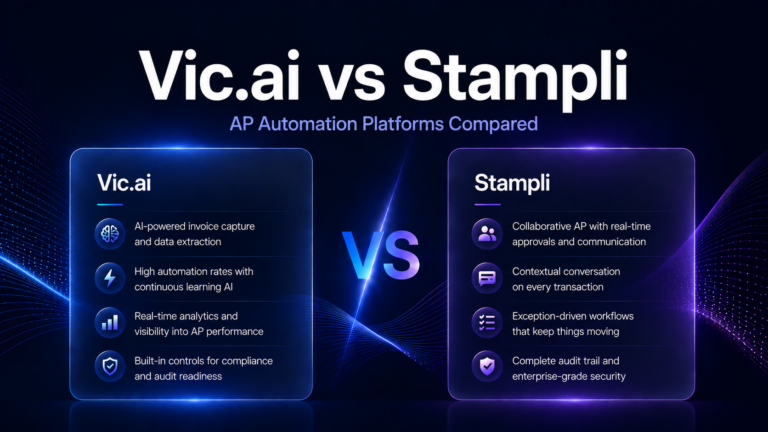
Stampli offers vendor onboarding capabilities integrated with its AP workflow platform, with solid ERP-sync that ensures vendor records created through onboarding are immediately available for invoice matching and coding.
Limitation for this use case: Stampli’s onboarding compliance features are more limited than Tipalti’s — particularly for W-8 international tax form collection and cross-border OFAC screening. For organizations with significant international supplier exposure, Stampli’s onboarding module may require supplemental compliance tooling.
Airbase includes vendor management and onboarding as part of its unified spend platform, keeping vendor setup within the same system used for procurement approvals and AP processing — which provides data consistency across the procurement-to-payment workflow.
Limitation for this use case: Airbase’s vendor onboarding capabilities are designed primarily for the domestic, SaaS-company context in which it has its strongest customer base. Multi-entity support and international tax form handling are less developed than Tipalti, making it a less suitable choice for organizations with complex global supplier relationships.
BILL provides basic vendor onboarding functionality appropriate for small businesses, including a vendor portal for banking information collection and W-9 tax form requests. See the BILL Review 2026 for details.
Limitation for this use case: BILL’s onboarding capabilities are limited to W-9 collection and basic banking detail entry — there is no OFAC screening, no W-8 international tax form support, and no multi-entity provisioning. For organizations where compliance screening and international vendor coverage are requirements, BILL’s onboarding module is insufficient.
Ramp includes vendor onboarding as part of its broader AP and spend platform, with a focus on speed and simplicity for domestic vendor setup. See the Ramp Review 2026 for the full picture.
Limitation for this use case: Ramp’s vendor onboarding is designed for simplicity over compliance depth. It lacks the sanctions screening, multi-entity support, and international tax form capabilities that mid-market and enterprise organizations require — making it appropriate for early-stage companies with straightforward domestic vendor bases, but not for organizations where compliance is a primary driver.
Comparison Table
The table below evaluates leading platforms across the criteria most important for vendor onboarding automation decisions.
| Platform | Self-Service Vendor Portal | Tax Form Collection | OFAC / Sanctions Screening | Duplicate Detection | Multi-Entity Support |
|---|---|---|---|---|---|
| Tipalti | Best-in-class | W-9, W-8 (all types) | Automatic | Strong | Best-in-class |
| Stampli | Strong | Basic | Via partners | Moderate | Moderate |
| Airbase | Strong | Moderate | Moderate | Moderate | Moderate |
| BILL | Moderate | W-9 only | Basic | Basic | Limited |
| Ramp | Moderate | Basic | Basic | Basic | Limited |
Implementation Considerations
Vendor onboarding automation projects have two distinct phases that are often conflated: system configuration and vendor migration. System configuration — building the portal, defining the intake workflow, configuring compliance screening, and setting up ERP provisioning rules — is the technology project. Vendor migration — getting your existing supplier base to update their information in the new system — is the change management project, and it is almost always the longer and harder of the two.
Plan a proactive vendor communication campaign before go-live. This involves emailing your active vendor base with clear instructions on what they need to do, why it benefits them (faster payment processing, self-service for banking updates), and what the deadline is. Vendors who do not complete the migration by the deadline should be identified and followed up individually by AP staff. Without this campaign, vendor migration can drag on for months and leave a portion of your vendor master unvalidated in the new system.
Banking detail change requests deserve special attention in your implementation design. The highest-risk event in vendor master management is a fraudulent request to change a vendor’s bank account — a common social engineering attack. Your onboarding platform’s process for handling bank account changes (separate verification workflow, notification to original email on file, mandatory wait period before activation) should be reviewed and validated as part of your security posture before go-live.
Which Companies Need This?
Any organization adding more than 10 new vendors per month has sufficient volume to justify automated onboarding. Below that threshold, manual onboarding is manageable with disciplined process — though the compliance and fraud risk arguments for automation apply regardless of volume.
Companies with international supplier bases have a specific need for automated onboarding because of the additional complexity of international tax forms (W-8 series), multi-currency payment configurations, and cross-border sanctions screening requirements. Manual processes for international vendor onboarding are particularly slow and error-prone.
Organizations under SOX compliance or preparing for a financial audit need documented evidence that vendor master changes — including new vendor additions and banking detail updates — were properly authorized and validated. Automated onboarding with workflow-based approvals provides this documentation automatically.
Frequently Asked Questions
How long does vendor onboarding automation typically take to implement?
System configuration typically takes two to four weeks. The vendor migration phase — getting existing suppliers into the new portal — typically adds four to eight weeks of ongoing communication and follow-up. Organizations with large, diverse vendor bases should plan for a 90-day full completion timeline from go-live, with a defined cutover point after which invoices from non-migrated vendors are held until onboarding is complete.
What tax forms should a vendor onboarding platform collect?
For US-based vendors, W-9 forms are required for 1099 reporting. For foreign vendors, the appropriate W-8 form (W-8BEN, W-8BEN-E, W-8ECI, or others depending on entity type and treaty status) is required. The best onboarding platforms determine which form is required dynamically based on vendor-provided information and guide the vendor through the correct form completion — eliminating the need for AP staff to know which form to request.
How does automated vendor onboarding reduce fraud risk?
Automated platforms reduce fraud risk through multiple controls: banking detail validation at submission, OFAC and sanctions screening, duplicate detection that flags suspiciously similar new vendors, segregation of duties that prevents the same person from both creating a vendor and approving a payment, and notification workflows that alert the original contact when banking details are changed. No single control is foolproof, but layering these controls substantially raises the cost and difficulty of vendor payment fraud.
Can vendor onboarding automation integrate with existing ERP vendor masters?
Yes. The strongest platforms synchronize bi-directionally with the ERP vendor master — new vendors created through the onboarding portal are automatically provisioned in the ERP, and updates to vendor information in the portal sync back to the ERP record. The depth of this integration varies by platform and ERP; validate the specific integration behavior for your ERP during the evaluation process.
What happens when a vendor needs to update their banking details after initial onboarding?
Best-in-class platforms provide a secure self-service flow for banking detail changes that includes identity verification, a separate internal approval step, notification to the original contact email on file, and a mandatory hold period before the new banking details become active for payment. This workflow is specifically designed to prevent the social engineering attacks that target bank account change processes.
Final Recommendation
For organizations with global supplier bases, multi-entity structures, or serious compliance requirements, Tipalti is the clear leader for vendor onboarding automation. For domestic mid-market companies prioritizing AP workflow integration over onboarding depth, Stampli and Airbase are strong alternatives. BILL and Ramp are appropriate for smaller organizations with simpler vendor bases and lower compliance stakes. In all cases, treat the vendor migration phase as seriously as the technology implementation — it determines the actual completeness of your vendor master and the compliance coverage of your new onboarding system. See our Best AP Automation Software guide for complete platform evaluations.