Supplier Portal Software for Finance Teams | FinanceCopilotHQ
Supplier portal software transforms the relationship between AP teams and their vendor base by giving suppliers a self-service channel to submit invoices, check payment status, update their banking details, access remittance information, and manage their own account records — without requiring AP staff to handle each request manually. For organizations with large or geographically distributed vendor bases, a well-implemented supplier portal reduces inbound vendor inquiry volume, accelerates invoice submission accuracy, and improves data quality across the vendor master. For a full platform comparison, see our Best AP Automation Software guide.
What it is: A secure web interface that allows vendors to submit invoices, view payment status, update banking and tax information, and manage their supplier profile — reducing inbound vendor calls and emails while improving data quality in the AP system.
Top tool for this use case: Tipalti for organizations with global, compliance-sensitive vendor bases requiring full self-service capability; Stampli for mid-market companies prioritizing invoice submission and status visibility for domestic vendors.
Ideal company profile: Organizations with 50+ active vendors, high inbound vendor inquiry volumes, or compliance requirements that make systematic banking and tax data collection a priority.
What Is Supplier Portal Software?
Supplier portal software is a secure, web-accessible interface that allows vendors to interact with your AP system directly — submitting invoices, checking the status of submitted invoices and outstanding payments, viewing remittance advice, updating their banking and tax information, and accessing dispute resolution workflows. From the AP team’s perspective, the portal converts a high volume of inbound vendor communications — phone calls asking “when will invoice 1234 be paid?”, email requests to update a bank account, paper W-9 submissions — into self-service transactions that require no AP staff time to process.
A well-designed supplier portal also improves the quality of data that enters the AP system. When vendors enter their own banking details, tax identification numbers, and contact information directly into a validated intake form — rather than having AP staff transcribe from a PDF or email — the error rate drops significantly. For global supplier bases, portals that support multiple languages, currencies, and tax form types (W-9, W-8BEN, local VAT registration) provide compliance infrastructure that manual onboarding cannot deliver consistently.
Supplier portals are closely related to the vendor onboarding automation and supplier self-service portals use cases — onboarding is the first interaction vendors have with the portal, and self-service is the ongoing use model after initial setup.
The Business Case
The time cost of managing vendor inquiries manually is consistently underestimated in AP operations analysis. IOFM research shows that AP teams at organizations without supplier portals spend a meaningful portion of total AP staff hours on inbound vendor inquiry management — answering payment status questions, processing bank account change requests, chasing down tax documentation, and re-sending remittance advice. At 200+ active vendors, this inquiry volume becomes a significant operational burden that scales with vendor count rather than invoice volume.
Supplier portals also reduce invoice submission errors at their source. Ardent Partners’ supplier relationship research documents that invoices submitted through structured portal interfaces have materially lower exception rates than invoices submitted via email — because the portal validates required fields at submission, enforces format standards, and guides vendors through any information that is missing before the invoice enters the AP queue. This upstream quality improvement reduces exception handling work downstream, compounding the efficiency benefit of portal adoption.
Payment fraud prevention is the third dimension of the business case. Tipalti’s own customer data and broader industry research from Gartner on AP fraud controls both identify uncontrolled banking detail changes — where vendors can update their account information via unverified email requests — as one of the highest-risk points in the AP workflow. Supplier portals with secure banking update workflows, identity verification steps, and notification to the original contact email address on file provide systematic fraud controls that ad-hoc email-based processes cannot match.
Common Challenges
Vendor adoption friction. Suppliers — particularly small businesses and international vendors — may resist registering for and using a new portal, preferring to continue submitting invoices via email. Without a proactive adoption campaign and clear incentives (faster payment, self-service status visibility), portal adoption rates stagnate below the threshold needed to reduce inquiry volume materially.
Portal usability for non-technical vendors. Supplier portals that require technical setup, multi-step authentication, or complex navigation reduce adoption among less technically sophisticated vendors. Portal UX quality varies significantly across platforms and directly affects adoption rates.
Multi-language and multi-currency support gaps. Organizations with international vendor bases need portals that present in vendors’ preferred languages, support local tax form requirements, and handle multiple currencies in payment preference configuration. Portals designed primarily for domestic vendor bases often lack these capabilities.
Banking detail change security. The highest-risk portal transaction is a request to change a vendor’s banking details. Without additional verification steps — identity confirmation, notification to the original registered email, mandatory hold periods — fraudulent banking changes can result in misdirected payments.
How Software Solves It
The strongest supplier portals solve the adoption problem through simplicity — a guided, step-by-step registration flow that vendors can complete without AP team assistance, and an ongoing interface that presents only the information and actions relevant to each vendor’s relationship with the buyer. Tipalti’s portal, in particular, is designed with vendor usability as a primary consideration, offering a clean self-service experience across 26 languages.
Banking change security is addressed through layered controls: the portal requires identity verification at the time of the change request, sends notification to both the existing and new contact email addresses, and applies a hold period before the new banking details become active for payment. AP teams are notified of every banking change request and can review and approve or reject the change before it takes effect.
Best Tools For Supplier Portal Software
Tipalti offers the most comprehensive supplier portal in this comparison — 26-language support, W-9/W-8 collection, OFAC screening on registration, banking detail verification, and payment preference management across 196 countries. Its portal is specifically designed for global, compliance-sensitive supplier bases. See the full evaluation in our AP Automation Buyer Guide.
Limitation for this use case: Tipalti’s portal adoption requires a supplier migration campaign that typically takes 60–90 days to achieve meaningful coverage of the active vendor base. The portal’s capability is the strongest available, but its value is only realized after vendors have registered — which requires active follow-up and communication investment.
Stampli provides a supplier portal focused on invoice submission and status visibility, with a clean vendor-facing interface integrated with its ERP-native AP workflow. Best for mid-market companies prioritizing invoice submission quality and status inquiry reduction for domestic vendor bases.
Limitation for this use case: Stampli’s portal is less comprehensive than Tipalti’s on the compliance and global payment dimensions — W-8 international tax form support and multi-currency payment preference management are more limited. For organizations with significant international vendor exposure, Tipalti’s portal offers deeper capability.
Airbase includes vendor management portal features as part of its unified spend platform, allowing vendors to manage their profiles, submit invoices, and view payment status within the Airbase ecosystem. Best for companies already using Airbase for AP and spend management who want to keep vendor interactions in a single platform.
Limitation for this use case: Airbase’s vendor portal is designed for the domestic SaaS and technology company context that characterizes its core customer base. Multi-language support and international tax form collection are less developed than Tipalti’s, limiting its applicability for globally diverse vendor bases.
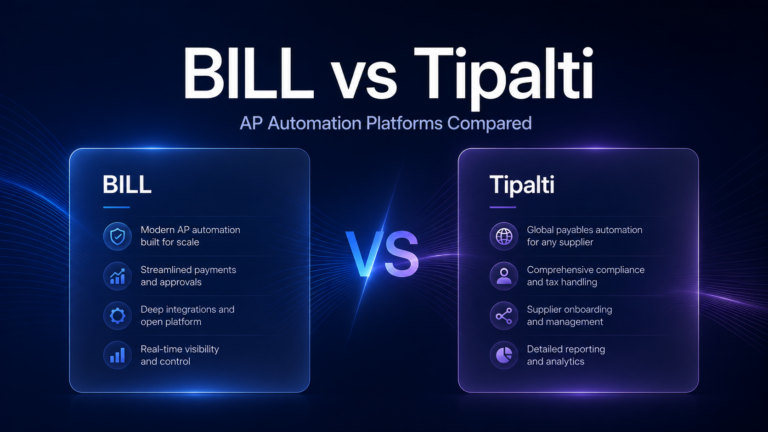
BILL provides a basic vendor network portal through which suppliers can receive payments and manage their BILL.com profile. Its network reach — over 6 million members — means many of your vendors may already be enrolled. See the BILL Review 2026.
Limitation for this use case: BILL’s portal capabilities are primarily payment-network focused rather than full supplier self-service. Invoice submission through the portal has limited format flexibility, compliance screening is basic, and the banking detail change workflow does not offer the layered security controls that mid-market and enterprise organizations require.
Ramp includes vendor portal features as part of its AP module, focusing on invoice submission and payment status. Best for fast-growth companies that want vendor self-service alongside Ramp’s card and spend management capabilities. See the Ramp Review 2026.
Limitation for this use case: Ramp’s vendor portal is less developed than its card and spend management capabilities. International tax form support and compliance screening are limited, making it appropriate for early-stage companies with straightforward domestic vendor bases but not for organizations where compliance depth is required.
Comparison Table
| Platform | Multi-Language Support | Tax Form Collection | Banking Change Security | Invoice Submission Quality | Payment Status Visibility |
|---|---|---|---|---|---|
| Tipalti | 26 languages | W-9, W-8 (all types) | Best-in-class | Strong | Best-in-class |
| Stampli | Limited | Basic | Strong | Best-in-class | Strong |
| Airbase | Limited | Moderate | Strong | Strong | Strong |
| BILL | English primary | W-9 only | Basic | Moderate | Moderate |
| Ramp | English primary | Basic | Basic | Moderate | Moderate |
Implementation Considerations
Plan a structured vendor adoption campaign before and after portal go-live. The campaign should communicate the portal’s benefits from the vendor’s perspective (faster payment processing, self-service status checks, secure banking update process), provide simple registration instructions, and include a deadline for registration with a follow-up sequence for non-registrants. Vendors who do not register during the initial campaign period should be segmented by spend volume — focus personal follow-up on high-spend vendors, as their registration delivers the most AP workflow benefit.
Banking detail change workflow design requires specific security review before go-live. Work with your information security team to validate that the portal’s banking change controls — verification steps, notification logic, hold period duration — meet your organization’s fraud risk standards. This is not a default configuration review; it is an active security design decision that should be documented and approved by your Controller or CFO before the portal goes live.
Which Companies Need This?
Organizations with 50 or more active vendors benefit from supplier portal software. Below that threshold, direct vendor communication is manageable without a self-service channel. Above it, the inquiry management burden grows with vendor count and is better addressed systemically than through additional AP staff time.
Companies with international supplier bases have a specific compliance driver — collecting the correct tax forms, supporting local payment preferences, and providing a compliant banking update workflow for non-US vendors — that makes portal quality a compliance requirement rather than purely an efficiency consideration.
Frequently Asked Questions
How do you get vendors to adopt a supplier portal?
The most effective adoption driver is connecting portal registration to faster payment processing — communicating clearly that invoices submitted through the portal are processed faster than those submitted by email. A structured communication campaign with a registration deadline, simple instructions, and personal follow-up for high-spend non-registrants typically achieves 70–80% adoption of active vendor spend within 90 days.
What security controls should a supplier portal have for banking detail changes?
At minimum: identity verification at the time of the change request (not just password authentication), email notification to both the existing and new contact addresses on file, a mandatory hold period before the new details become active for payment, and AP team approval of the change before activation. Organizations with higher fraud risk should add telephone verification for high-value vendor banking changes.
Can a supplier portal handle invoices from vendors who are not yet registered?
Yes. Most organizations run a hybrid model during and after portal rollout — portal-submitted invoices from registered vendors process through the portal workflow, while email-submitted invoices from non-registered vendors continue through the email capture workflow. This allows go-live without requiring 100% vendor registration upfront, while the adoption campaign drives portal registration over the following months.
Final Recommendation
For organizations with global supplier bases or compliance-sensitive vendor relationships, Tipalti’s supplier portal is the most complete solution available. For domestic mid-market companies prioritizing invoice submission quality and vendor inquiry reduction, Stampli provides strong portal capability with excellent AP workflow integration. In all cases, invest in the vendor adoption campaign as seriously as the technology implementation — portal coverage of your active vendor spend is what determines whether inquiry volume actually decreases. See our Best AP Automation Software guide for complete platform comparisons.