Invoice Coding Automation for Finance Teams | FinanceCopilotHQ
Invoice coding automation addresses one of the most time-consuming manual tasks in accounts payable: determining the correct general ledger account, cost center, project code, and department for each incoming invoice. Manual GL coding is not only slow — it is a primary source of accounting errors that require correction during close, create reconciliation variances, and generate audit findings when consistently misapplied. AI-powered coding automation eliminates the majority of this manual work for organizations with sufficient invoice history to train on. For a full platform comparison, see our Best AP Automation Software guide.
What it is: Software that uses machine learning to automatically suggest or apply GL account, cost center, and project code assignments to incoming invoices — based on vendor identity, line-item descriptions, and historical coding patterns — without manual AP staff input for routine invoices.
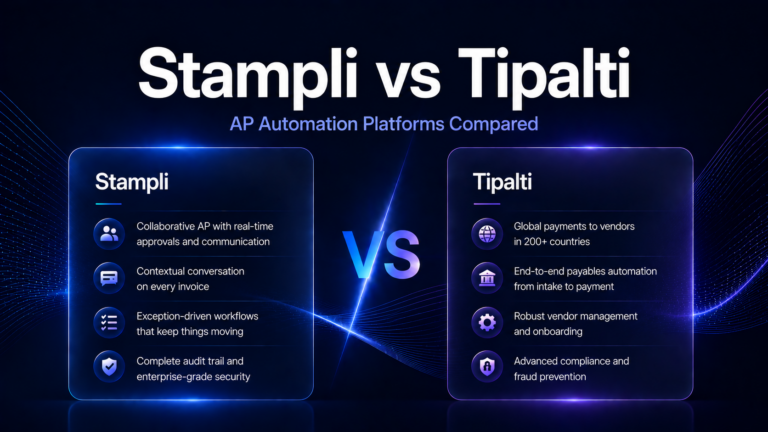
Top tool for this use case: Vic.ai for organizations with high invoice volumes where autonomous coding accuracy is the primary driver; Stampli for teams that want AI coding suggestions with human review remaining in the loop.
Ideal company profile: Organizations processing 300+ invoices per month across multiple GL accounts, cost centers, or projects — particularly those that have experienced close-process coding corrections or audit findings related to coding consistency.
What Is Invoice Coding Automation?
Invoice coding automation is the use of AI and machine learning to assign general ledger accounts, cost centers, project codes, and department identifiers to incoming invoices automatically — without AP staff manually looking up account codes and entering them for each invoice. In its most basic form, this means suggesting codes based on vendor identity (a known utility vendor always codes to the same GL account). In its most sophisticated form, it means reading invoice line-item descriptions, comparing them against contract terms, and making multi-dimensional coding decisions across dozens of GL segments simultaneously.
The automation is typically implemented as a learning system: the platform observes historical coding decisions made by AP staff, identifies patterns (this vendor + this invoice description = this GL code), and applies those patterns to future invoices. Over time, it improves its accuracy on the specific coding vocabulary of the organization’s chart of accounts. Human corrections are fed back into the model, further improving accuracy — a feedback loop that means the system becomes more valuable the longer it operates.
Invoice coding automation integrates directly with the invoice capture and approval workflow use cases — coded invoices feed directly into approval routing (where cost center often determines the approver), and coding accuracy upstream reduces close-process reconciliation work downstream.
The Business Case
The time cost of manual GL coding is often invisible in AP operations analysis because it is bundled with other AP staff activities rather than tracked separately. APQC’s AP benchmarking data suggests that GL coding and review is one of the top three time consumers in manual AP workflows — and that organizations that have automated coding spend significantly less total time per invoice than those that have not, even when all other process steps are equivalent.
Coding errors compound during the financial close. Ardent Partners’ research identifies miscoded invoices as a leading cause of close-process journal entries and reconciliation variances — corrections that require Controller or Accounting Manager time to identify, investigate, and correct. At scale, the close-process cost of routine coding errors often exceeds the original AP labor cost of the miscoding. Reducing the error rate at the source — through AI-assisted coding that applies rules consistently — reduces both the AP coding burden and the downstream close-process correction burden simultaneously.
The productivity impact is most pronounced at high invoice volumes. Deloitte’s analysis of AP automation deployments notes that organizations achieving the highest AP automation ROI are those that have combined capture automation with coding automation — because the two together enable end-to-end straight-through processing for routine invoices, with human attention reserved for genuine exceptions. Our AI for Accounts Payable Automation guide covers the coding automation technology landscape in depth.
Common Challenges
Chart of accounts complexity. Organizations with large, multi-segment charts of accounts — company code, cost center, project, profit center, department, and GL account — require the coding automation system to make multiple interdependent decisions for each invoice, increasing the complexity and potential error surface.
Historical data quality. AI coding systems learn from historical coding decisions. If the historical data contains significant miscoding — due to staff turnover, inconsistent practices, or legacy system migrations — the model will learn incorrect patterns and perpetuate errors rather than correct them.
New vendors and new spend categories. Coding automation is most accurate on known vendors with established coding history. New vendors and new spend categories require human coding input until sufficient history accumulates, which means the system will not achieve maximum automation rates immediately after deployment.
Multi-line split coding. Invoices that need to be split across multiple cost centers, projects, or departments require the system to both determine the appropriate split logic and apply the correct codes to each split — a significantly harder problem than single-line coding.
Chart of accounts changes. When the chart of accounts is modified — new accounts added, old accounts retired, cost center structures reorganized — coding automation systems need to be updated to reflect the new structure, or they will continue coding to retired accounts until the discrepancy is discovered.
How Software Solves It
Best-in-class coding automation platforms address complexity through multi-dimensional ML models that learn coding patterns across all GL segments simultaneously, rather than applying separate rules for each segment independently. They handle multi-line split invoices through learned split ratios for recurring vendors and configurable split rules for new vendors. And they apply confidence scoring to every coding suggestion — routing low-confidence codes for human review while auto-applying high-confidence codes — which maintains accuracy rates even as vendor and spend category diversity increases.
Chart of accounts synchronization is handled through bi-directional ERP integration that pulls current account structure at the time of coding — ensuring that the model always codes to active accounts and that retired account references generate immediate alerts rather than posting to closed GL accounts.
The learning loop is the core of sustained coding automation value. Platforms like Vic.ai implement continuous learning architectures where every human correction to an AI coding suggestion feeds back into the model — improving accuracy on similar invoices going forward. Over a 90–180 day period in production, organizations typically see autonomous coding rates rise from 40–50% at go-live to 70–80% at maturity.
Best Tools For Invoice Coding Automation
Vic.ai is the market leader for AI-native invoice coding automation. Its machine learning models are trained on each organization’s specific coding history and improve continuously from corrections — making it the strongest choice for organizations with high invoice volumes where maximizing autonomous coding rates is the primary driver. See the AP Automation Buyer Guide.
Limitation for this use case: Vic.ai’s coding automation requires a meaningful historical data foundation — typically 6+ months of clean, consistently coded invoice history. Organizations migrating from inconsistent or fragmented coding environments will need a data quality remediation phase before Vic.ai can achieve its full coding automation potential.
Stampli provides strong AI coding suggestions through its Billy the Bot assistant, which learns from organizational coding patterns and presents suggestions inline within the invoice processing workflow. Its human-in-the-loop design means AP staff review and confirm coding suggestions rather than having them applied autonomously — which maintains oversight at the cost of lower touchless processing rates.
Limitation for this use case: Stampli’s coding automation is suggestion-based rather than fully autonomous. For organizations targeting the highest possible touchless coding rates, Stampli will not match Vic.ai’s autonomous processing rates because the workflow keeps human review in the loop for most coding decisions.
Tipalti provides solid coding automation as part of its end-to-end platform, with configurable coding rules and GL sync. Best for organizations that want coding automation integrated with global payment and compliance workflows rather than as a standalone capability. Read our AP Automation Buyer Guide.
Limitation for this use case: Tipalti’s coding automation is rule-based rather than fully AI-native, which means its accuracy on new vendor types and unusual invoice formats depends on the quality of the rules configured during implementation rather than improving from live corrections over time.
Yooz combines its document intelligence capture engine with coding automation, using the invoice content extracted during capture to inform coding suggestions. This tight integration between capture and coding is a meaningful differentiator for organizations with high document format variability.
Limitation for this use case: Yooz’s coding automation is most effective on invoices where the line-item description in the captured document clearly maps to a GL account. For invoices with vague or generic descriptions — common in professional services — the coding suggestions rely more heavily on vendor identity alone, reducing accuracy on service spend categories.
BILL provides basic coding defaults by vendor, adequate for small businesses with limited GL complexity. See the BILL Review 2026.
Limitation for this use case: BILL’s coding capabilities are rule-based defaults rather than AI-learning systems. They do not adapt to coding pattern changes over time, cannot handle complex multi-segment coding, and are not suitable for organizations with more than 20–30 distinct GL coding rules across their vendor base.
Comparison Table
| Platform | Coding Method | Multi-Segment Support | Split Coding | Autonomous Rate (Mature) | Continuous Learning |
|---|---|---|---|---|---|
| Vic.ai | ML autonomous | Strong | Strong | 70–80% | Yes |
| Stampli | AI suggestion | Strong | Moderate | 40–60% (suggestion) | Yes |
| Tipalti | Rule-based | Strong | Moderate | 50–65% | Limited |
| Yooz | AI + rules | Moderate | Moderate | 50–65% | Moderate |
| BILL | Vendor defaults | Limited | Basic | 30–40% | No |
Implementation Considerations
Before deploying coding automation, conduct a historical coding quality review covering the last 12 months of AP transactions. Identify coding inconsistencies, retired account usage, and high-correction vendors. Cleaning this data — or explicitly excluding it from the training set — will significantly improve initial model accuracy and reduce the post-go-live correction rate that erodes confidence in the system during its first months of operation.
Define confidence thresholds explicitly before go-live. Determine what confidence level is required for autonomous coding (no human review) versus suggestion-only coding (AP staff confirm the suggestion before posting). Most organizations start with a conservative threshold and loosen it as the model’s accuracy track record builds. Document the threshold decisions and the rationale in your audit file.
Establish a monthly coding accuracy review as an ongoing operational practice. Track the autonomous coding rate, the correction rate on auto-coded invoices, and the most common correction types. These metrics tell you whether the model is improving as expected and surface the vendors or invoice types where manual review should remain in the workflow longer than the default threshold suggests.
Which Companies Need This?
Invoice coding automation delivers its clearest ROI for organizations processing 300+ invoices per month across a complex chart of accounts with multiple GL segments, cost centers, or project codes. Below that volume, the configuration investment may not be justified. Above it, the labor savings and coding consistency improvements compound with volume.
Organizations that experience recurring close-process adjustments for miscoded invoices — or that have received audit findings related to coding consistency — have a direct quality driver for coding automation independent of volume considerations. The close-process cost of correcting systematic miscoding is often the clearest ROI argument in these environments.
Frequently Asked Questions
How long does it take for AI coding automation to reach high accuracy?
Most platforms achieve 60–70% autonomous coding rates within 30–60 days of go-live, improving to 70–80%+ by 90–180 days as the model learns from live corrections. The rate of improvement depends on invoice volume (more invoices = faster learning), historical data quality, and the complexity of the chart of accounts.
What happens to coding accuracy when the chart of accounts changes?
Platforms with real-time ERP sync detect chart of accounts changes immediately and prevent coding to retired accounts. However, the coding model itself may need to be updated to reflect new account structures — particularly if new accounts are added for spend categories the model has not previously encountered. Plan for a brief post-change accuracy dip and a recalibration period after significant chart of accounts reorganizations.
Can coding automation handle invoices with multiple cost centers?
Yes, but the capability and accuracy vary significantly by platform. Platforms like Vic.ai support multi-segment split coding with learned split ratios for recurring vendors. Platforms with simpler coding models may handle single-line coding well but require manual input for split-coded invoices. Evaluate multi-segment coding capability explicitly if split coding is common in your AP environment.
Final Recommendation
For organizations targeting maximum autonomous coding rates, Vic.ai is the clear leader. For organizations that want AI coding suggestions with human review in the loop, Stampli provides the best combination of coding quality and workflow integration. Conduct a historical data quality review before any coding automation deployment — the quality of your coding history is the single largest determinant of initial model performance. See our Best AP Automation Software guide for complete platform evaluations.