Non-PO Invoice Processing for Finance Teams | FinanceCopilotHQ
Non-PO invoice processing represents a significant and often undermanaged portion of accounts payable volume. In most organizations, 30–60% of invoices arrive without an associated purchase order — covering services, subscriptions, utilities, professional fees, and other spend categories that do not flow through formal procurement channels. Without a structured processing workflow for these invoices, AP teams default to ad-hoc email routing, verbal approvals, and manual coding — creating the exact audit exposure and processing inefficiency that automation is designed to eliminate. For a full platform comparison, see our Best AP Automation Software guide.
What it is: A structured AP workflow for invoices that arrive without purchase orders — using automated coding suggestions, approval routing, and audit trail generation to process service, subscription, and utility invoices as rigorously as PO-backed spend.
Top tool for this use case: Airbase for organizations wanting upstream spend controls before non-PO invoices arrive; Stampli for teams that need flexible approval routing and collaboration on invoice exceptions without requiring a PO process change.
Ideal company profile: Professional services, SaaS, and technology companies with high proportions of subscription and service-based spend; any organization where non-PO invoices exceed 30% of AP volume.
What Is Non-PO Invoice Processing?
Non-PO invoice processing refers to the workflow for handling invoices that do not have an associated purchase order in the AP system. These invoices cannot be validated through PO matching automation because there is no PO to match against — instead, their authorization depends on a human approver confirming that the goods or services were legitimately ordered and received, that the amount is correct, and that the GL coding is appropriate.
Non-PO spend categories typically include professional services, SaaS and software subscriptions, utilities, travel and expense reimbursements from vendors, maintenance contracts, marketing services, and any purchases that were initiated informally without a formal procurement request. In organizations without a mature procurement function, the majority of spend may be non-PO.
Automated non-PO invoice processing replaces the ad-hoc email routing and verbal approval approach with a structured workflow: invoices are captured and coded automatically or with AI-assisted coding suggestions, routed to the appropriate approver based on amount and cost center, and logged with an immutable audit trail that documents the approval authorization for every payment. This is closely related to the invoice approval workflows use case, which covers the approval routing layer in depth.
The Business Case
Ardent Partners’ AP research identifies non-PO invoice processing as one of the top five sources of AP exceptions and processing delays — precisely because these invoices lack the PO anchor that enables automated matching and straight-through processing. The result is that non-PO invoices frequently take longer to process than PO-backed invoices, even though they are often for smaller, routine amounts that should require minimal human attention.
The audit exposure is equally significant. Gartner’s AP control research notes that non-PO spend is the category most commonly cited in AP audit findings — not because the spend is necessarily unauthorized, but because the authorization documentation is missing or reconstructed after the fact. When an auditor asks how a $15,000 consulting invoice was authorized, a forwarded email chain is not a satisfying answer. An automated workflow with a timestamped approval record is.
For organizations with high subscription and SaaS spend — which has grown significantly across most mid-market companies — non-PO invoice processing automation also enables better contract compliance monitoring. When every subscription invoice is routed through a structured workflow, AP teams can identify invoices that do not match contracted rates, subscriptions that have grown beyond authorized seat counts, and vendors that are billing for services no longer in use. Our AI for Accounts Payable Automation guide covers how AI tools are being applied to non-PO spend categorization and anomaly detection.
Common Challenges
No PO anchor for validation. Without a PO to compare against, the approval workflow carries the full authorization burden — and if that workflow is ad-hoc, there is no systematic validation that the invoice is legitimate, correctly priced, or within authorized spend limits.
GL coding complexity. Non-PO invoices require manual GL coding by AP staff, which is time-consuming and error-prone. Service invoices in particular often span multiple cost centers, projects, or departments, requiring split-coding that multiplies the manual effort.
Approval routing ambiguity. Without a PO that identifies the requester and cost center, routing non-PO invoices to the correct approver requires AP staff knowledge or lookup — a manual step that creates delays and routing errors when staff turnover occurs.
Recurring invoice verification. Subscription and recurring service invoices should ideally be validated against contract terms — amount, frequency, and service scope — but most AP systems have no automated mechanism to do this without a PO, leaving contract compliance dependent on AP staff memory.
Maverick spend visibility. When non-PO invoices are processed informally, finance leaders lack visibility into the total non-PO spend footprint — making it impossible to identify unauthorized vendors, duplicate service contracts, or spend that should have gone through procurement channels.
How Software Solves It
Modern AP automation platforms address non-PO invoice processing through a combination of AI-assisted GL coding suggestions, automated approval routing based on cost center and amount rules, and structured exception workflows. When an invoice arrives without a PO, the system applies historical coding patterns to suggest the appropriate GL accounts, routes the invoice to the correct approver based on vendor and amount rules, and logs the full approval chain as an immutable record — without AP staff needing to manually determine routing or coding for each invoice.
For organizations that want to reduce non-PO spend at its source, pre-approval platforms like Airbase route employees through a guided procurement request before any vendor commitment is made — converting what would have been a non-PO invoice into a pre-approved spend event. This upstream control approach is more complete from an AP controls perspective but requires broader organizational behavior change than invoice-stage automation. This connects closely to the invoice approval workflow and vendor onboarding use cases, which together define the full non-PO invoice lifecycle.
Best Tools For Non-PO Invoice Processing
Airbase provides the strongest upstream control model for non-PO spend — employees submit purchase requests that go through finance approval before a vendor is engaged, which means most invoices that arrive have already been authorized upstream rather than requiring invoice-stage approval. Best for organizations willing to invest in the change management required to shift procurement behavior.
Limitation for this use case: Airbase’s guided procurement workflow requires employees outside finance to change how they initiate purchases. Organizations that want a low-friction improvement to non-PO invoice routing without requiring upstream behavioral change will find Airbase’s value harder to capture without full adoption.
Stampli excels at non-PO invoice collaboration — its invoice communication thread allows AP staff to route questions to department heads, project managers, and budget owners directly on the invoice, without email chains. Combined with its AI-assisted coding suggestions, it significantly reduces the manual routing and coding burden for non-PO invoices. See the AP Automation Buyer Guide for details.
Limitation for this use case: Stampli does not provide upstream purchase request controls. Non-PO invoices still arrive as invoices rather than being pre-authorized — which means the approval workflow carries the full authorization burden without the PO validation layer that Airbase provides upstream.
Tipalti handles non-PO invoice processing as part of its end-to-end AP platform, with configurable approval routing and GL coding rules. Best for organizations that want non-PO processing integrated with global payment execution and compliance infrastructure. Read our AP Automation Buyer Guide.
Limitation for this use case: Tipalti’s non-PO invoice workflow is less differentiated than its global payment and supplier management capabilities. Teams whose primary driver is non-PO invoice UX and coding quality will find more purpose-built capabilities in Stampli or Airbase.
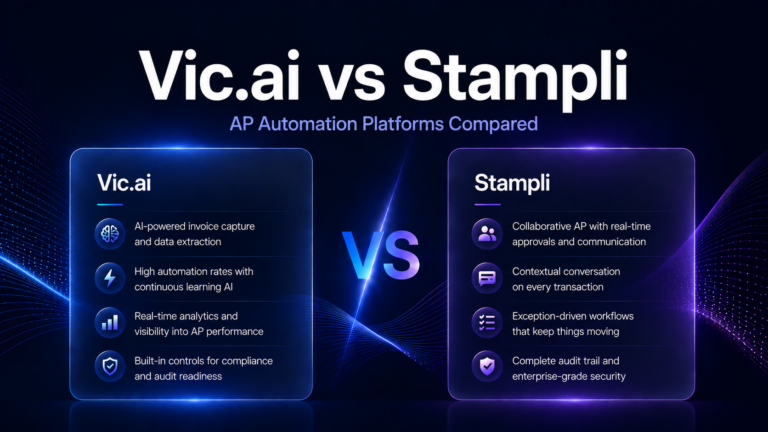
Vic.ai applies machine learning to GL coding for non-PO invoices, learning from historical coding patterns to suggest and increasingly automate the coding step that is the primary manual burden in non-PO processing. Best for organizations with high non-PO volumes where coding automation has the largest efficiency impact.
Limitation for this use case: Vic.ai’s coding intelligence requires a meaningful historical data foundation. Organizations migrating from disorganized or inconsistent coding environments will see limited coding automation benefit until the system has learned from a sufficient volume of clean historical transactions.
BILL provides basic non-PO invoice processing with approval routing and coding for small businesses. See the BILL Review 2026 for details.
Limitation for this use case: BILL’s approval routing for non-PO invoices is relatively simple — it does not support the conditional cost-center-based routing or AI coding suggestions that make non-PO processing scalable at mid-market invoice volumes. Organizations with complex non-PO spend categories will encounter BILL’s workflow configuration limits quickly.
Comparison Table
| Platform | Upstream Spend Control | AI GL Coding | Approval Routing Flexibility | Recurring Invoice Tracking | Audit Trail Quality |
|---|---|---|---|---|---|
| Airbase | Best-in-class | Strong | Strong | Strong | Strong |
| Stampli | Invoice-stage only | Strong | Best-in-class | Moderate | Strong |
| Tipalti | Invoice-stage only | Moderate | Strong | Moderate | Best-in-class |
| Vic.ai | Invoice-stage only | Best-in-class | Strong | Moderate | Strong |
| BILL | Invoice-stage only | Basic | Moderate | Basic | Adequate |
Implementation Considerations
The most important configuration decision in non-PO invoice processing is the approval routing matrix — the rules that determine who must approve each non-PO invoice based on vendor, amount, and cost center. This matrix should be designed in collaboration with department heads and budget owners, not dictated by AP, because they need to both understand and accept the approval responsibilities assigned to them. Without their buy-in, approval bottlenecks emerge within weeks of go-live.
GL coding rules should be built from a review of the last 12 months of non-PO invoice coding history. Identify the 20 most common vendor-to-GL-account coding patterns and encode them as rules or train them as AI suggestions before going live. This front-loaded configuration work dramatically reduces the manual coding burden in the first months of operation and accelerates the AI learning curve on platforms like Vic.ai.
Organizations with significant recurring vendor spend should build a vendor-to-contract registry as part of implementation — a structured record of expected invoice amounts, frequencies, and GL assignments for each recurring vendor. This enables the system to flag invoices that deviate from contract terms automatically, converting what was previously an informal check into a systematic control.
Which Companies Need This?
Any organization where non-PO invoices represent more than 20% of AP volume should have a structured non-PO processing workflow. Professional services, SaaS, media, and marketing companies — where service-based and subscription spend is the norm rather than the exception — typically have non-PO ratios above 60% and benefit most directly from this use case.
Organizations that have grown quickly through headcount expansion — adding dozens of SaaS tools, professional service vendors, and contract resources without formalizing their procurement process — frequently discover in an audit or budget review that their non-PO spend is both larger and less controlled than management realized. Implementing structured non-PO processing provides both the immediate efficiency gain and the spend visibility to rationalize the vendor base.
Frequently Asked Questions
What percentage of invoices are typically non-PO?
Ardent Partners’ research consistently shows that 30–60% of invoices in a typical mid-market company arrive without a purchase order. The percentage is higher in professional services and technology companies and lower in manufacturing and distribution companies with formal procurement processes.
How is non-PO invoice authorization documented for audit purposes?
Automated non-PO invoice processing creates a timestamped, immutable record of every approval action — who approved, at what dollar amount, at what time, and from what system. This record is created automatically in the AP platform and syncs to the ERP as part of the invoice posting, providing the audit trail that replaces the forwarded email chain that manual processes rely on.
Can non-PO invoice processing be used for recurring subscriptions?
Yes. The best platforms allow you to configure expected invoice parameters for recurring vendors — amount, frequency, GL account — so that invoices matching the expected pattern route for expedited approval or auto-approve within configured limits, while deviations from the expected pattern flag for review. This effectively creates a soft contract-matching layer for non-PO recurring spend.
Final Recommendation
For organizations with high non-PO spend ratios and the organizational appetite for upstream behavior change, Airbase provides the most complete non-PO spend control model. For teams that want structured non-PO invoice processing without requiring procurement process changes, Stampli and Vic.ai deliver the strongest combination of approval workflow quality and AI-assisted coding automation. See our Best AP Automation Software guide for complete platform comparisons.