Three-Way Matching Automation for Finance Teams | FinanceCopilotHQ
Three-way matching automation is the AP control that finance leaders depend on most to prevent unauthorized or incorrect payments — and it is also one of the most time-consuming manual processes in accounts payable when it runs without software. Matching invoices against purchase orders and goods receipt confirmations manually, at any meaningful volume, consumes disproportionate AP staff time and still produces exceptions that require senior finance involvement to resolve. This guide covers what three-way matching automation involves, where manual processes fail, and which platforms handle it best. For a full AP platform comparison, see our Best AP Automation Software guide.
What it is: Software that automatically compares invoices against purchase orders and goods receipt confirmations, clearing matched invoices for straight-through payment processing and routing exceptions to the appropriate reviewer — without manual document comparison.
Top tool for this use case: Stampli for mid-market organizations prioritizing exception resolution throughput; Tipalti for multi-entity companies needing matching integrated with global payment execution.
Ideal company profile: Organizations processing 100+ PO-backed invoices per month, particularly manufacturing, distribution, construction, and retail companies — and any team preparing for or operating under SOX compliance.
What Is Three-Way Matching Automation?
Three-way matching is the process of verifying that three documents agree before an invoice is approved for payment: the purchase order (the authorization to buy), the goods receipt or service confirmation (evidence that what was ordered was actually received), and the vendor invoice (the request for payment). When all three documents align within defined tolerance limits — the quantity matches, the price matches, the vendor is the same — the invoice can be processed for payment without requiring additional manual approval. When they do not align, an exception is created and routed for investigation.
Three-way matching automation is the use of software to perform these comparisons automatically at the point of invoice processing, rather than through manual document comparison by AP staff. At its most efficient, an automated three-way match system receives an invoice, identifies the corresponding PO and goods receipt from the ERP, performs the comparison against configured tolerance rules, and either clears the invoice for straight-through processing or routes a structured exception to the appropriate reviewer — all without human intervention for the matching step itself.
Two-way matching (invoice against PO only, without goods receipt confirmation) and four-way matching (adding an inspection record as a fourth document) are variants used in specific procurement contexts, but three-way matching is the most widely deployed standard in mid-market and enterprise AP environments. The automation principles are the same across all variants.
The Business Case
Three-way matching automation delivers value in two distinct ways: it speeds up the processing of clean invoices and it creates defensible audit evidence for every matched transaction. IOFM benchmarking shows that top-quartile AP teams process invoices in under three days, while median performers take 9.7 days — and a significant share of that gap in PO-backed invoice environments is attributable to the time manual matching adds before an invoice can enter the approval queue. When matching completes automatically for clean invoices, the invoice is in the approval queue within minutes of receipt rather than hours or days.
The exception-related cost reduction is equally significant. Gartner research on procure-to-pay automation identifies manual exception handling — investigating why an invoice does not match its PO — as the primary AP bottleneck in organizations without automated matching, accounting for a disproportionate share of total AP staff hours. Automated matching creates structured exceptions with the relevant documents, variance details, and routing information already assembled, which means AP staff can investigate and resolve exceptions faster and with less context-gathering overhead.
APQC’s process benchmarking data shows that top-performing organizations processing invoices at the lowest cost per invoice are those with the highest straight-through processing rates — where invoices clear automated controls without human intervention. Three-way matching automation is one of the two most significant contributors to straight-through processing rate improvement (alongside automated capture), and its ROI compounds directly with invoice volume. For context on how AI is improving matching accuracy and exception prioritization specifically, see our AI for Accounts Payable Automation guide.
Common Challenges
PO and receipt data quality in the ERP. Three-way matching automation is only as good as the underlying data it matches against. If POs are created late (after goods are received), are missing line-item detail, or contain incorrect pricing, the matching process generates exceptions on otherwise clean invoices — creating false positive exceptions that frustrate AP staff and slow payment cycles.
Partial deliveries and split receipts. When an order is delivered in multiple shipments, the goods receipt records in the ERP reflect partial quantities. Matching an invoice against a partial receipt requires the system to understand cumulative receipt quantities across multiple GRN records — logic that many basic matching systems handle poorly.
Price tolerance management. Invoiced prices rarely match PO prices exactly — exchange rate movements, fuel surcharges, shipping variations, and contract price adjustments create legitimate price differences that should not block payment. Defining and maintaining tolerance rules that allow legitimate variances while blocking genuine price errors requires deliberate configuration and periodic review.
Service invoices and non-PO spend. Three-way matching is designed for goods-based procurement with formal PO processes. Service invoices, utilities, subscriptions, and other non-PO spend cannot be three-way matched by definition and require separate approval workflows. Organizations with significant non-PO spend need to design controls for both PO-backed and non-PO invoice populations — not just the former.
PO-to-invoice field mapping mismatches. Even when PO and invoice amounts agree in substance, field format differences — different units of measure, different line-item descriptions, different date formats — can cause automated matching to fail on technically clean invoices. Field normalization during capture is a prerequisite for reliable matching.
Exception resolution accountability gaps. When automated matching creates an exception, someone needs to investigate and resolve it. Without clear ownership rules and escalation paths, exceptions age in a queue without resolution — creating payment backlogs and vendor relationship tension.
How Software Solves It
Best-in-class three-way matching platforms solve the data quality problem through bi-directional ERP integration that pulls current PO and receipt data directly from the ERP at the time of matching — ensuring that the matching process always works with the most current version of each document, including mid-cycle PO amendments and multi-shipment receipt accumulations. This is categorically more reliable than batch-sync approaches that may be hours or days out of date when a match is attempted.
Tolerance rule engines allow finance teams to define acceptable variance ranges by vendor, commodity, cost center, or invoice amount — so that a 2% price variance on a commodity purchase routes differently than a 2% variance on a fixed-price professional services engagement. The configuration flexibility to express real-world tolerance policy in the system (rather than applying a single global threshold) substantially reduces both false positives and missed genuine exceptions.
AI-assisted exception triage — offered by platforms including Vic.ai and Stampli — adds a prioritization layer on top of matching exceptions. Rather than presenting AP staff with a flat list of exceptions to work through, these systems score exceptions by likely root cause, urgency, and resolution complexity, allowing the highest-priority exceptions to be resolved first. Stampli’s communication-on-invoice model is particularly effective for exception resolution because the context (PO details, receipt records, match variance) is presented alongside the exception in the same interface where resolution occurs. Details on Stampli’s matching capabilities are included in our AP Automation Buyer Guide.
Best Tools For Three-Way Matching Automation
Tipalti provides strong three-way matching as part of its end-to-end AP platform, with robust real-time ERP sync that ensures matching operates against current PO and receipt data including mid-cycle amendments. Its multi-entity capabilities extend matching across complex organizational structures — checking that invoices match POs and receipts at the correct entity level. Full evaluation in our AP Automation Buyer Guide.
Limitation for this use case: Tipalti’s exception resolution interface is functional but less intuitive than Stampli’s for the AP staff who work exceptions daily. Organizations where exception resolution throughput is a primary concern — where the team resolves dozens of exceptions per day — will find the workflow experience less streamlined than purpose-built exception-handling platforms.
Stampli excels specifically at exception-centric matching workflows. Its communication-on-invoice model makes it fast to investigate and resolve matching exceptions — the PO details, receipt records, and match variance are presented in the same interface alongside a conversation thread where AP staff, procurement, and approvers can exchange context without leaving the invoice.
Limitation for this use case: Stampli’s payment capabilities are more limited than Tipalti’s. For organizations that need matching tightly integrated with global payment execution and multi-currency settlement, Stampli requires additional platform components or partner integrations to complete the full AP cycle.
Vic.ai applies machine learning to the matching process, using historical patterns to improve tolerance calibration over time and surface exceptions most likely to indicate genuine pricing or receipt issues rather than format mismatches. This AI layer reduces the false positive burden on AP staff significantly in mature deployments.
Limitation for this use case: Vic.ai’s matching is best understood as an intelligence layer on top of matching logic rather than a full procure-to-pay workflow. Organizations looking for comprehensive PO management, goods receipt tracking, and supplier collaboration within the same platform will need to integrate Vic.ai with a procurement system or ERP that handles these upstream processes.
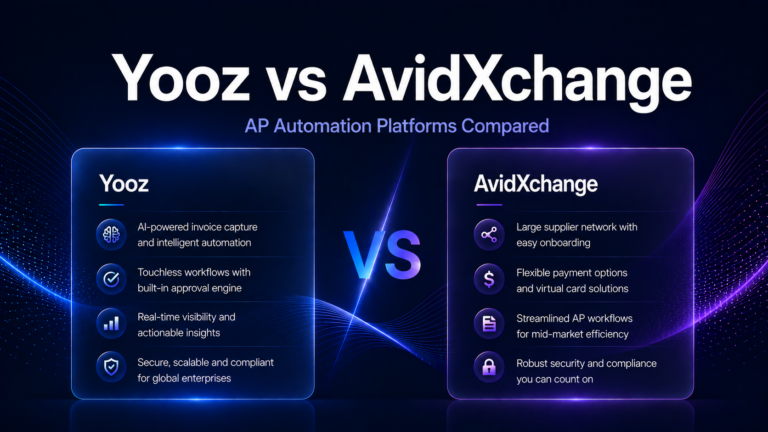
Yooz handles three-way matching with strong document intelligence capabilities, making it particularly valuable in industries where POs and receipts come in non-standard formats or are sourced from external procurement systems not directly integrated with the AP platform.
Limitation for this use case: Yooz’s ERP sync for matching is available in both batch and real-time modes depending on the ERP connector, and not all 250+ connectors provide real-time sync. For organizations where PO amendments and partial receipts are frequent, verify that real-time sync is available for your specific ERP before relying on Yooz’s matching for time-sensitive invoice processing.
BILL supports basic PO matching for small businesses but does not provide full three-way matching with goods receipt confirmation in its standard tier. See the BILL Review 2026 for details on its matching capabilities.
Limitation for this use case: BILL’s matching is two-way (invoice against PO) without goods receipt confirmation, which means it does not address the “did we actually receive what we ordered?” question that three-way matching is specifically designed to answer. For organizations with formal procurement processes where goods receipt validation is a controls requirement, BILL is not an appropriate platform for this use case.
Comparison Table
The table below evaluates leading platforms across the criteria most important for three-way matching automation decisions.
| Platform | Match Depth (2-way / 3-way) | Tolerance Rule Flexibility | Partial Receipt Handling | Exception Resolution UX | ERP Data Sync Speed |
|---|---|---|---|---|---|
| Tipalti | 2-way + 3-way | Strong | Strong | Strong | Real-time |
| Stampli | 2-way + 3-way | Strong | Strong | Best-in-class | Real-time (70+ ERPs) |
| Vic.ai | 2-way + 3-way | ML-assisted | Strong | Strong | Real-time (major ERPs) |
| Yooz | 2-way + 3-way | Moderate | Moderate | Moderate | Batch + real-time (varies) |
| BILL | 2-way (basic) | Limited | Basic | Basic | Batch |
Implementation Considerations
The most important prerequisite for three-way matching automation is a clean, current PO process in your ERP. If purchasers in your organization routinely create POs after goods are received (backdating POs to close matching exceptions), or if your procurement team does not consistently enter goods receipts in the ERP at the time of delivery, matching automation will generate constant exceptions on otherwise legitimate invoices. Before deploying a matching system, audit your PO and receipt process discipline and close any gaps — matching automation amplifies both good and bad procurement process hygiene.
Tolerance rule design deserves dedicated workshops with procurement, finance, and operations stakeholders. The right tolerance structure is specific to your business — commodity mix, vendor contract structures, currency exposure, and procurement category risk profiles all influence what constitutes an acceptable variance versus a genuine exception. Generic defaults will either let too many errors through or generate too many false positives. Invest the time upfront to design a tolerance framework that reflects your actual procurement reality.
Exception ownership is as important as exception detection. Define, before go-live, which types of matching exceptions are owned by AP, which require procurement involvement, and which escalate to the Controller or CFO. Build these escalation paths into the system configuration. Teams that launch matching automation without clear exception ownership rules find that exceptions accumulate unresolved, creating payment backlogs that are worse than the pre-automation state.
Which Companies Need This?
Three-way matching automation is most valuable for organizations with formal procurement processes — companies that issue purchase orders as a standard part of their procurement cycle, have goods receipt processes in their ERP, and have at least 100 PO-backed invoices per month. Below that volume, manual matching is manageable with disciplined process; above it, the time cost of manual matching compounds quickly.
Manufacturing, distribution, construction, and retail companies — where PO-backed procurement for physical goods is the norm — benefit most from three-way matching automation. Professional services and SaaS companies with predominantly subscription and service-based spend may find that non-PO invoice approval workflows are a more relevant use case than three-way matching, given the absence of goods receipt confirmations in their procurement model.
Organizations preparing for or currently under SOX compliance have a specific requirement: three-way matching controls must be documented, consistently applied, and demonstrably operating. Manual matching processes that depend on individual AP staff judgment do not satisfy this requirement. Automated matching with documented tolerance rules and exception audit trails does.
Frequently Asked Questions
What is the difference between two-way, three-way, and four-way matching?
Two-way matching compares the invoice against the purchase order only. Three-way matching adds the goods receipt or service confirmation as a third document, verifying that what was ordered was actually delivered before payment is authorized. Four-way matching adds an inspection or quality acceptance record as a fourth document, used in industries where formal quality control sign-off is a payment prerequisite. Three-way matching is the standard for most mid-market and enterprise procurement environments.
What happens to non-PO invoices in a three-way matching environment?
Non-PO invoices — for services, subscriptions, utilities, and other spend categories without formal purchase orders — cannot be three-way matched by definition. They should route through a separate approval workflow that provides equivalent authorization evidence. The best AP automation platforms handle both PO-backed and non-PO invoices in the same system, applying matching logic to the former and approval workflow logic to the latter based on invoice type classification at capture.
How are matching tolerances typically set?
Matching tolerances are typically expressed as either a percentage variance (e.g., invoice amount may not exceed PO amount by more than 3%) or an absolute dollar variance (e.g., line-item price may not vary by more than $50). Most platforms support both types and allow different tolerances to be set by vendor, commodity category, cost center, or invoice amount band. Tolerance design should be driven by your actual procurement contract terms and your risk appetite for unreviewed price variances.
Can three-way matching automation handle invoices in multiple currencies?
Yes, but currency handling requires careful configuration. When a PO is issued in one currency and an invoice arrives in another, the matching system needs a defined exchange rate source and rate snapshot date to perform a meaningful comparison. Most enterprise-grade platforms handle this through ERP-sourced exchange rates, but the rate snapshot logic — which rate to use and at what point in the transaction — should be explicitly configured and validated against your accounting policy.
How does automated matching affect vendor payment terms compliance?
Automated matching significantly improves payment terms compliance by removing the processing delay that manual matching introduces. When matching completes automatically on invoice receipt for clean invoices, the time from invoice arrival to payment approval is measured in hours rather than days — which makes early payment discount windows achievable and reduces late payment penalty exposure. Exception resolution time is the remaining variable; teams that resolve exceptions quickly capture this benefit fully.
Final Recommendation
For organizations with formal procurement processes processing 100+ PO-backed invoices per month, three-way matching automation is a high-priority AP investment — both for the efficiency gain on clean invoices and for the audit trail it provides on exceptions. Stampli and Tipalti are the strongest complete platforms for this use case in the mid-market; Vic.ai is the best choice for high-volume environments where AI-assisted exception triage is needed. Before deploying any matching system, invest in PO and goods receipt process discipline in your ERP — the technology only delivers its ROI when the underlying procurement data is clean and timely. See our Best AP Automation Software guide for complete platform evaluations and procurement-to-payment stack recommendations.
Related Guides
- Best AP Automation Software in 2026
- Invoice Capture Automation for Finance Teams
- Invoice Approval Workflows for Finance Teams
- Duplicate Invoice Detection for Finance Teams
- BILL vs Tipalti (2026): AP Platform Comparison
- AI for Accounts Payable Automation: Best Tools Compared
- Finance Software Categories