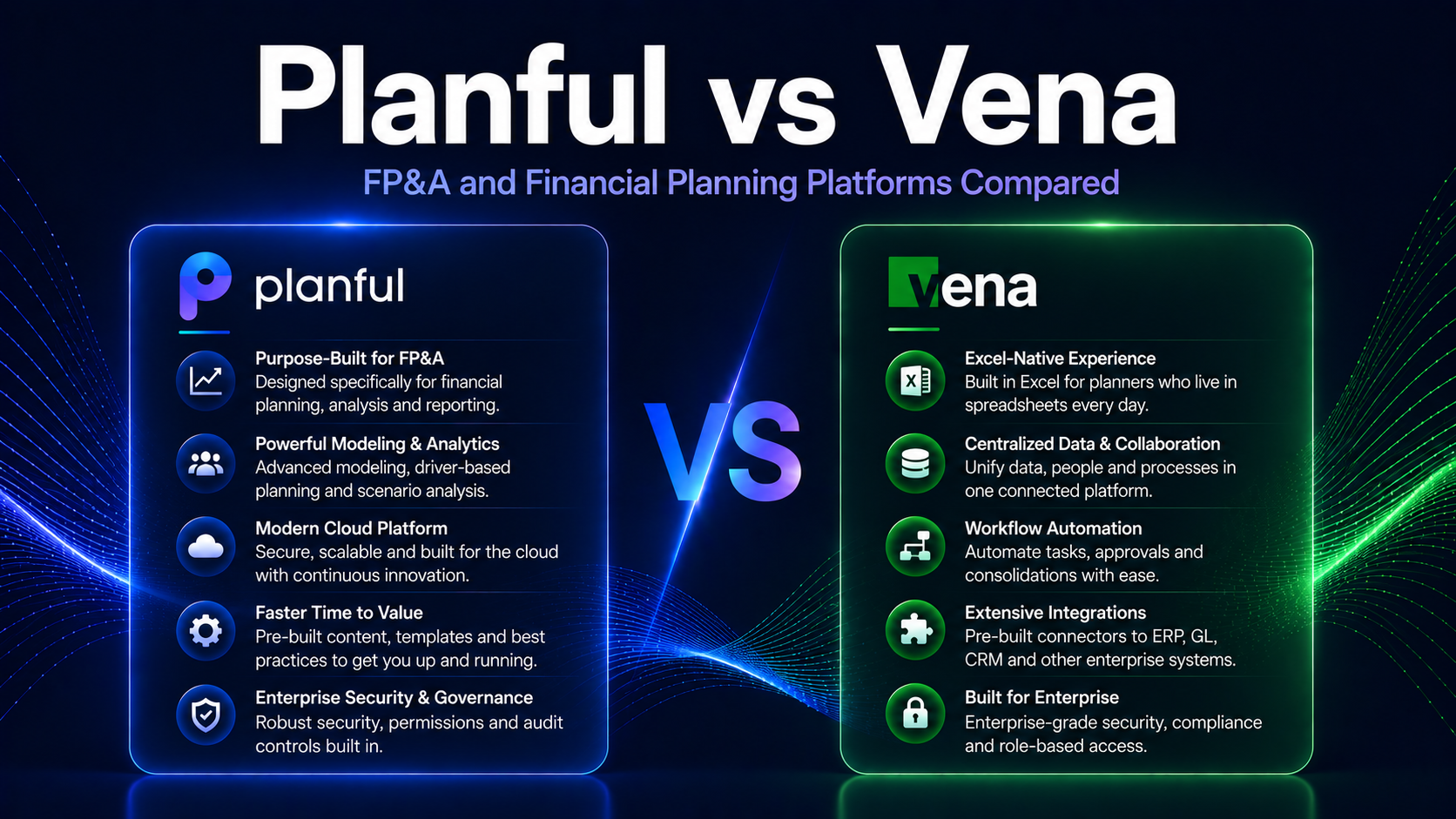
Planful vs Vena (2026): Which FP&A Platform Is Best?
Planful vs Vena (2026): Which FP&A Platform Is Best?
An independent head-to-head comparison of Planful and Vena for financial planning and analysis in 2026. Covers planning, budgeting, consolidation, reporting, Excel integration, pricing, and which platform fits your finance team.
Planful and Vena are both established FP&A platforms with strong financial planning and reporting capabilities, but they take meaningfully different approaches to how finance teams interact with the data. Planful is a purpose-built financial planning platform with structured reporting and consolidation depth. Vena is built around a native Microsoft Excel interface, making it the natural choice for Excel-centric finance teams that want the power of a cloud FP&A platform without abandoning spreadsheet workflows.
FP&A leaders and controllers evaluating Planful and Vena. Finance teams comparing structured planning platforms against Excel-native FP&A solutions.
Quick Verdict
Planful vs Vena: Quick Verdict
| Category | Winner | Why |
|---|---|---|
| Excel-Native Experience | Vena | Built around Excel as the primary interface |
| Structured Reporting | Planful | More mature structured financial reporting engine |
| Financial Consolidation | Planful | Deeper multi-entity consolidation module |
| Finance Team Adoption | Vena | Excel familiarity reduces adoption friction |
| Budgeting & Forecasting | Tie | Both strong for core FP&A planning cycles |
| Collaboration | Planful | Better structured workflow for multi-team planning |
| IT Dependency | Vena | Excel-based models require less IT involvement |
| Modern UI | Planful | More modern web interface outside Excel |
Side-by-Side Comparison
Planful vs Vena: Feature Comparison
| Feature | Planful | Vena |
|---|---|---|
| Annual Budgeting | ✓ Structured Planning module | ✓ Excel-native templates |
| Rolling Forecasts | ✓ Dynamic Planning module | ✓ Supported |
| Financial Consolidation | ✓ Multi-entity consolidation | ✓ Supported |
| Excel Integration | ✓ Excel add-in available | ✓ Excel as primary interface |
| Scenario Modeling | ✓ Supported | ✓ Supported |
| Reporting & Dashboards | ✓ Mature reporting engine | ✓ Excel-based + dashboards |
| Workforce Planning | ✓ Supported | ✓ Supported |
| Data Integration | ✓ Broad ERP connectors | ✓ Broad ERP connectors |
Planful Deep Dive
Planful: Platform Overview
Planful (formerly Host Analytics) has been building FP&A software since 2000. Its three core modules—Structured Planning for budgeting, Dynamic Planning for rolling forecasts, and Reporting for financial statement production—serve finance teams that need a purpose-built planning platform with mature consolidation and reporting capabilities.
Planful’s reporting engine produces board-quality financial statements, management reports, and consolidations with multi-entity support. For organizations with complex reporting hierarchies or statutory consolidation requirements, Planful’s depth in this area is a significant advantage over simpler planning tools.
Vena Deep Dive
Vena: Platform Overview
Vena is uniquely positioned in the FP&A market as a platform built around Excel rather than alongside it. The Vena Complete Planning platform uses Excel as its primary interface, with a cloud database backend that handles data management, version control, and workflow orchestration. Finance teams can build and manage planning models in familiar Excel templates while benefiting from central data governance.
Vena’s Excel-native approach dramatically reduces training requirements for finance teams that already live in spreadsheets. New users can begin working in Vena immediately without learning a new planning interface. This adoption advantage is particularly valuable in organizations where FP&A processes involve many contributors from business units who are not power users of specialized planning tools.
Pricing Comparison
Planful vs Vena: Pricing
| Factor | Planful | Vena |
|---|---|---|
| Pricing Model | Module-based / per-user | Per-user / module-based |
| Mid-Market Range | $50K–$120K/year | $50K–$120K/year |
| Enterprise Pricing | Custom contract | Custom contract |
| Implementation Cost | Moderate to high | Moderate |
| Contract Length | Annual or multi-year | Annual or multi-year |
| Free Trial | Demo available | Demo available |
Integrations
Planful vs Vena: Integrations
| Integration | Planful | Vena |
|---|---|---|
| NetSuite | ✓ Native | ✓ Native |
| Salesforce | ✓ Native | ✓ Native |
| Workday | ✓ Supported | ✓ Native |
| SAP | ✓ Supported | ✓ Supported |
| Oracle ERP | ✓ Supported | ✓ Supported |
| Microsoft Dynamics | ✓ Supported | ✓ Native |
| BambooHR / Rippling | ✓ Supported | ✓ HRIS connectors |
Decision Guide
Planful vs Vena: How to Choose
Final Verdict
Planful vs Vena: Final Verdict
Planful is the stronger choice for finance teams that want a purpose-built FP&A platform with mature reporting, multi-entity consolidation, and structured planning workflows. Its depth in reporting and consolidation is a clear advantage for organizations with complex financial statement requirements.
Vena is the right choice for Excel-centric finance teams that want cloud FP&A governance without replacing Excel. Its unique Excel-native approach delivers the adoption and familiarity advantages that matter when rolling out planning processes across multiple business unit contributors.
Planful for purpose-built FP&A with structured reporting and consolidation depth. Vena for Excel-native finance teams that want cloud governance while keeping Excel as the planning interface.