Microsoft Dynamics 365 vs NetSuite (2026): Which ERP Platform Is Best?
Microsoft Dynamics 365 vs NetSuite (2026): Which ERP Platform Is Best?
An independent head-to-head comparison of Microsoft Dynamics 365 and NetSuite for cloud ERP in 2026. Covers financial management, scalability, Microsoft 365 integration, implementation, pricing, and which platform fits your organization.
Microsoft Dynamics 365 and NetSuite (Oracle NetSuite) are two of the most widely evaluated cloud ERP platforms for mid-market and growing enterprise organizations. Dynamics 365 is the natural choice for organizations deeply embedded in the Microsoft ecosystem—Office 365, Azure, Power BI, and Teams. NetSuite is the dominant cloud ERP for high-growth companies, particularly in e-commerce, software, and professional services, with a track record of scaling from startup through IPO.
CFOs and finance leaders evaluating cloud ERP platforms for mid-market or growing enterprise organizations. IT decision makers comparing Microsoft Dynamics 365 and NetSuite.
Quick Verdict
Microsoft Dynamics 365 vs NetSuite: Quick Verdict
| Category | Winner | Why |
|---|---|---|
| Microsoft Ecosystem Fit | Microsoft Dynamics 365 | Native Office 365, Teams, Power BI, Azure integration |
| High-Growth / E-Commerce Fit | NetSuite | Strong track record scaling from startup to enterprise |
| Financial Management | Tie | Both offer comprehensive mid-market financials |
| Customization Flexibility | Microsoft Dynamics 365 | Broader customization via Power Platform |
| Implementation Speed | NetSuite | More standardized deployment for mid-market |
| Multi-Entity / Multi-Currency | NetSuite | Stronger native multi-subsidiary support |
| Manufacturing Module | Microsoft Dynamics 365 | Deeper manufacturing capabilities via D365 Supply Chain |
| Total Cost (Mid-Market) | Tie | Comparable TCO with different cost structure |
Side-by-Side Comparison
Microsoft Dynamics 365 vs NetSuite: Feature Comparison
| Feature | Microsoft Dynamics 365 | NetSuite |
|---|---|---|
| Financial Management | ✓ Comprehensive cloud financials | ✓ Comprehensive cloud financials |
| Multi-Entity / Multi-Currency | ✓ Supported | ✓ Core strength |
| Supply Chain / Inventory | ✓ D365 Supply Chain module | ✓ Supported |
| Manufacturing | ✓ D365 Manufacturing | ✓ Light manufacturing |
| E-Commerce Integration | ✓ D365 Commerce module | ✓ SuiteCommerce native |
| Power BI / Analytics | ✓ Native Power BI integration | ✓ Built-in SuiteAnalytics |
| Microsoft Teams Integration | ✓ Native | Third-party required |
| CRM Integration | ✓ Native D365 Sales / CRM | ✓ NetSuite CRM module |
Microsoft Dynamics 365 Deep Dive
Microsoft Dynamics 365: Platform Overview
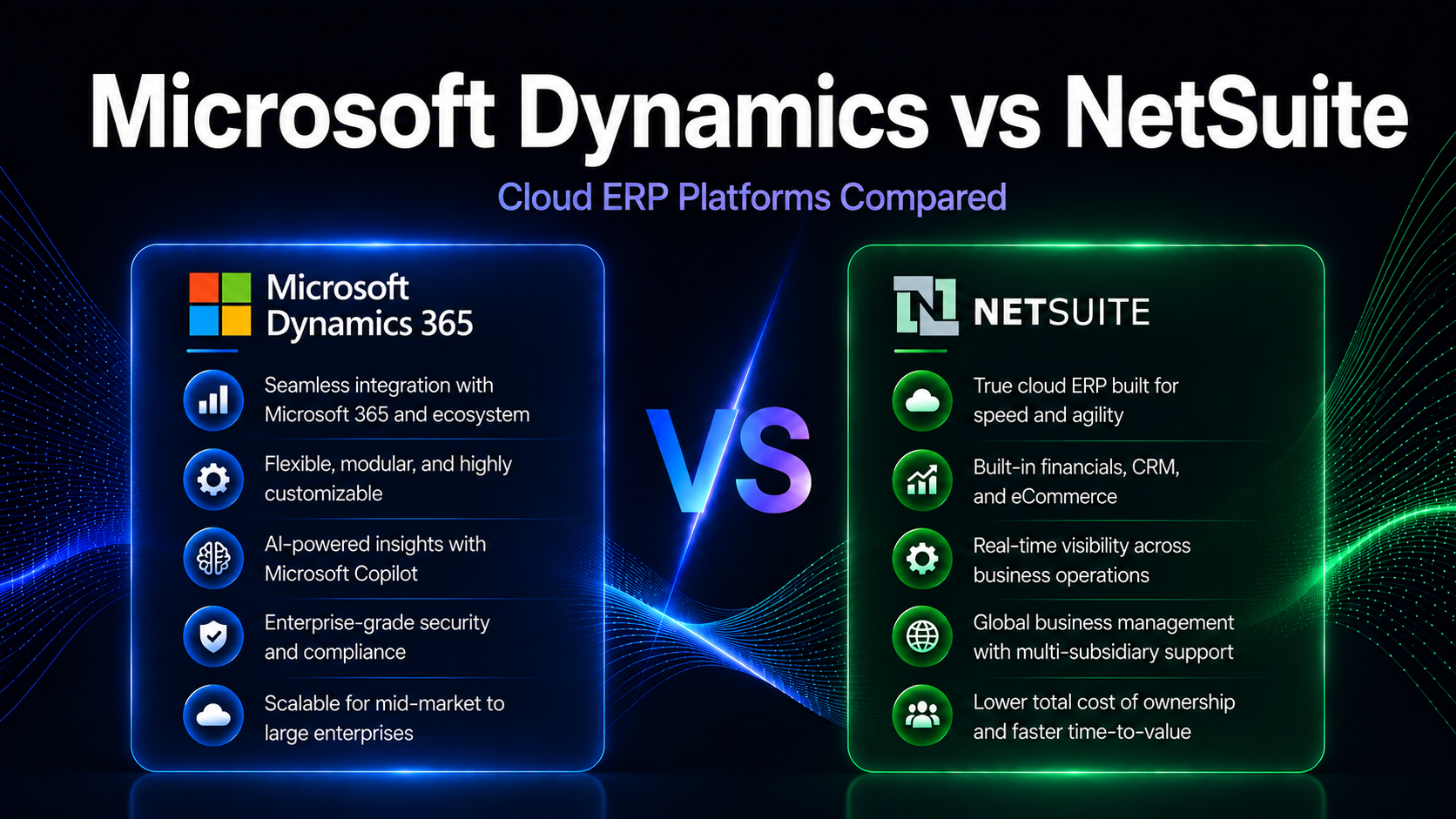
Microsoft Dynamics 365 Finance is the financial management application within Microsoft’s broader Dynamics 365 ecosystem. Its native integration with Office 365, Teams, Power BI, and Azure gives organizations already running Microsoft infrastructure a seamless ERP experience. The Power Platform—Power Apps, Power Automate, and Power BI—extends Dynamics 365 with low-code customization and workflow automation that can be managed by finance and operations teams without deep development resources.
Dynamics 365 scales from mid-market through enterprise and can be deployed alongside other Dynamics 365 modules for Sales, Supply Chain, Commerce, and Human Resources. For organizations that want a Microsoft-native end-to-end business application platform, Dynamics 365 Finance provides financial management as part of a unified Microsoft ecosystem.
NetSuite Deep Dive
NetSuite: Platform Overview
NetSuite is Oracle’s cloud ERP platform and the most widely deployed cloud ERP globally for mid-market and growing companies. The platform’s track record of scaling with high-growth businesses—from early startup through public company—has made it the default ERP evaluation for venture-backed and PE-backed companies. NetSuite’s multi-subsidiary and multi-currency capabilities are particularly strong, making it a natural fit for companies with international operations or complex entity structures.
NetSuite’s SuiteCommerce module provides native e-commerce capabilities for product companies selling direct to consumer. SuiteAnalytics provides embedded reporting without requiring a separate BI tool license. The platform’s deployment is more standardized than Dynamics 365, with well-established mid-market implementation playbooks that can accelerate time-to-value.
Pricing Comparison
Microsoft Dynamics 365 vs NetSuite: Pricing
| Factor | Microsoft Dynamics 365 | NetSuite |
|---|---|---|
| Pricing Model | Per-user subscription | Base license + user seats |
| Mid-Market Range | $100K–$500K/year | $75K–$300K/year |
| Enterprise Pricing | Custom enterprise contract | Custom enterprise contract |
| Implementation Cost | Moderate to high | Moderate |
| Contract Length | Annual or multi-year | Annual or multi-year |
| Free Trial | Demo available | Demo available |
Integrations
Microsoft Dynamics 365 vs NetSuite: Integrations
| Integration | Microsoft Dynamics 365 | NetSuite |
|---|---|---|
| Microsoft Office 365 | ✓ Native deep integration | Third-party connectors |
| Microsoft Teams | ✓ Native | Third-party required |
| Power BI | ✓ Native | ✓ Via connector |
| Salesforce | ✓ Supported (CRM overlap) | ✓ Supported |
| Azure | ✓ Native | ✓ Supported |
| Shopify / E-Commerce | ✓ D365 Commerce or connector | ✓ SuiteCommerce native |
| Workday / HRIS | ✓ D365 HR or third-party | ✓ Supported |
Decision Guide
Microsoft Dynamics 365 vs NetSuite: How to Choose
Final Verdict
Microsoft Dynamics 365 vs NetSuite: Final Verdict
Microsoft Dynamics 365 Finance is the right ERP for organizations that are Microsoft-native and want a cloud ERP that leverages their existing investment in Office 365, Teams, Power BI, and Azure. Its Power Platform extensibility provides a low-code customization layer that finance and operations teams can use without heavy IT involvement.
NetSuite is the right choice for high-growth companies, e-commerce businesses, and mid-market organizations that need a proven cloud ERP with strong multi-entity capabilities and a reliable scaling track record. Its deployment maturity and broad implementation partner network make it one of the most de-risked mid-market ERP options.
Microsoft Dynamics 365 for Microsoft-ecosystem organizations wanting deep Office 365, Teams, and Power BI integration. NetSuite for high-growth companies and mid-market organizations wanting proven cloud ERP scalability.