Oracle Fusion ERP vs SAP S/4HANA (2026): Which ERP Platform Is Best?
Oracle Fusion ERP vs SAP S/4HANA (2026): Which ERP Platform Is Best?
An independent head-to-head comparison of Oracle Fusion ERP and SAP S/4HANA for enterprise resource planning in 2026. Covers financial management, implementation, cloud architecture, analytics, pricing, and which platform fits your organization.
Oracle Fusion ERP and SAP S/4HANA are the two dominant enterprise ERP platforms at the top of the market. Both serve global enterprises with complex financial management, supply chain, and HR requirements. Oracle Fusion is a cloud-native ERP built from the ground up for modern deployment. SAP S/4HANA is the modernized version of SAP’s flagship ERP, with an in-memory HANA database replacing earlier architecture. Choosing between them is one of the largest technology decisions a CFO or CIO will make.
Enterprise CFOs and CIOs evaluating Oracle Fusion ERP and SAP S/4HANA. Finance and IT leaders making ERP selection decisions for large, complex organizations.
Quick Verdict
Oracle Fusion ERP vs SAP S/4HANA: Quick Verdict
| Category | Winner | Why |
|---|---|---|
| Cloud-Native Architecture | Oracle Fusion ERP | Born-in-cloud design vs SAP’s modernized on-prem heritage |
| Manufacturing / Supply Chain | SAP S/4HANA | Deeper manufacturing and supply chain capabilities |
| Financial Management Depth | Tie | Both offer enterprise-grade financial management |
| Analytics & Reporting | Oracle Fusion ERP | Oracle Analytics Cloud integration is more seamless |
| Existing SAP Ecosystem Fit | SAP S/4HANA | Migration from older SAP systems is more natural |
| Implementation Complexity | Tie | Both are multi-year enterprise implementations |
| Retail / Consumer Goods | SAP S/4HANA | Stronger vertical depth for retail and CPG |
| HR / HCM Integration | Oracle Fusion ERP | Tighter native Fusion HCM integration |
Side-by-Side Comparison
Oracle Fusion ERP vs SAP S/4HANA: Feature Comparison
| Feature | Oracle Fusion ERP | SAP S/4HANA |
|---|---|---|
| Financial Management | ✓ Cloud-native financials | ✓ Enterprise-grade, HANA-powered |
| Supply Chain Management | ✓ Supported | ✓ Industry-leading depth |
| Manufacturing / MES | ✓ Supported | ✓ Deep manufacturing modules |
| HCM / HR | ✓ Native Fusion HCM | ✓ SAP SuccessFactors (separate) |
| Analytics & Reporting | ✓ Oracle Analytics Cloud | ✓ SAP Analytics Cloud |
| Cloud Deployment | ✓ Cloud-native | ✓ Cloud, hybrid, on-prem |
| AI / ML Capabilities | ✓ Oracle AI layer | ✓ SAP AI core |
| Industry Solutions | ✓ Broad industry verticals | ✓ Extensive industry solutions |
Oracle Fusion ERP Deep Dive
Oracle Fusion ERP: Platform Overview
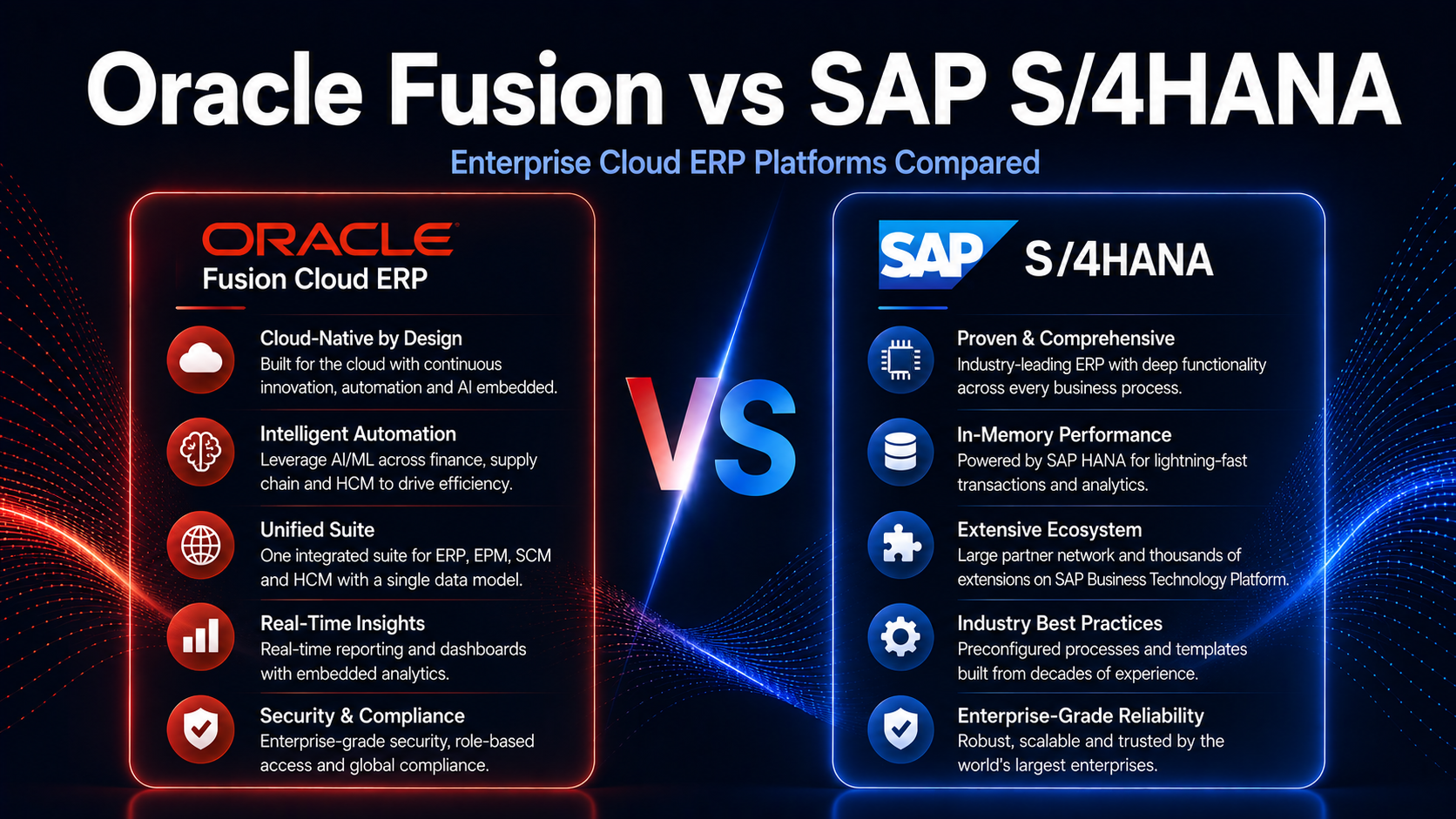
Oracle Fusion ERP (Oracle Cloud ERP) was built cloud-native from the beginning, giving it architectural advantages in deployment flexibility, update cadency, and integration with Oracle’s broader cloud platform including Oracle Analytics Cloud, Oracle AI, and Oracle HCM. The platform delivers comprehensive financial management—general ledger, accounts payable, accounts receivable, fixed assets, and project accounting—in a unified cloud environment.
Oracle Fusion’s continuous update model means organizations always run the latest version without major upgrade projects. Its integration with Oracle Analytics Cloud provides strong embedded analytics and reporting capabilities directly within the ERP environment. For enterprises already invested in Oracle infrastructure, Fusion ERP’s ecosystem integration is a significant advantage.
SAP S/4HANA Deep Dive
SAP S/4HANA: Platform Overview
SAP S/4HANA is the current generation of SAP’s flagship ERP, powered by the in-memory HANA database that dramatically improves processing speed and real-time analytics compared to earlier SAP versions. For enterprises running older SAP systems, S/4HANA migration is the natural progression path. SAP’s deep manufacturing, supply chain, and industry-specific vertical solutions remain unmatched in several sectors.
SAP’s industry solution depth—particularly in discrete manufacturing, automotive, oil and gas, retail, and consumer goods—reflects decades of vertical specialization. For organizations in these sectors, SAP’s pre-built industry content and large partner ecosystem of certified implementation firms make S/4HANA the default enterprise ERP evaluation.
Pricing Comparison
Oracle Fusion ERP vs SAP S/4HANA: Pricing
| Factor | Oracle Fusion ERP | SAP S/4HANA |
|---|---|---|
| Pricing Model | Subscription (cloud) | License + subscription (cloud/hybrid) |
| Enterprise Range | $500K–$5M+/year | $500K–$10M+/year |
| Implementation Cost | Very high (multi-year) | Very high (multi-year) |
| Total Cost of Ownership | High | Very high |
| Contract Length | Multi-year | Multi-year |
| Free Trial | Demo / POC available | Demo / POC available |
Integrations
Oracle Fusion ERP vs SAP S/4HANA: Integrations
| Integration | Oracle Fusion ERP | SAP S/4HANA |
|---|---|---|
| Oracle Analytics Cloud | ✓ Native seamless | Separate tool required |
| SAP Analytics Cloud | Separate tool required | ✓ Native seamless |
| Salesforce | ✓ Supported | ✓ Supported |
| Workday | Competitive overlap | Competitive overlap |
| Oracle HCM | ✓ Native | Not applicable |
| SAP SuccessFactors | Not applicable | ✓ Supported |
| Third-Party Middleware | ✓ Open APIs | ✓ SAP Integration Suite |
Decision Guide
Oracle Fusion ERP vs SAP S/4HANA: How to Choose
Final Verdict
Oracle Fusion ERP vs SAP S/4HANA: Final Verdict
Oracle Fusion ERP is the stronger choice for enterprises building cloud-native financial management with seamless analytics integration on Oracle infrastructure. Its cloud-native architecture, continuous updates, and Oracle HCM integration make it the preferred choice for finance-led ERP selections outside of heavy manufacturing.
SAP S/4HANA is the stronger choice for enterprises in manufacturing, retail, automotive, and consumer goods verticals, and for organizations with significant existing SAP investments. Its industry solution depth and global implementation partner ecosystem remain unmatched for complex industrial enterprises.
Oracle Fusion ERP for cloud-native financial management with Oracle ecosystem integration. SAP S/4HANA for manufacturing, supply chain complexity, and organizations migrating from existing SAP systems.