Pigment vs Vena (2026): Which FP&A Platform Is Best?
Pigment vs Vena (2026): Which FP&A Platform Is Best?
An independent head-to-head comparison of Pigment and Vena for financial planning and analysis in 2026. Covers planning approach, Excel integration, collaboration, reporting, pricing, and which platform fits your finance team.
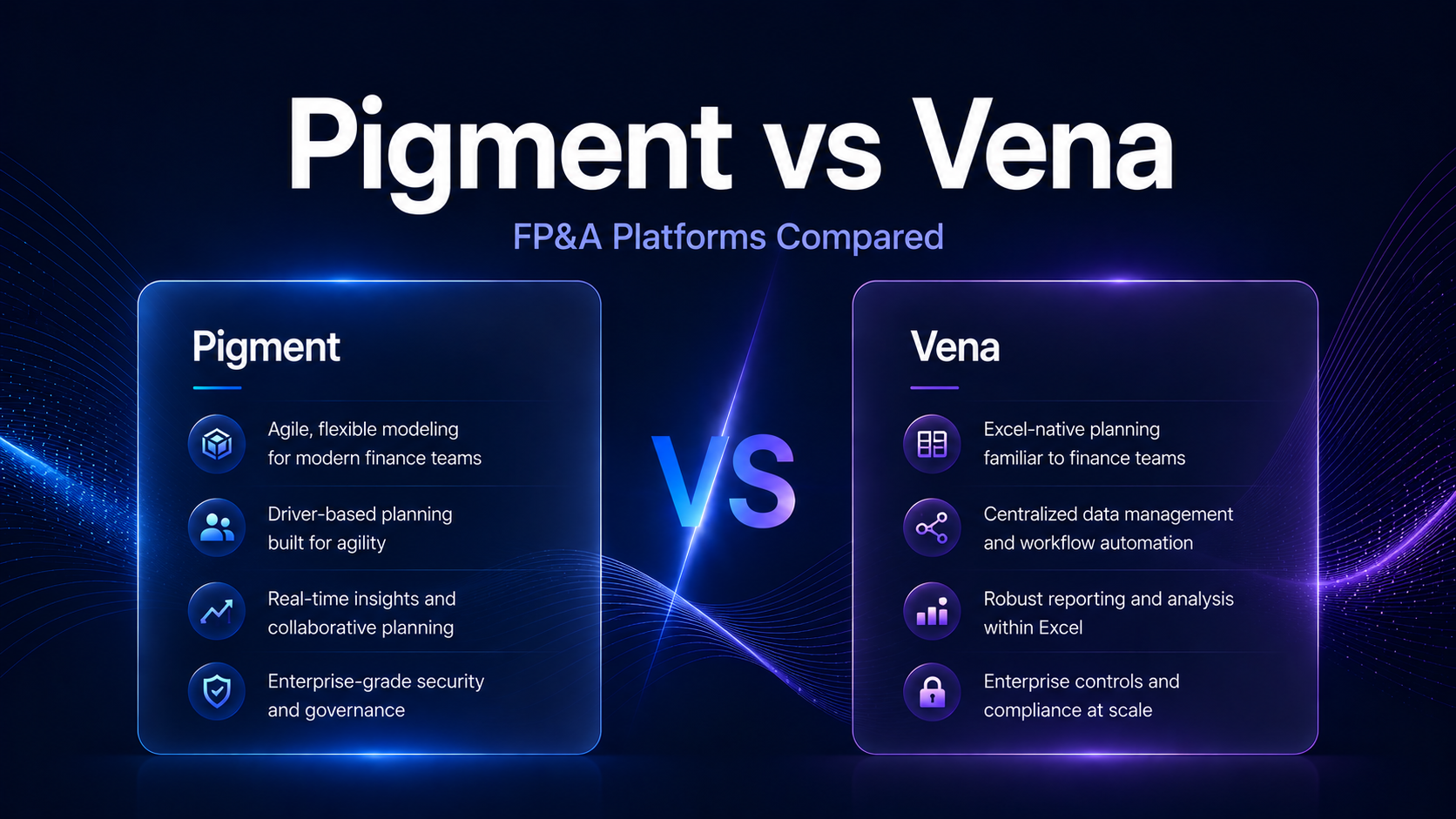
Pigment and Vena represent two fundamentally different philosophies about how FP&A software should work. Vena doubles down on Excel as the planning interface—bringing enterprise-grade data management and workflow behind the spreadsheet experience finance teams already know. Pigment replaces the spreadsheet entirely with a purpose-built visual planning environment. The right choice depends on how much your organization values Excel familiarity versus planning modernization.
FP&A leaders weighing Excel-first versus modern planning approaches. Finance teams evaluating Pigment vs Vena for a planning transformation initiative. CFOs trying to balance user adoption risk against planning capability upgrades.
Quick Verdict
Pigment vs Vena: Quick Verdict
| Category | Winner | Why |
|---|---|---|
| Planning Flexibility | Pigment | Block-based modeling adapts to any business structure |
| Excel Familiarity | Vena | Uses actual Excel as the planning interface |
| Scenario Modeling | Pigment | Superior multi-scenario visualization |
| Adoption Risk | Vena | Finance teams already know Excel |
| Data Integrity | Vena | Central database eliminates version control issues |
| User Experience | Pigment | Modern, visual, purpose-built planning environment |
| Collaboration | Pigment | Real-time cross-functional planning |
| Implementation Speed | Vena | Faster for Excel-fluent teams |
Side-by-Side Comparison
Pigment vs Vena: Feature Comparison
| Feature | Pigment | Vena |
|---|---|---|
| Planning Interface | Purpose-built visual environment | Native Excel interface |
| Budgeting & Forecasting | ✓ Flexible block-based | ✓ Excel templates + central DB |
| Scenario Modeling | ✓ Visual, multi-scenario | ✓ Supported |
| Workforce Planning | ✓ Deep headcount module | ✓ Supported |
| Financial Reporting | ✓ Good | ✓ Excel-based reports |
| Consolidation | Growing | ✓ Supported |
| Driver-Based Planning | ✓ Core design | ✓ Supported |
| Rolling Forecasts | ✓ Yes | ✓ Yes |
| Collaboration | ✓ Real-time | ✓ Workflow-managed |
| Audit Trail | ✓ Yes | ✓ Yes |
| AI Features | ✓ Growing | ✓ Vena Intelligence |
| ERP Integration | ✓ Major ERPs | ✓ Major ERPs |
| Mobile Access | ✓ Yes | Limited (Excel dependency) |
| Implementation Time | 2–4 months | 2–4 months |
Pigment Deep Dive
Pigment: Platform Overview
Pigment is a purpose-built planning platform that replaces the spreadsheet entirely. Its block-based modeling approach allows finance teams to construct planning models that mirror actual business logic—revenue drivers, headcount growth, cost assumptions—without conforming to spreadsheet row-and-column constraints. The result is planning models that are easier to build, easier to audit, and easier to explain to business partners.
Scenario modeling is where Pigment truly differentiates. Finance teams can maintain multiple active scenarios—base case, upside, downside, and custom variants—and visualize the financial implications side-by-side. This capability transforms board and executive conversations from static point estimates to dynamic range discussions.
Pigment’s collaboration model is designed for cross-functional planning—bringing sales, HR, and operations teams into the planning process through role-appropriate interfaces without requiring them to understand finance model construction. This is a significant advancement over traditional FP&A tools that treat planning as a finance-only exercise.
Vena Deep Dive
Vena: Platform Overview
Vena’s core insight is that finance teams are extraordinarily productive in Excel—and that the problem with spreadsheet-based planning isn’t the interface, it’s the data fragmentation and version control chaos. Vena solves this by keeping Excel as the front-end while replacing the email-driven data collection workflow with a centralized database, controlled templates, and automated consolidation.
In practice, Vena users plan in familiar Excel workbooks that connect to a central database. Changes are synchronized automatically, version control is managed by the platform, and workflow approvals route submissions through defined hierarchies. The result is that planning feels familiar to finance teams while delivering the data integrity and auditability that enterprises need.
Vena Intelligence, the platform’s AI layer, provides forecast recommendations and variance analysis within the Excel interface. This embedded approach means finance teams access AI-assisted insights without leaving their familiar working environment.
Pricing Comparison
Pigment vs Vena: Pricing
| Factor | Pigment | Vena |
|---|---|---|
| Pricing Model | Per-user / custom enterprise | Per-user / module-based |
| Typical Mid-Market Range | $60K–$150K/year | $50K–$120K/year |
| Enterprise Pricing | Custom contract | Custom contract |
| Implementation Cost | Moderate | Moderate |
| Contract Length | Annual or multi-year | Annual |
| Free Trial | Demo available | Demo available |
Integrations
Pigment vs Vena: Integrations
| Integration | Pigment | Vena |
|---|---|---|
| NetSuite | ✓ Native | ✓ Native |
| Salesforce | ✓ Native | ✓ Native |
| Workday | ✓ Native | ✓ Supported |
| SAP | ✓ Supported | ✓ Supported |
| Oracle ERP | ✓ Supported | ✓ Supported |
| Microsoft Dynamics | ✓ Supported | ✓ Native |
| HRIS Systems | ✓ Multiple connectors | ✓ Supported |
| Excel | ✓ Import/Export | ✓ Native interface |
| REST API | ✓ Available | ✓ Available |
Decision Guide
Pigment vs Vena: How to Choose
Final Verdict
Pigment vs Vena: Final Verdict
Pigment is the better planning platform for organizations willing to make a clean break from spreadsheet-based workflows. Its modeling flexibility, scenario visualization, and collaboration capabilities represent a genuine step forward in how FP&A teams operate. Finance teams that complete the transition consistently report faster cycle times and higher business partner engagement.
Vena is the better choice for organizations where Excel fluency is a cultural asset and change management risk is a meaningful constraint. By preserving the Excel interface while solving the data integrity and workflow problems that make spreadsheet planning painful, Vena delivers real value with minimal disruption. For organizations not ready to abandon Excel, Vena is the pragmatic answer.
Pigment for modern FP&A teams ready to move beyond Excel into a purpose-built planning environment. Vena for organizations that want enterprise planning infrastructure without changing the Excel interface their teams already know. Both deliver meaningful improvements over unmanaged spreadsheet planning.