Anaplan vs Pigment (2026): Which FP&A Platform Is Best?
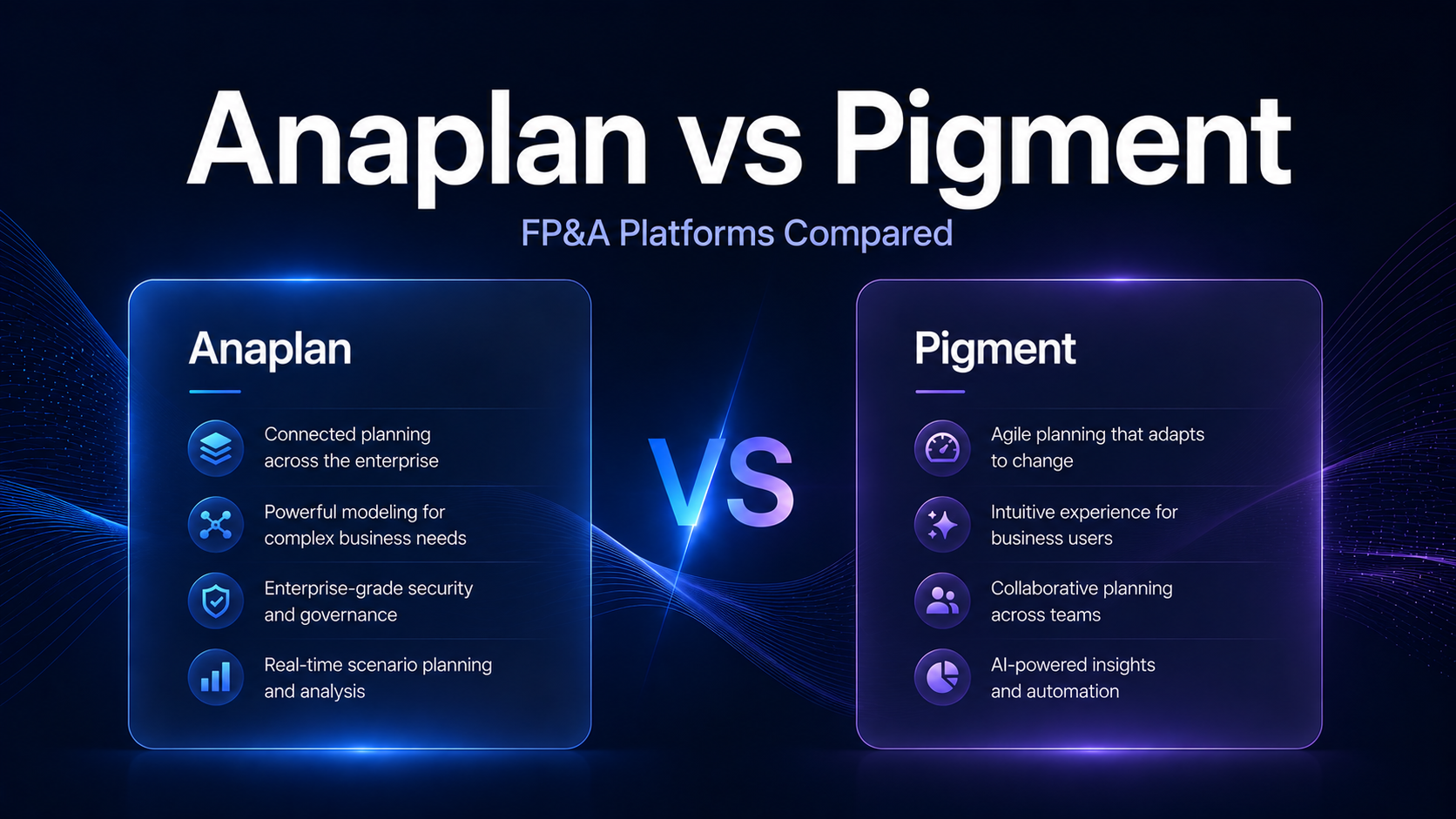
Anaplan vs Pigment (2026): Which FP&A Platform Is Best?
An independent, head-to-head evaluation of two leading FP&A platforms — reviewed across pricing, AI capabilities, scenario modeling, integrations, and total cost of ownership.
Anaplan and Pigment are two of the most frequently shortlisted FP&A platforms for companies that have outgrown spreadsheets and legacy planning tools. Both offer connected planning, scenario modeling, and cross-functional collaboration — but they differ significantly in implementation complexity, AI maturity, and target market. This guide tells you exactly which platform fits your business.
Quick Verdict
At a Glance: Which Platform Wins Each Category?
| Use Case | Winner | Why |
|---|---|---|
| Best for Enterprise | Anaplan | Hyperblock calculation engine handles billions of cells; purpose-built for large, complex enterprise planning with thousands of users and multi-dimensional models |
| Best for Mid-Market | Pigment | Faster implementation, more intuitive interface, and lower TCO make Pigment the better default for companies between $50M and $500M that need power without enterprise-grade complexity |
| Best for Scenario Planning | Anaplan | Anaplan’s multi-dimensional modeling and dynamic scenario comparison capabilities are the deepest in the market for complex, interconnected business scenarios |
| Best for Ease of Use | Pigment | Modern UI, faster time-to-value, and lower model-builder skill requirement give Pigment a clear usability advantage over Anaplan’s more technical platform |
| Best Overall | Depends on size | Pigment for companies under $500M prioritizing speed and usability; Anaplan for enterprise organizations requiring maximum modeling scale and global complexity |
Side-by-Side Comparison
Anaplan vs Pigment: Full Feature Comparison
| Criteria | Anaplan | Pigment |
|---|---|---|
| Company size | Mid-market to large enterprise (500–50,000+ employees) | Mid-market to upper mid-market (50–5,000+ employees) |
| Pricing model | Subscription; workspace-based pricing; custom enterprise contracts | Subscription; user-based pricing; more transparent than Anaplan |
| Budgeting | Highly configurable multi-dimensional budgeting; handles complex hierarchies and cost center structures | Intuitive budgeting with strong collaboration; slightly less flexible for very large hierarchies |
| Forecasting | Rolling forecasts, driver-based models, and real-time actuals integration; enterprise-grade scale | Rolling forecasts and driver-based planning; fast model iteration; strong for mid-market complexity |
| Scenario modeling | Best-in-class multi-dimensional scenario modeling; unlimited versions; dynamic what-if analysis | Strong scenario planning with visual comparison; excellent UI; slightly less scale than Anaplan |
| Driver-based planning | Deep driver-based modeling with complex formula support (Anaplan Modeling Language) | Driver-based planning with intuitive formula builder; lower technical barrier |
| Workforce planning | Full workforce planning module; headcount, compensation, and org structure modeling at enterprise scale | Workforce planning available; well-suited for mid-market headcount and compensation modeling |
| Collaboration | Multi-user collaboration with role-based access; suitable for thousands of concurrent users | Modern collaboration with comments, mentions, and real-time co-editing; strong for cross-functional use |
| AI capabilities | PlanIQ: ML-based forecasting; anomaly detection; predictive insights integrated into planning workflows | Pigment AI: scenario suggestions, automated anomaly detection, and AI-assisted model building |
| Reporting | Highly flexible reporting and dashboards; strong for board and management reporting at scale | Modern, visually strong dashboards; excellent for business partner self-service reporting |
| ERP integrations | NetSuite, SAP, Oracle, Workday, Salesforce (native); 200+ connectors via integration partners | NetSuite, SAP, Salesforce, Workday, HubSpot (native); growing connector library |
| Ease of implementation | 6–18 months typical; requires certified implementation partner; high technical complexity | 2–6 months typical; partner-assisted or self-service; significantly lower implementation burden |
| Strengths | Modeling scale, enterprise depth, scenario complexity, established partner ecosystem | Ease of use, faster implementation, modern UI, lower TCO, strong mid-market fit |
| Weaknesses | High implementation cost, steep learning curve, expensive at lower volumes, dated UX | Less proven at very large enterprise scale; smaller partner ecosystem than Anaplan |
Anaplan Deep Dive
Anaplan Strengths
Anaplan‘s defining technical advantage is its Hyperblock calculation engine. Unlike spreadsheet-based tools or conventional database planning systems, Hyperblock handles multi-dimensional models with billions of data cells at interactive speed. For large enterprises modeling across thousands of cost centers, hundreds of product lines, and dozens of geographies simultaneously, this calculation scale is genuinely irreplaceable. No other planning platform in the mid-market or enterprise space offers comparable raw modeling power.
Anaplan’s connected planning philosophy — the idea that finance, sales, supply chain, HR, and operations should plan on a single shared data model — is more fully realized than in any competing platform. The Anaplan ecosystem supports deep integration between financial planning, headcount planning, revenue planning, and supply chain planning, with shared assumptions and real-time knock-on effects when any input changes. For enterprises that have historically managed planning in silos, this integration is transformative.
The Anaplan partner ecosystem is the deepest in the planning platform market. Hundreds of certified implementation partners — including Deloitte, KPMG, Accenture, and PwC — have built practices around Anaplan deployment. This means large organizations can find qualified implementation resources globally, and the platform is well-understood by the consulting firms that advise large enterprises on finance transformation. For organizations that rely on Big Four advisory relationships, Anaplan’s partner depth is a practical advantage.
Anaplan’s scenario modeling capabilities are best-in-class for enterprise complexity. The platform supports unlimited scenario versions, dynamic what-if analysis across interconnected models, and multi-dimensional sensitivity analysis that surfaced business drivers in ways that simpler planning tools cannot replicate. For CFOs and FP&A teams that need to present a rigorous range of outcomes to boards and investors, Anaplan’s scenario depth is a genuine strategic asset.
Anaplan Weaknesses
Anaplan’s implementation complexity is its most significant drawback. Deploying Anaplan for a mid-size enterprise typically takes 6 to 12 months with a certified implementation partner. Large, multi-module deployments can run 12 to 18 months and cost more than $1M in professional services. For finance leaders who need a planning platform live within a quarter or a fiscal year, Anaplan’s implementation runway is a serious constraint.
The Anaplan Modeling Language (AML) creates a technical dependency that most FP&A teams cannot manage internally. Building and maintaining complex Anaplan models requires trained model builders — a skill set that is expensive to hire and difficult to retain. Many Anaplan customers find themselves dependent on their implementation partner for ongoing model changes, which drives up total cost of ownership beyond the subscription fee.
Anaplan’s user interface, while functional, carries the design decisions of a platform built over 20 years ago. The planning canvas and end-user experience are less intuitive than newer competitors including Pigment. Business partners and budget owners who interact with Anaplan infrequently often find the interface confusing, which drives lower adoption rates and heavier IT and FP&A team support burden.
Anaplan’s pricing is opaque and typically higher than alternatives for equivalent functionality at mid-market scale. Workspace-based pricing makes cost projections difficult, and enterprise contract negotiations are complex. Companies that model Anaplan’s 3-year TCO — including implementation, licensing, and ongoing model maintenance — often find that Pigment delivers comparable functionality at meaningfully lower total cost for organizations below enterprise scale.
Pigment Deep Dive
Pigment Strengths
Pigment was built from the ground up with the user experience as a first-order design concern. The platform’s visual interface — featuring intuitive board layouts, drag-and-drop modeling, and modern collaborative features including comments, mentions, and real-time co-editing — dramatically reduces the training burden compared to Anaplan. Finance teams report that business partners and department heads adopt Pigment quickly, which drives more accurate bottom-up input and better planning participation across the organization.
Pigment’s implementation timeline is a major competitive advantage. Most mid-market companies are live on Pigment within 2 to 4 months — a fraction of Anaplan’s typical deployment timeline. This speed derives from Pigment’s template library, which provides pre-built planning models for P&L, headcount, revenue, and OpEx that teams can adapt rather than build from scratch. The reduced implementation time directly lowers professional services cost, which is frequently the largest line item in FP&A platform TCO.
Pigment’s formula engine is powerful and accessible. Unlike Anaplan’s proprietary AML, Pigment’s formula language is intuitive for users with Excel or SQL backgrounds, reducing the model builder skill barrier significantly. FP&A teams can build and iterate models without specialized certifications, which reduces external dependency and allows finance teams to own their planning infrastructure internally.
Pigment’s AI capabilities are well-integrated into the planning workflow. The platform’s AI assists with scenario generation, flags anomalies in actuals versus plan, and provides natural-language interfaces for querying planning data. For mid-market FP&A teams that want AI to accelerate analysis without requiring dedicated data science resources, Pigment’s AI integration is practical and immediately useful.
Pigment Weaknesses
Pigment’s most significant limitation is its track record at the very top of the enterprise market. Anaplan has thousands of enterprise deployments across Fortune 500 companies and has proven its modeling engine at extreme scale. Pigment, founded in 2019, has not yet accumulated the same depth of very large, complex enterprise deployments. Organizations with genuinely extreme planning complexity — tens of thousands of users, hundreds of millions of data rows, and highly customized multi-dimensional models — should evaluate Pigment’s reference customers carefully against their own requirements.
Pigment’s partner ecosystem, while growing, is smaller than Anaplan’s. Companies that rely on Big Four consulting firms for finance transformation advisory and require those firms to lead the implementation may find fewer Pigment-certified resources available compared to the deep Anaplan practices at Deloitte, KPMG, and Accenture. This is less of a concern for mid-market companies doing self-directed or boutique-partner implementations, but matters for large enterprise procurement processes.
Pigment’s connector library, while covering the most common ERP and CRM integrations, is smaller than Anaplan’s 200+ connector ecosystem. Companies with unusual ERP configurations, legacy data sources, or complex data pipeline requirements may find Pigment’s out-of-the-box integration coverage insufficient, requiring custom API work that offsets some of the implementation speed advantage.
Pricing Comparison
Anaplan vs Pigment: Pricing
| Pricing Factor | Anaplan | Pigment |
|---|---|---|
| Pricing model | Workspace-based; custom enterprise contracts | User-based subscription; more transparent tiers |
| Starting price | Typically $30,000–$80,000+/year for small deployments | Typically $20,000–$50,000/year for mid-market entry |
| Mid-market cost | $100,000–$300,000+/year for 50–200 users | $50,000–$150,000/year for 50–200 users |
| Enterprise cost | $300,000–$2M+/year; custom; multi-year commitments | $150,000–$800,000+/year; custom enterprise pricing |
| Implementation cost | $150,000–$1M+ for mid-market; $1M–$5M+ for enterprise | $30,000–$200,000 for mid-market; partner-assisted |
| Ongoing model maintenance | High; typically requires retained partner or dedicated AML resource | Lower; FP&A teams can manage most changes internally |
| 3-year TCO (mid-market, 100 users) | $800,000–$2M+ all-in | $250,000–$600,000 all-in |
| Free trial | Not typically available; demo-driven sales process | Sandbox/demo available; self-service evaluation supported |
AI Capabilities Comparison
Anaplan vs Pigment: AI Capabilities Compared
Both platforms have made significant AI investments, but their approaches differ. Anaplan’s PlanIQ focuses on ML-based demand and revenue forecasting integrated into planning workflows. Pigment’s AI layer is broader, covering scenario generation, anomaly detection, and natural-language interfaces for planning data.
| AI Feature | Anaplan | Pigment |
|---|---|---|
| Statistical forecasting | PlanIQ: ML-based forecasting with multiple algorithm selection and accuracy scoring | AI-assisted forecasting with trend detection and seasonality adjustment |
| Anomaly detection | AI-driven anomaly flagging within plan vs. actuals variance | Automated anomaly detection with contextual alerts |
| Scenario generation | Manual scenario building with AI-assisted sensitivity analysis | AI can suggest scenario parameters based on historical drivers |
| Natural language interface | Limited; primarily formula and model-driven interaction | Natural language queries for planning data exploration |
| Model building assistance | Not available; requires AML expertise | AI assists with formula suggestions and model structure recommendations |
| Driver identification | AI-assisted identification of key revenue and cost drivers | AI-driven driver analysis with visual correlation mapping |
| Forecast accuracy improvement | PlanIQ demonstrates measurable forecast accuracy improvement on structured data sets | AI forecasting competitive for most mid-market use cases |
| Integration with planning workflow | PlanIQ integrated into connected planning models; feeds into planning assumptions | AI deeply embedded in planning UI; accessible to all users without technical expertise |
Integrations Comparison
Anaplan vs Pigment: Integration Ecosystem
Integration quality is a critical factor in FP&A platform selection. A planning tool is only as useful as the data flowing into it — poor ERP or CRM integration means planning on stale or incomplete data, which undermines the platform’s core value proposition.
| Integration | Anaplan | Pigment |
|---|---|---|
| NetSuite | Native integration; well-established connector | Native integration; strong for mid-market NetSuite customers |
| SAP S/4HANA | Native integration; enterprise-grade SAP connector | Native integration available; growing maturity |
| Oracle | Native Oracle ERP Cloud and Oracle EBS connectors | Available via API; less mature than Anaplan’s Oracle connector |
| Workday | Native Workday Financials and HCM integration | Native Workday integration; strong for headcount planning |
| Salesforce | Native Salesforce integration; widely used for revenue planning | Native Salesforce integration; well-suited for revenue planning |
| HubSpot | Via middleware or API | Native HubSpot integration; useful for revenue planning in HubSpot shops |
| Data warehouses | Snowflake, Databricks, BigQuery (via connectors) | Snowflake, BigQuery, Databricks (native); strong modern data stack support |
| Open API | REST API; well-documented; extensive partner integrations | REST API; well-documented; growing ecosystem |
| Total connectors | 200+ via Anaplan App Hub and integration partners | Growing library; covers most common mid-market stacks |
Decision Guide
Which Platform Should You Choose?
The right platform depends on your company’s size, planning complexity, tech stack, implementation capacity, and total cost tolerance. Here is the decision framework:
Choose Pigment for Mid-Market Companies
If you are a company between $50M and $500M in revenue with a finance team of 2–10 FP&A professionals, Pigment is the stronger default. The platform delivers enterprise-grade scenario modeling, driver-based planning, and cross-functional collaboration at lower cost and faster implementation than Anaplan. Most mid-market FP&A needs — annual budgeting, rolling forecasts, headcount planning, and board reporting — are well within Pigment’s capability set. Start with Pigment and revisit at the $1B+ revenue milestone if complexity outgrows the platform.
Choose Anaplan for Enterprise Organizations
If you are a company above $1B in revenue with a large, distributed FP&A function, thousands of planning users, and highly complex multi-dimensional models spanning finance, sales, supply chain, and HR, Anaplan is the right investment. The Hyperblock engine, deep partner ecosystem, and proven enterprise track record justify the higher TCO for organizations where planning complexity is genuinely a competitive variable. Engage a certified implementation partner early and budget for a 9–18 month deployment timeline.
Choose Anaplan for Complex Scenario Planning
If your planning process requires highly complex, interconnected scenario models — multiple simultaneous what-if analyses across dozens of business drivers, with real-time knock-on effects across financial statements, workforce plans, and operational models — Anaplan’s scenario depth is unmatched. CFOs who need to present a rigorous, multi-dimensional view of business risk and opportunity to boards or private equity owners will find Anaplan’s scenario modeling capabilities more powerful than Pigment’s for the most demanding use cases.
Choose Pigment for Cross-Functional Planning
If your primary goal is to extend planning beyond the finance team to include sales, marketing, HR, and operations as active contributors, Pigment’s modern collaboration features, intuitive interface, and low learning curve give it the advantage. Anaplan can support cross-functional planning, but its complexity often limits genuine adoption outside of the FP&A team. Pigment’s design makes it practical for department heads and business partners to own their planning inputs directly, which drives more accurate plans and less manual aggregation by the finance team.
Choose Pigment for Fast-Growing Businesses
If you are a high-growth company — Series C+, PE-backed, or scaling rapidly through acquisition — that needs a planning platform live before the next budget cycle, Pigment’s 2–4 month implementation timeline is a decisive advantage. Anaplan’s 6–18 month deployment timeline is incompatible with the planning cadence of fast-moving organizations. Pigment’s template library and self-service onboarding mean you can be running meaningful planning models within weeks of signing, not months.
Final Verdict
Final Verdict: Anaplan vs Pigment
Anaplan and Pigment are both serious FP&A platforms — but they are optimized for different buyer profiles. The wrong choice creates either an under-powered planning environment or a multi-million-dollar implementation that never fully delivers on its promise.
Choose Anaplan if you are a large enterprise with genuinely complex, multi-dimensional planning needs, thousands of planning users, and the implementation budget and timeline to deploy a best-in-class planning engine with a certified partner. Anaplan’s Hyperblock engine, connected planning architecture, and deep partner ecosystem make it the most capable planning platform in the market for organizations where planning complexity is extreme.
Choose Pigment if you are a mid-market or growth-stage company that needs enterprise-grade planning capabilities with faster time-to-value, a modern user experience, and meaningfully lower total cost of ownership. Pigment delivers most of what Anaplan offers for companies under $500M in revenue, at a fraction of the implementation cost and complexity. Its AI capabilities, collaboration features, and intuitive interface make it the better default for the majority of FP&A platform buyers today.
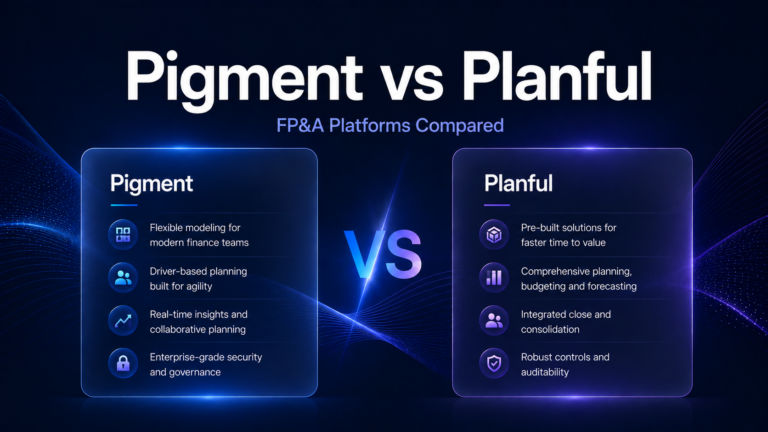
For a broader view of the full FP&A platform market — including Workday Adaptive Planning, OneStream, Vena, and Planful — see our Best FP&A Software guide. Also compare Pigment vs Vena and Pigment vs Planful. Teams evaluating broader FP&A options may also consider the Board review, Vena review, and OneStream review.