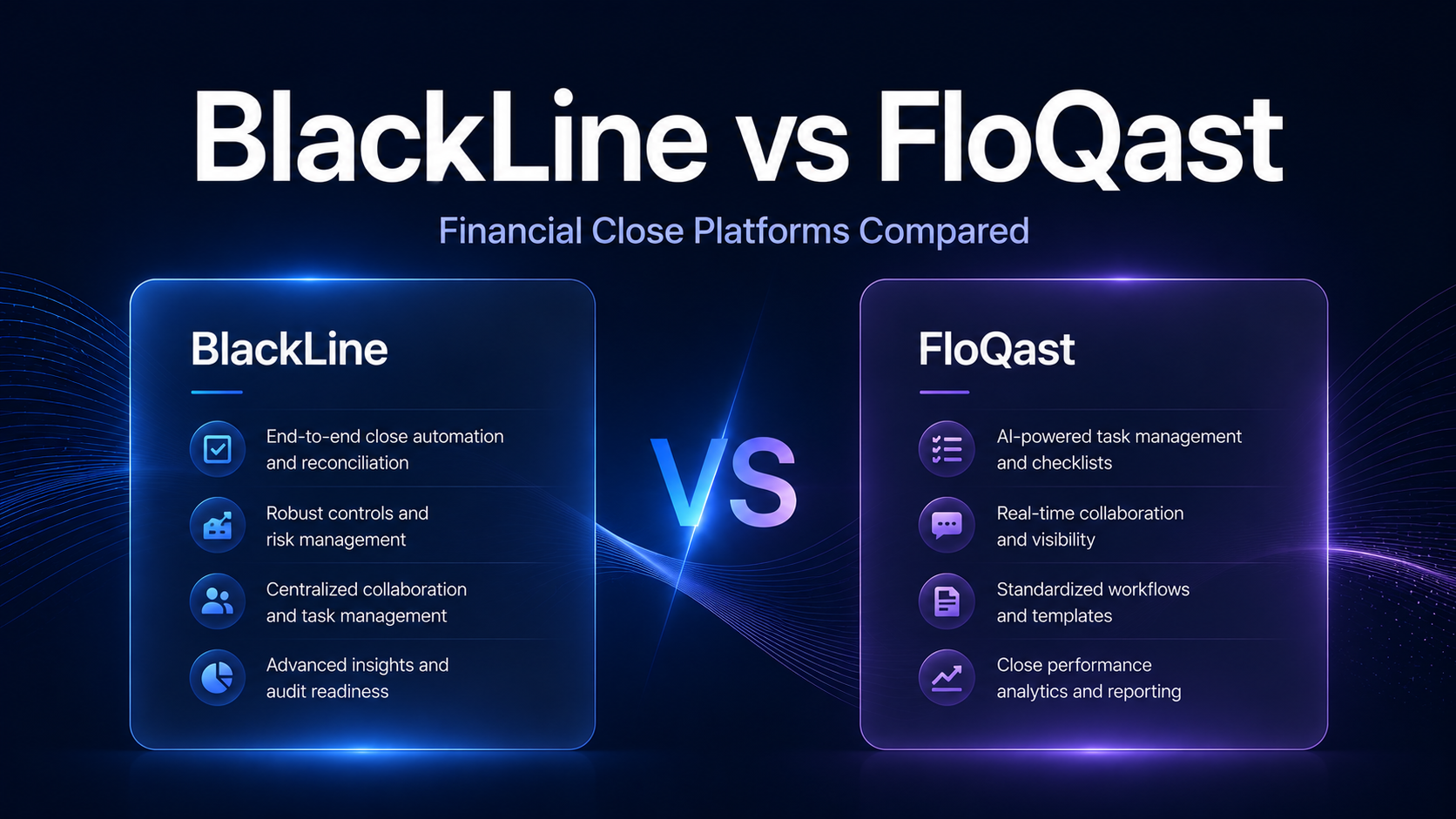
BlackLine vs FloQast (2026): Which Financial Close Platform Is Best?
BlackLine vs FloQast (2026): Which Financial Close Platform Is Best?
An independent, head-to-head evaluation of two leading financial close platforms — reviewed across account reconciliations, close management, AI capabilities, ERP integrations, and total cost of ownership.
BlackLine and FloQast are the two most frequently shortlisted financial close platforms for accounting teams that have outgrown manual spreadsheet-based close processes. Both automate account reconciliations, close task management, and journal entry workflows — but they differ substantially in implementation complexity, target market, and the breadth of close automation they provide. This guide tells you exactly which platform fits your team.
Quick Verdict
At a Glance: Which Platform Wins Each Category?
| Use Case | Winner | Why |
|---|---|---|
| Best for Enterprise | BlackLine | Full-suite close automation with journal entry management, intercompany hub, and deep SAP/Oracle integration built for global enterprise accounting operations |
| Best for Mid-Market | FloQast | Faster implementation, intuitive interface, and native integration with existing Excel workflows make FloQast the better default for accounting teams under 30 people |
| Best for Ease of Use | FloQast | Modern UI designed for accountants, not IT administrators; teams are productive within days of going live with minimal training overhead |
| Best for Global Organizations | BlackLine | Multi-entity, multi-currency reconciliation; intercompany financial hub; and enterprise-grade controls built for multinational accounting operations |
| Best Overall | Depends on size | FloQast for companies under $500M prioritizing speed and simplicity; BlackLine for enterprises requiring full-suite close automation at global scale |
Side-by-Side Comparison
BlackLine vs FloQast: Full Feature Comparison
| Criteria | BlackLine | FloQast |
|---|---|---|
| Company size | Mid-market to large enterprise (200–50,000+ employees) | SMB to mid-market (20–2,000+ employees) |
| Pricing model | Subscription; module-based; custom enterprise contracts | Subscription; user-based pricing; more predictable at mid-market scale |
| Account reconciliations | Automated reconciliation with match confidence scoring, risk-based prioritization, and full audit trail | Reconciliation management with Excel-native integration; strong for teams already working in Excel |
| Close management | Full close task management with role-based assignments, status dashboards, and real-time close progress tracking | Close checklist and task management with Slack and Teams integration; excellent visibility for accounting managers |
| Task workflows | Configurable task workflows with approval chains, escalation rules, and SOX-compliant audit trails | Intuitive task management with comments, attachments, and reviewer sign-off; lower configuration burden |
| Journal entries | Automated journal entry preparation, review, and posting with ERP integration; supports complex multi-entity JE workflows | Journal entry management available; adequate for mid-market complexity; less native automation than BlackLine |
| Compliance support | SOX, IFRS, and GAAP compliance automation; evidence collection; control attestation built into the platform | SOX compliance support with sign-off workflows and audit evidence collection; well-suited for mid-market compliance requirements |
| Audit readiness | Audit-ready documentation automatically generated; external auditor access portal; real-time audit trail | Audit-ready close packages with evidence linking; auditor collaboration tools; strong for annual audit support |
| ERP integrations | SAP (best-in-class), Oracle, NetSuite, Workday, Microsoft Dynamics (native); 200+ connectors | NetSuite, QuickBooks, Sage Intacct, Microsoft Dynamics, Oracle, SAP (native); strong mid-market ERP coverage |
| AI capabilities | AI-powered transaction matching, anomaly detection, risk scoring, and predictive close insights | AI-assisted anomaly flagging, automated reconciliation suggestions, and close pattern recognition |
| Reporting | Real-time close dashboards, management reporting, compliance reporting, and multi-entity consolidation views | Close status dashboards, manager reporting, and team productivity metrics; strong for close-cycle visibility |
| Ease of implementation | 4–12 months typical; requires implementation partner; complex for full-suite deployments | 4–8 weeks typical; self-service or partner-assisted; significantly lower implementation burden |
| Strengths | Enterprise scale, full close automation suite, SAP/Oracle depth, compliance rigor, global multi-entity support | Ease of use, fast implementation, Excel-native design, Slack/Teams integration, lower TCO |
| Weaknesses | High implementation cost, complex for smaller teams, steeper learning curve, expensive at mid-market scale | Less capable for very large enterprise complexity; journal entry automation less mature than BlackLine |
BlackLine Deep Dive
BlackLine Strengths
BlackLine is the most comprehensive financial close automation platform in the market. Unlike point solutions that address one part of the close, BlackLine covers the full close cycle: account reconciliations, journal entry management, task and workflow automation, intercompany financial processing, and compliance documentation. For controllers at large organizations who want to consolidate multiple close tools into a single platform, BlackLine’s breadth is a genuine strategic advantage.
BlackLine’s SAP integration is best-in-class. As a certified SAP partner with a native connector built over many years, BlackLine’s integration with SAP S/4HANA pulls transaction data, balances, and journal entries in real time — eliminating the manual extract-and-load process that plagues most finance teams on SAP. For the large installed base of SAP customers, this integration depth is frequently the decisive factor in BlackLine selection. Oracle integration is comparably strong, making BlackLine the natural choice for enterprises on the two dominant enterprise ERP platforms.
BlackLine’s compliance automation is built for audit-heavy environments. The platform automatically generates audit-ready documentation as a byproduct of normal close workflows — not as a separate reporting task. SOX controls, attestations, and evidence packages are assembled in real time, and external auditors can access a dedicated portal to review evidence without burdening the accounting team with document assembly. For public companies, PE-backed businesses preparing for exit, and organizations under regulatory scrutiny, BlackLine’s compliance infrastructure is materially valuable.
BlackLine’s intercompany financial hub is a capability with no direct equivalent in FloQast. For multinational organizations managing intercompany transactions across dozens of entities and currencies, BlackLine’s intercompany module automates the matching, netting, and settlement of intercompany balances that would otherwise require days of manual coordination. This capability alone frequently justifies the BlackLine investment for organizations with complex intercompany structures.
BlackLine Weaknesses
BlackLine’s implementation complexity is its most frequently cited limitation. A mid-market deployment covering reconciliations and close management typically takes 4 to 6 months with a certified implementation partner. A full-suite enterprise deployment — adding journal entries, intercompany, and compliance modules — can take 9 to 12 months and cost $200K–$500K or more in professional services before any accounting efficiency is realized. For controllers who need the close process improved before the next fiscal year end, this timeline creates real operational risk.
BlackLine’s platform complexity creates an ongoing administrative burden. Unlike FloQast, which accounting managers can largely self-administer, BlackLine requires a dedicated system administrator or retained implementation partner to manage configuration changes, user provisioning, and template updates. For smaller accounting teams, this dependency adds headcount or consulting cost that offsets some of the efficiency gains the platform delivers.
BlackLine’s user experience, while functional, carries the weight of a platform built incrementally over two decades. End users — particularly staff accountants who interact with the platform monthly or quarterly — often find the interface less intuitive than newer close tools. This drives higher training costs and slower adoption at the account preparer level, which can limit the percentage of close tasks that are genuinely managed through the platform versus reverted to offline spreadsheets.
BlackLine’s pricing is opaque and typically high for companies under $200M in revenue. The module-based pricing model makes it difficult to get a reliable total cost estimate before deep sales engagement, and smaller companies often find that the minimum viable BlackLine deployment costs more than their close complexity warrants. The TCO gap versus FloQast is most pronounced in the $50M–$300M revenue range.
FloQast Deep Dive
FloQast Strengths
FloQast was designed by accountants for accountants, and this origin is evident in every aspect of the platform’s design. Rather than requiring teams to abandon Excel-based workflows entirely, FloQast integrates natively with Excel — reconciliations link directly to workpapers in Excel, and the platform tracks completion status, reviewer sign-offs, and variance explanations without forcing accountants to re-enter data into a separate system. For the vast majority of mid-market accounting teams that will continue using Excel as their primary workpaper tool for years to come, FloQast’s Excel-native approach dramatically reduces adoption friction.
FloQast’s implementation timeline is a decisive advantage for teams that need to improve the close quickly. Most accounting teams are fully live on FloQast within 4 to 8 weeks — including configuration, training, and first-close support. This is achievable through a largely self-service implementation that does not require a certified external partner. The speed of deployment means that teams can typically see close cycle improvement within 60 to 90 days of signing, which is materially different from BlackLine’s multi-month implementation runway.
FloQast’s Slack and Microsoft Teams integration is genuinely differentiated for modern accounting teams. Close status notifications, task completions, review requests, and escalations flow directly into the communication tools that accounting teams already use. This eliminates the context-switching between the close platform and communication tools that adds friction in traditional close workflows. Managers get real-time close visibility in their Slack workspace without logging into a separate application.
FloQast’s close analytics provide strong operational visibility for accounting managers. The platform tracks close cycle time by task, by preparer, and by entity — giving controllers the data to identify bottlenecks, benchmark performance across periods, and build the case for additional resources or process changes. For teams that have historically managed the close through shared spreadsheets and email, FloQast’s visibility layer is immediately valuable.
FloQast Weaknesses
FloQast’s journal entry automation is less mature than BlackLine’s. While FloQast manages journal entry tasks and sign-off workflows, it does not provide the automated JE preparation, population, and ERP posting that BlackLine delivers for large-volume journal entry environments. For enterprise accounting teams processing thousands of journal entries per period, FloQast’s JE capabilities create workflow gaps that require supplemental tooling or manual processes to fill.
FloQast does not offer a native intercompany financial hub. Organizations with complex intercompany transaction structures — multiple legal entities, intercompany loans, shared services allocations, or cross-border transactions requiring netting and settlement — will find FloQast’s intercompany capabilities insufficient. For these organizations, BlackLine’s intercompany module or a dedicated intercompany solution is required.
FloQast’s scale ceiling, while higher than it once was, remains lower than BlackLine’s for the most complex global enterprises. Very large organizations with hundreds of entities, thousands of reconciliations, and deeply customized ERP configurations may find that FloQast’s architecture imposes constraints that do not exist in BlackLine. This is less relevant for mid-market buyers but should be evaluated carefully by organizations above $1B in revenue with complex multi-entity structures.
Pricing Comparison
BlackLine vs FloQast: Pricing
| Pricing Factor | BlackLine | FloQast |
|---|---|---|
| Pricing model | Module-based subscription; custom enterprise contracts | User-based subscription; more transparent mid-market pricing |
| Starting price | Typically $40,000–$80,000+/year for entry-level deployments | Typically $20,000–$40,000/year for small team deployments |
| Mid-market cost (15 users) | $80,000–$150,000+/year depending on modules | $40,000–$80,000/year all-in |
| Enterprise cost | $200,000–$1M+/year; custom multi-year contracts | $100,000–$400,000+/year; custom enterprise pricing |
| Implementation cost | $75,000–$500,000+ depending on scope and partner | $10,000–$50,000; often self-service or lightweight partner engagement |
| Ongoing admin burden | High; typically requires dedicated admin or retained partner | Low; accounting managers can self-administer most configuration |
| 3-year TCO (15-person team) | $400,000–$1M+ all-in | $150,000–$300,000 all-in |
| Free trial | Not typically available; demo-driven sales process | Demo available; guided trial supported |
AI Capabilities Comparison
BlackLine vs FloQast: AI Capabilities Compared
Both platforms have invested in AI for the close, but BlackLine’s AI capabilities are deeper and more mature — particularly in transaction matching, risk scoring, and anomaly detection at enterprise data volumes. FloQast’s AI is more focused on surface-level automation that delivers immediate value for mid-market teams without requiring configuration.
| AI Feature | BlackLine | FloQast |
|---|---|---|
| Transaction matching | AI-powered automated transaction matching with configurable match rules and confidence scoring | Automated matching available; less sophisticated rule engine than BlackLine |
| Anomaly detection | ML-based anomaly detection on reconciliation balances, journal entries, and close tasks | AI-assisted anomaly flagging on reconciliation variances |
| Risk scoring | AI-driven risk scoring prioritizes which reconciliations need human review; reduces unnecessary review burden | Risk-based prioritization available; adequate for mid-market close complexity |
| Close insights | Predictive close insights: estimated close completion time, bottleneck identification, capacity forecasting | Close analytics with performance benchmarking and trend identification |
| Reconciliation suggestions | AI suggests reconciliation explanations and prior-period comparisons | AI-assisted reconciliation notes and variance explanations |
| Journal entry AI | AI-assisted JE preparation, coding suggestions, and error detection | Basic JE workflow support; limited AI on JE preparation |
| Natural language interface | Limited; primarily workflow and dashboard-driven interaction | Conversational close status queries in development |
| Touchless reconciliation rate | ~60–80% on low-risk reconciliations with clean data | ~50–70% on standard reconciliations |
Integrations Comparison
BlackLine vs FloQast: Integration Ecosystem
ERP integration quality is the single most important technical factor in financial close platform selection. A close tool that cannot reliably pull balances and transactions from the general ledger forces manual data entry, which undermines the automation value proposition entirely.
| Integration | BlackLine | FloQast |
|---|---|---|
| SAP S/4HANA | Best-in-class; certified SAP partner; native real-time connector | Native integration available; adequate for standard SAP deployments |
| Oracle ERP Cloud | Native integration; strong Oracle customer base | Native integration; covers most Oracle ERP Cloud use cases |
| Oracle EBS | Native connector for legacy Oracle EBS environments | Available; coverage varies by EBS version |
| NetSuite | Native integration; widely deployed | Native integration; strong for mid-market NetSuite customers |
| Sage Intacct | Available via connector | Native integration; well-suited for mid-market Intacct customers |
| QuickBooks | Limited; BlackLine is not optimized for QuickBooks environments | Native integration; strong for SMB and lower mid-market QB customers |
| Microsoft Dynamics 365 | Native integration | Native integration |
| Workday Financials | Native Workday integration | Native Workday integration |
| Slack / Teams | Available; workflow notifications | Deep native integration; close tasks and alerts surface directly in Slack and Teams |
| Total connectors | 200+ via BlackLine and partner connectors | Growing connector library; covers all major mid-market ERP stacks |
Decision Guide
Which Platform Should You Choose?
The right platform depends on your organization’s size, close complexity, ERP landscape, implementation capacity, and total cost tolerance. Here is the decision framework:
Choose FloQast for Mid-Market Companies
If you are a company between $50M and $500M in revenue with an accounting team of 3–20 people, FloQast is the stronger default. The platform delivers structured close management, reconciliation automation, and audit-ready documentation at lower cost and faster implementation than BlackLine. Most mid-market close needs — monthly reconciliations, close checklists, reviewer sign-offs, and audit evidence packages — are well within FloQast’s capability set. The Excel-native design means your team can adopt the platform without abandoning the workpaper workflows they already know.
Choose BlackLine for Enterprise Organizations
If you are a company above $500M in revenue with a large, distributed accounting function, thousands of reconciliations, and complex journal entry workflows on SAP or Oracle, BlackLine is the right investment. The full-suite close automation, best-in-class SAP integration, and intercompany financial hub justify the higher TCO for organizations where close complexity is genuinely enterprise-grade. Engage a certified implementation partner early and budget for a 6–12 month deployment timeline.
Choose BlackLine for Complex Close Processes
If your close involves highly complex workflows — multi-step journal entry approvals across dozens of entities, complex intercompany netting across currencies, or SOX control attestations across hundreds of control owners — BlackLine’s depth is unmatched. FloQast handles mid-market close complexity well, but for the most demanding close automation use cases, BlackLine’s platform breadth, compliance infrastructure, and journal entry capabilities provide capabilities that FloQast does not replicate.
Choose BlackLine for Multi-Entity Environments
If you operate multiple legal entities with intercompany transactions, shared services, or cross-border consolidation requirements, BlackLine’s intercompany financial hub provides automation that FloQast does not offer natively. The intercompany module automates matching, netting, and settlement of intercompany balances — eliminating the manual coordination between entity accounting teams that is one of the most time-consuming and error-prone parts of the enterprise close.
Choose BlackLine for Audit-Heavy Organizations
If you are a public company, a PE-backed business preparing for exit, or an organization subject to heavy regulatory audit scrutiny, BlackLine’s audit infrastructure — automatic evidence collection, external auditor portal, and real-time SOX control attestation — provides a level of audit readiness automation that FloQast, while audit-capable, does not fully match. The cost and time savings during annual audit can be significant for organizations that currently invest heavily in audit preparation.
Final Verdict
Final Verdict: BlackLine vs FloQast
BlackLine and FloQast are both serious financial close platforms — but they serve meaningfully different buyers. The wrong choice creates either an under-powered close process or a multi-month implementation that delivers less value than a simpler tool would have.
Choose BlackLine if you are a mid-market or enterprise organization with a complex, high-volume close process on SAP or Oracle, significant intercompany activity, or audit and compliance requirements that demand best-in-class documentation automation. BlackLine’s full-suite close platform, depth of ERP integration, and compliance infrastructure make it the most capable financial close solution in the market for organizations where close complexity is a genuine operational and strategic priority.
Choose FloQast if you are a mid-market accounting team that needs faster close cycles, better close visibility, and audit-ready documentation without the implementation complexity, cost, and administrative burden of an enterprise close platform. FloQast delivers most of what mid-market accounting teams need from financial close automation — in a fraction of the time and at a fraction of the cost. Its Excel-native design, Slack integration, and rapid deployment make it the best default for accounting teams under 25 people.
For a broader view of the full financial close automation market — including Trintech, Workiva, and Oracle ARCS — see our Best Financial Close Automation Software guide. Also compare BlackLine vs Trintech and FloQast vs Trintech. Read the full FloQast review, Trintech review, and Numeric review for additional perspectives.