Pigment vs Planful (2026): Which FP&A Platform Is Best?
Pigment vs Planful (2026): Which FP&A Platform Is Best?
An independent head-to-head comparison of Pigment and Planful for financial planning and analysis in 2026. Covers planning flexibility, scenario modeling, collaboration, reporting, pricing, and which platform fits your finance team.
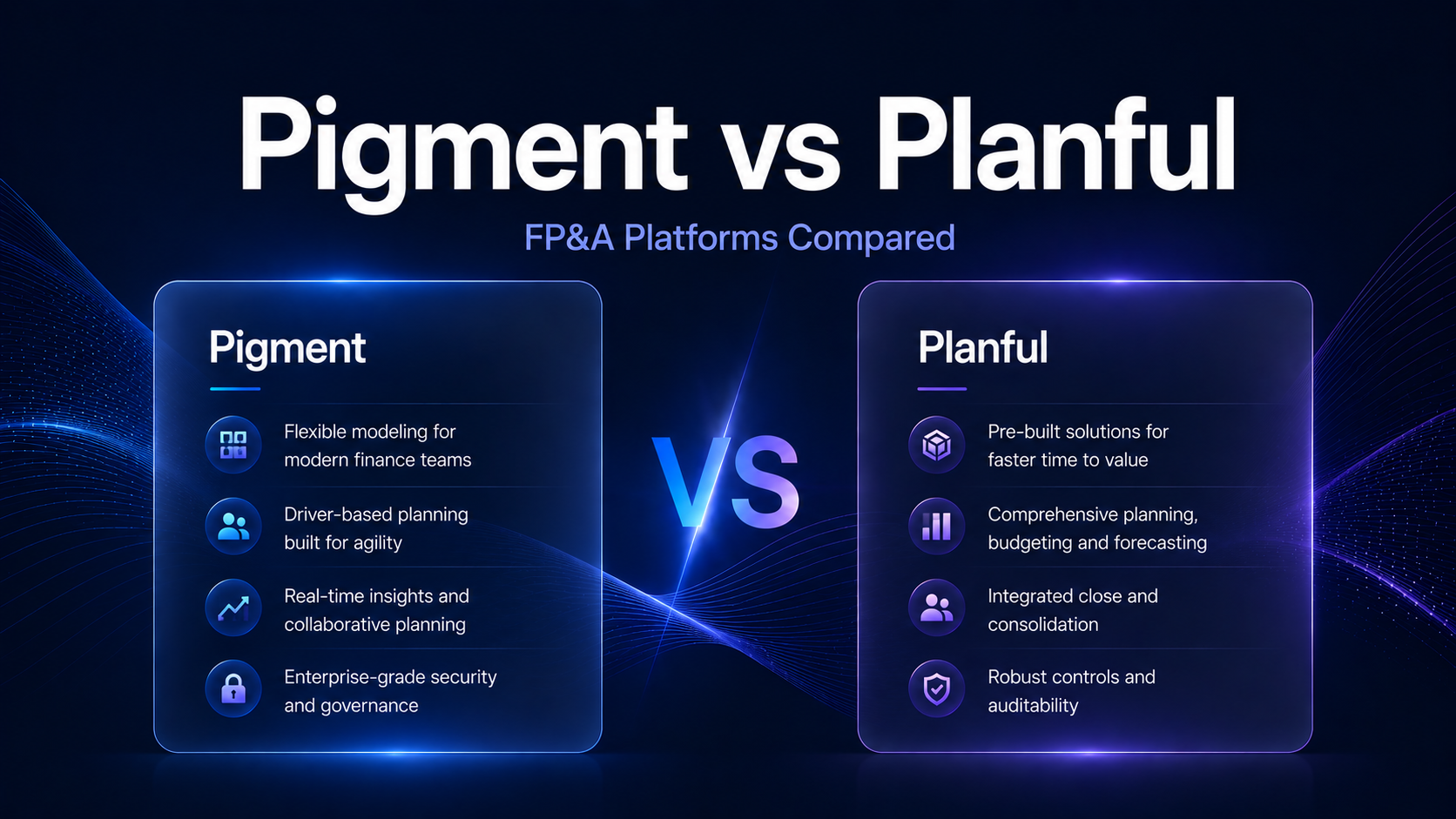
Pigment and Planful both target the FP&A function, but they represent two different generations of planning software. Planful is a proven, mature platform with deep reporting and budgeting capabilities built over two decades. Pigment is a next-generation platform emphasizing flexibility, visual modeling, and cross-functional planning. The right choice depends on where your organization sits in its planning maturity journey.
FP&A leaders evaluating modern planning platforms. Finance teams replacing legacy budgeting tools or Excel-based planning. CFOs benchmarking Pigment vs Planful for a finance transformation initiative.
Quick Verdict
Pigment vs Planful: Quick Verdict
| Category | Winner | Why |
|---|---|---|
| Planning Flexibility | Pigment | Block-based modeling is more adaptable and visual |
| Scenario Modeling | Pigment | Superior multi-scenario comparison and visualization |
| Workforce Planning | Pigment | Deeper headcount planning capabilities |
| Financial Reporting | Planful | Mature structured reporting with consolidation |
| Budgeting & Forecasting | Tie | Both are strong for core budget cycles |
| Implementation Speed | Pigment | Faster setup for modern mid-market teams |
| Enterprise Consolidation | Planful | Stronger multi-entity and consolidation toolset |
| User Experience | Pigment | More modern and intuitive interface |
Side-by-Side Comparison
Pigment vs Planful: Feature Comparison
| Feature | Pigment | Planful |
|---|---|---|
| Planning & Budgeting | ✓ Block-based, flexible | ✓ Structured, proven |
| Scenario Modeling | ✓ Multi-scenario visual | ✓ Supported |
| Workforce Planning | ✓ Deep headcount module | ✓ Supported |
| Financial Consolidation | Growing | ✓ Multi-entity consolidation |
| Structured Reporting | ✓ Good | ✓ Excellent |
| Dashboard & Visualization | ✓ Superior | ✓ Standard |
| Rolling Forecasts | ✓ Yes | ✓ Yes |
| Driver-Based Planning | ✓ Core design | ✓ Supported |
| Collaboration | ✓ Real-time, cross-functional | ✓ Workflow-based |
| Audit Trail | ✓ Yes | ✓ Yes |
| ERP Integration | ✓ Major ERPs | ✓ Major ERPs |
| AI Features | ✓ Growing | ✓ Planful Predict |
| Mobile Access | ✓ Yes | ✓ Yes |
| Implementation Time | 2–4 months | 3–6 months |
Pigment Deep Dive
Pigment: Platform Overview
Pigment launched in 2019 with a clear thesis: planning software needed to be as flexible and visual as the best business intelligence tools, while remaining calculation-accurate and finance-grade. The platform’s block-based modeling approach allows finance teams to build planning models that mirror their business logic rather than conforming to predefined templates. This flexibility is Pigment’s greatest strength.
Scenario modeling in Pigment stands out. Finance teams can build multiple scenarios simultaneously, visualize them side-by-side, and instantly communicate the financial implications of different business assumptions. This is particularly valuable for CFOs and FP&A leaders who need to present board-ready scenario analyses quickly.
Pigment has also invested heavily in workforce planning, offering a dedicated headcount module that integrates with HRIS systems and allows finance and HR teams to collaborate on hiring plans, compensation models, and organizational cost projections.
Planful Deep Dive
Planful: Platform Overview
Planful (formerly Host Analytics) has been in the FP&A market since 2000 and brings two decades of product development to its planning, reporting, and consolidation capabilities. The platform serves a wide range of mid-market and enterprise customers with its core modules: Structured Planning for annual budgeting, Dynamic Planning for driver-based rolling forecasts, and Reporting for financial statement production.
Planful’s reporting engine is mature and capable, producing financial statements, management reports, and board decks directly from planning data. Its consolidation module handles multi-entity eliminations, currency conversion, and intercompany reconciliation—capabilities that growing companies eventually need and that Planful has refined over years of enterprise deployments.
Planful Predict, the platform’s AI capability, provides machine-learning-based forecast recommendations and anomaly alerts. While not as visually differentiated as Pigment’s approach, Planful Predict is embedded in standard planning workflows in a way that finance teams find accessible.
Pricing Comparison
Pigment vs Planful: Pricing
| Factor | Pigment | Planful |
|---|---|---|
| Pricing Model | Per-user / custom enterprise | Per-user / module-based |
| Typical Mid-Market Range | $60K–$150K/year | $50K–$120K/year |
| Enterprise Pricing | Custom contract | Custom contract |
| Implementation Cost | Moderate | Moderate to high |
| Contract Length | Annual or multi-year | Typically annual |
| Free Trial | Demo available | Demo available |
Integrations
Pigment vs Planful: Integrations
| Integration | Pigment | Planful |
|---|---|---|
| NetSuite | ✓ Native | ✓ Native |
| Salesforce | ✓ Native | ✓ Native |
| Workday | ✓ Native | ✓ Supported |
| SAP | ✓ Supported | ✓ Supported |
| Oracle ERP | ✓ Supported | ✓ Supported |
| BambooHR / Rippling | ✓ HRIS connectors | Limited |
| Slack / Microsoft Teams | ✓ Notifications | ✓ Supported |
| Excel | ✓ Import/Export | ✓ Import/Export |
| REST API | ✓ Available | ✓ Available |
Decision Guide
Pigment vs Planful: How to Choose
Final Verdict
Pigment vs Planful: Final Verdict
Pigment represents the next generation of FP&A software—flexible, visual, and built for cross-functional planning in a way that legacy tools never were. For high-growth companies and finance teams tired of wrestling with rigid planning models, Pigment delivers a genuinely differentiated experience. Its scenario modeling and workforce planning capabilities are class-leading.
Planful remains the stronger choice for structured reporting, multi-entity consolidation, and organizations that need proven enterprise reliability. Two decades of FP&A product development show in the maturity of Planful’s reporting engine and consolidation capabilities. For finance leaders who need board-quality financial statements produced reliably each month, Planful earns its position.
Pigment for modern, flexible FP&A with superior scenario modeling and user experience. Planful for structured financial reporting, multi-entity consolidation, and proven enterprise reliability. The best choice depends on whether planning agility or reporting maturity is your primary need.