Planful vs Datarails (2026): Which FP&A Platform Is Best?
Planful vs Datarails (2026): Which FP&A Platform Is Best?
An independent head-to-head comparison of Planful and Datarails for financial planning and analysis in 2026. Covers budgeting, forecasting, reporting, Excel integration, market segment fit, pricing, and which platform is best for your finance team.
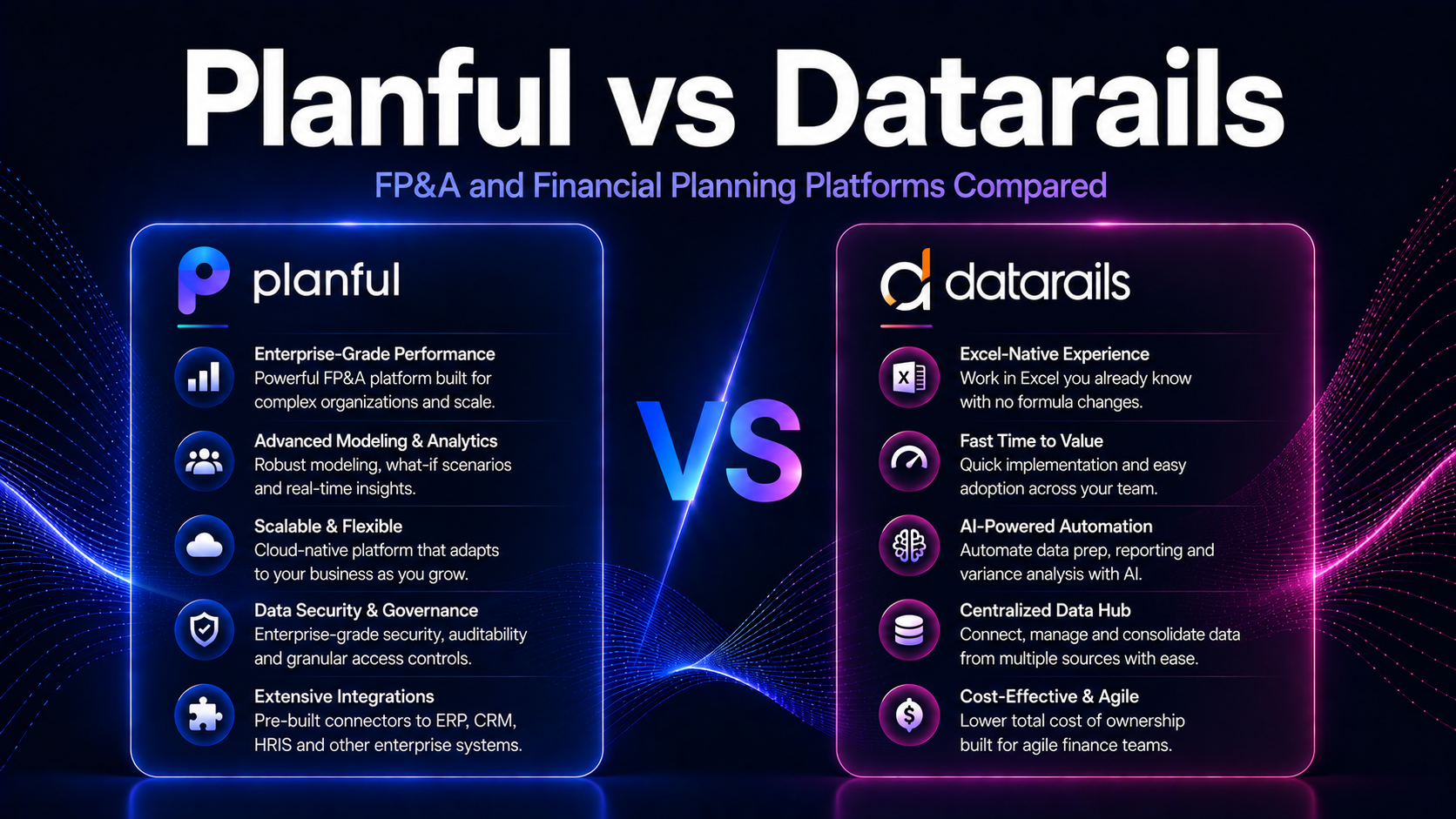
Planful and Datarails both help finance teams move beyond manual spreadsheet planning, but they target different market segments and take different approaches to Excel. Planful is a structured FP&A platform for mid-market and enterprise organizations that want purpose-built planning software. Datarails is built specifically for SMB and smaller mid-market finance teams, automating Excel-based planning workflows rather than replacing them.
FP&A leaders and finance managers comparing Planful and Datarails. SMB and mid-market finance teams evaluating Excel-native planning tools against structured FP&A platforms.
Quick Verdict
Planful vs Datarails: Quick Verdict
| Category | Winner | Why |
|---|---|---|
| SMB Fit | Datarails | Built specifically for SMB finance teams with Excel-first approach |
| Enterprise & Mid-Market Depth | Planful | Deeper structured reporting and consolidation for larger orgs |
| Excel Automation | Datarails | Core focus on automating existing Excel-based processes |
| Financial Consolidation | Planful | Multi-entity consolidation module built for complexity |
| Time to Value | Datarails | Faster deployment by working with existing Excel models |
| Reporting Depth | Planful | More mature financial reporting capabilities |
| Total Cost (SMB) | Datarails | Lower cost entry point designed for smaller teams |
| FP&A Team Adoption | Datarails | Excel familiarity reduces adoption barriers |
Side-by-Side Comparison
Planful vs Datarails: Feature Comparison
| Feature | Planful | Datarails |
|---|---|---|
| Annual Budgeting | ✓ Structured Planning module | ✓ Excel-native automation |
| Rolling Forecasts | ✓ Dynamic Planning module | ✓ Supported |
| Financial Consolidation | ✓ Multi-entity | ✓ Basic |
| Excel Integration | ✓ Excel add-in | ✓ Excel as core interface |
| Scenario Modeling | ✓ Supported | ✓ Supported |
| Board & Management Reporting | ✓ Mature engine | ✓ AI-assisted reports |
| Workforce Planning | ✓ Supported | ✓ Headcount planning |
| ERP Integration | ✓ Broad connectors | ✓ Broad connectors |
Planful Deep Dive
Planful: Platform Overview
Planful’s three-module structure—Structured Planning, Dynamic Planning, and Reporting—gives mid-market and enterprise finance teams a purpose-built planning environment separate from Excel. Its reporting engine is mature and produces financial statements with multi-entity consolidation support, making it a strong choice for organizations with complex reporting requirements.
Planful integrates with NetSuite, Salesforce, Workday, SAP, and Oracle, making it broadly compatible with enterprise and mid-market ERP environments. Its structured approach to planning workflows ensures consistent budgeting processes across large, distributed finance teams.
Datarails Deep Dive
Datarails: Platform Overview
Datarails was purpose-built for the finance team that runs on Excel and wants to keep it that way while gaining the efficiency of automated data consolidation and reporting. Rather than asking finance teams to learn a new planning interface, Datarails connects to all data sources, consolidates them automatically, and feeds the results into Excel templates that the team already uses.
Datarails’ AI-powered FP&A assistant helps finance teams generate management reports, budget vs. actual analyses, and narrative commentary faster. For SMB finance teams where the finance function is one or two people managing complex Excel-based models, Datarails provides significant time savings without requiring a full FP&A platform implementation.
Pricing Comparison
Planful vs Datarails: Pricing
| Factor | Planful | Datarails |
|---|---|---|
| Pricing Model | Module-based / per-user | Per-user, SMB-focused |
| SMB Range | Not primary target | $20K–$60K/year |
| Mid-Market Range | $50K–$120K/year | $30K–$80K/year |
| Enterprise Pricing | Custom contract | Custom for larger teams |
| Implementation Cost | Moderate to high | Low (works with existing Excel) |
| Free Trial | Demo available | Demo available |
Integrations
Planful vs Datarails: Integrations
| Integration | Planful | Datarails |
|---|---|---|
| NetSuite | ✓ Native | ✓ Native |
| QuickBooks | Limited | ✓ Native |
| Xero | Limited | ✓ Supported |
| Salesforce | ✓ Native | ✓ Supported |
| SAP | ✓ Supported | ✓ Supported |
| Workday | ✓ Supported | ✓ Supported |
| BambooHR | ✓ Supported | ✓ HRIS connectors |
Decision Guide
Planful vs Datarails: How to Choose
Final Verdict
Planful vs Datarails: Final Verdict
Planful is the stronger fit for mid-market and enterprise organizations with structured reporting requirements, multi-entity consolidation needs, and sufficient scale to justify a full FP&A platform. Its maturity and depth in reporting make it a solid choice for complex planning environments.
Datarails is the stronger fit for SMB and smaller mid-market finance teams. Its Excel-native approach delivers real efficiency gains with minimal implementation friction, and its AI-powered reporting capabilities provide genuine time savings for small finance teams managing complex spreadsheet environments.
Planful for mid-market and enterprise FP&A with structured reporting and consolidation. Datarails for SMB and smaller teams wanting Excel automation with fast time-to-value.