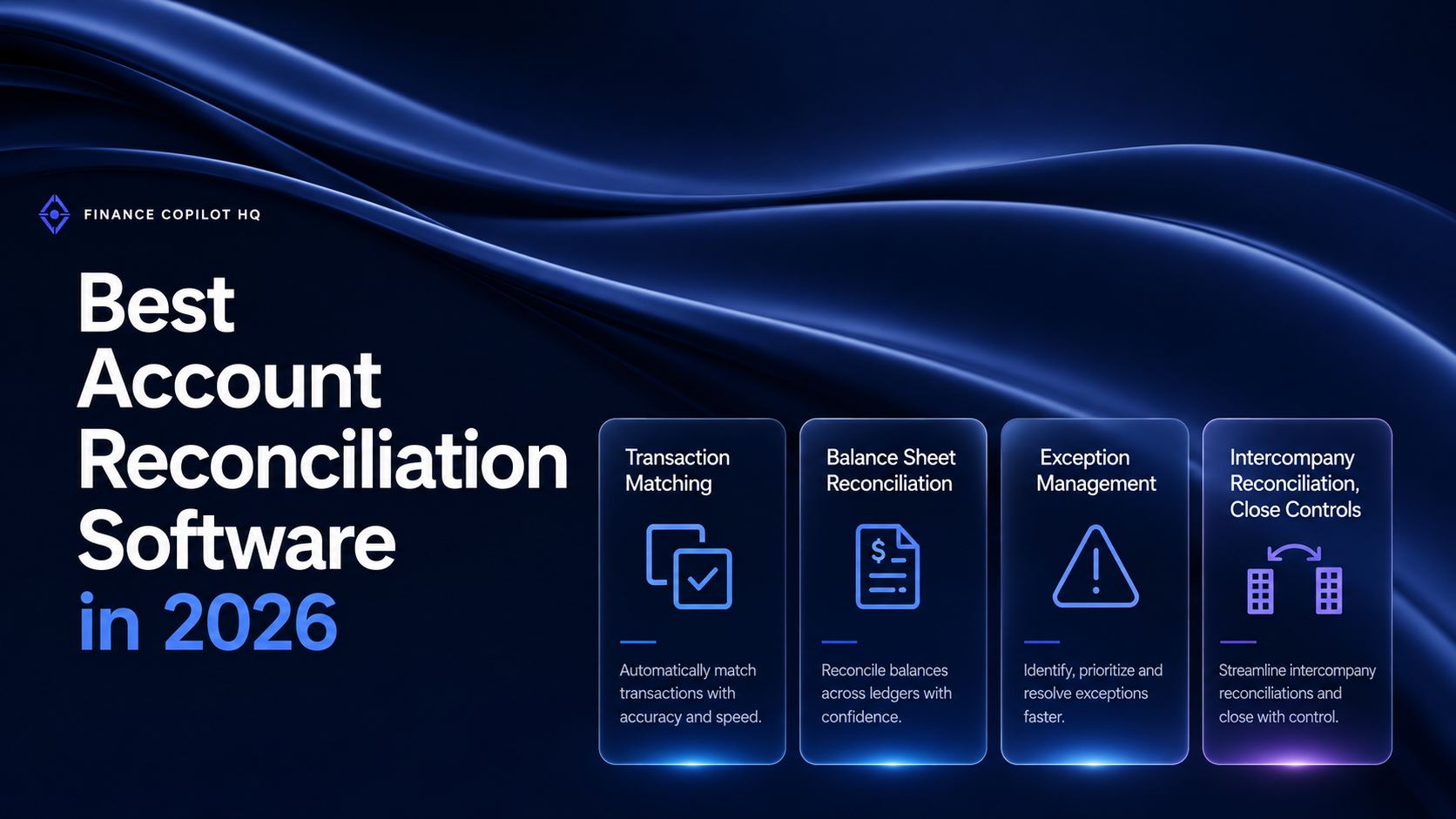
Best Account Reconciliation Software in 2026
Best Account Reconciliation Software in 2026
An independent, practitioner-grade evaluation of eight account reconciliation platforms — reviewed across automation depth, ERP integration, audit readiness, and total cost of ownership.
- Executive Summary
- What Is Account Reconciliation Software?
- Evaluation Methodology
- Comparison Table
- Individual Platform Reviews (8 platforms)
- Implementation Considerations
- Pricing Comparison
- Best Solutions by Company Size
- Best Solutions by ERP Environment
- Vendor Selection Framework
- Frequently Asked Questions
- Final Recommendations
Executive Summary
Account reconciliation is among the most resource-intensive processes in corporate finance. For mid-market and enterprise organizations, the month-end close involves hundreds or thousands of individual balance sheet accounts, each requiring documentation, variance investigation, and sign-off before the period can close. Manual reconciliation — spreadsheet-based, reliant on email chains, and prone to human error — remains the dominant approach at most organizations despite carrying measurable risk and operational cost.
This report evaluates eight leading account reconciliation software platforms available in 2026: BlackLine, Trintech Adra, FloQast, Numeric, Oracle Account Reconciliation Cloud, OneStream, HighRadius, and SolveXia. It is written for CFOs, Controllers, Finance Operations Leaders, and Accounting Managers who are evaluating platforms either for the first time or reassessing incumbent solutions in light of material product changes or organizational growth.
The central finding of this analysis is that no single platform is optimal for all organizations. BlackLine and Trintech lead in enterprise depth and audit capability. FloQast and Numeric offer superior implementation timelines and usability for mid-market teams. Oracle and OneStream suit organizations already embedded in those respective ERP ecosystems. HighRadius excels when reconciliation is primarily a sub-ledger matching problem driven by high transaction volume. SolveXia delivers strong value for smaller teams seeking automation without enterprise pricing.
Finance leaders evaluating this market should resist the impulse to optimize for feature breadth. The platforms that deliver the strongest ROI are those aligned to the team’s existing ERP environment, staffing model, and close complexity — not those with the longest feature list.
What Is Account Reconciliation Software?
Account reconciliation software is a category of financial operations technology that automates and standardizes the process of verifying that general ledger account balances are accurate, supported by documentation, and free of unexplained variances. It replaces or augments the traditional workflow in which accountants manually pull trial balances, match transactions against sub-ledger records or external statements, document open items, and route completed reconciliations for management review.
At minimum, a purpose-built reconciliation platform provides a structured workspace for each account, version-controlled documentation, workflow routing for preparer and reviewer sign-off, and a centralized status dashboard showing close progress. More capable platforms add automated data ingestion from ERPs and source systems, transaction-level matching using rule-based or ML-powered logic, risk-based prioritization of accounts, and integration with broader financial close orchestration workflows.
Reconciliation software is distinct from general ledger software, which records transactions, and from close management software, which orchestrates tasks across the close but does not necessarily manage the reconciliation document itself. The distinction matters in vendor selection because several platforms — FloQast, for example — are primarily close management tools that include reconciliation as a module, while others such as BlackLine and Trintech are purpose-built reconciliation platforms with close management added later.
Account Reconciliation Software vs. Close Management Software
The terminology in this market is often used loosely, and establishing a precise distinction is essential before evaluating vendors. Account reconciliation software focuses specifically on verifying and documenting individual GL account balances — the completeness, accuracy, and auditability of what sits in each account at period end. Close management software, by contrast, orchestrates the broader set of tasks that constitute the financial close: journal entry preparation, intercompany eliminations, consolidation, reporting package preparation, and reconciliation task tracking.
Many platforms span both categories to varying degrees. FloQast began as a close management tool and added reconciliation modules. BlackLine began as a reconciliation platform and later added close task management, journal entry automation, and consolidation. Oracle Account Reconciliation Cloud and OneStream are reconciliation modules within broader financial management suites.
The practical implication for buyers: if your primary problem is reconciliation quality, completeness, and audit trail, buy a reconciliation-first platform. If your primary problem is close coordination and timeline compression, a close management platform with reconciliation functionality may be sufficient. If both problems are material, evaluate platforms that handle both with equal depth rather than assuming strength in one area implies strength in the other.
For further context on close management tools, see our companion report: Best Financial Close Automation Software in 2026.
Evaluation Methodology
This report applies a structured, six-dimension evaluation framework consistently across all eight platforms. The analysis draws on product documentation, independently published user reviews from G2, Gartner Peer Insights, and TrustRadius, publicly available pricing and implementation data, and analyst research. No vendor provided financial compensation in connection with this report, and inclusion does not constitute endorsement.
The six evaluation dimensions are:
Reconciliation automation depth: The platform’s ability to automatically match transactions, identify variances, and reduce manual effort. This covers matching rule sophistication, ML-based matching where present, and the range of account types supported — bank, intercompany, sub-ledger, and general balance sheet.
ERP and data integration: The breadth and reliability of native connectors to SAP, Oracle, Microsoft Dynamics 365, NetSuite, Workday, and other common ERP environments, and the configuration effort required at implementation.
Workflow and controls: Completeness of preparer/reviewer workflow, role-based access controls, exception escalation, and the quality of the audit trail required to satisfy internal control frameworks such as SOX, ICFR, and external audit requirements.
Usability and adoption: The learning curve for accountants performing reconciliations, UI quality, and the degree to which the platform requires IT involvement for routine tasks. High usability scores correlate with faster adoption and lower ongoing support costs.
Analytics and reporting: The ability to surface close status, aging open items, high-risk accounts, and historical reconciliation trends in formats relevant to controllers and CFOs — not just task-level status for individual preparers.
Total cost and value: The fully loaded cost of deployment including licensing, implementation services, integration development, data migration, training, and ongoing administration — assessed relative to the expected productivity gain for organizations of different sizes and complexity.
Comparison Table: Account Reconciliation Software in 2026
| Platform | Recon Automation | ERP Integration | Workflow & Controls | Usability | Analytics | Value | Best Fit |
|---|---|---|---|---|---|---|---|
| BlackLine | Excellent | Excellent | Excellent | Good | Excellent | Moderate | Large enterprise |
| Trintech Adra | Excellent | Very Good | Excellent | Very Good | Very Good | Very Good | Mid-market to enterprise |
| FloQast | Good | Very Good | Very Good | Excellent | Very Good | Very Good | Mid-market, close-first |
| Numeric | Good | Very Good | Very Good | Excellent | Very Good | Excellent | High-growth mid-market |
| Oracle Recon Cloud | Very Good | Excellent | Excellent | Good | Very Good | Good | Oracle ERP customers |
| OneStream | Very Good | Excellent | Excellent | Good | Excellent | Good | Enterprise CPM users |
| HighRadius | Excellent | Very Good | Very Good | Very Good | Very Good | Good | High transaction volume |
| SolveXia | Very Good | Good | Good | Very Good | Good | Excellent | SMB to lower mid-market |
Individual Platform Reviews
1. BlackLine
Overview: BlackLine is the market-defining platform in enterprise account reconciliation. Founded in 2001 and now part of the SAP ecosystem following a strategic partnership and equity investment, BlackLine serves over 4,300 customers globally, predominantly large enterprises and Fortune 1000 companies. Its account reconciliation module is the foundation of its product suite, which has expanded over time to include journal entry automation, intercompany accounting, task management, and variance analysis.
Reconciliation capabilities: BlackLine’s reconciliation engine supports a broad range of account types and matching methodologies. The platform’s Auto-Certification feature allows low-risk accounts that meet configurable criteria to close automatically without manual preparer action, reducing the volume of accounts requiring hands-on attention. Transaction Matching — sold as a separate module — applies rule-based and ML-assisted logic to match high-volume transaction sets such as bank statements, credit card feeds, and sub-ledger exports against GL balances. For complex accounts, the platform provides a structured reconciliation workspace with supporting document attachment, narrative fields, and full version history.
ERP integration: BlackLine maintains certified connectors to SAP (including S/4HANA), Oracle ERP Cloud, Microsoft Dynamics 365, Workday, NetSuite, and most major mid-market ERP systems. Bidirectional data flow with SAP is particularly strong, reflecting the strategic partnership between the two companies. Real-time or near-real-time data sync reduces the latency between ERP posting and reconciliation workspace population, which is a meaningful differentiator for organizations running fast close processes.
Workflow and controls: BlackLine’s control framework is among the most complete in the market. Role-based access, configurable preparer/reviewer/approver chains, risk-weighted account prioritization, and a complete audit trail that timestamps every action — including document uploads, narrative edits, and status changes — create a control environment that satisfies SOX, CSOX, and equivalent ICFR frameworks. The platform’s Compliance Dashboard provides controller-level visibility into reconciliation status, certification completeness, and open items.
Limitations: BlackLine’s primary weaknesses are implementation complexity and cost. Deployments at large enterprises typically require 6 to 18 months and significant consulting resources, either from BlackLine Professional Services or a partner such as Deloitte or Accenture. The platform’s UI reflects its enterprise heritage — functional and auditable, but not modern by the standards of newer entrants like Numeric or FloQast. User training requirements are higher than mid-market alternatives, and total cost of ownership is the highest in this comparison at scale.
Pricing: BlackLine does not publish list pricing. Enterprise contracts typically start in the $150,000 to $200,000 ARR range for core reconciliation and scale significantly with transaction matching modules, user counts, and entity complexity. Mid-market configurations (50-150 users) typically range from $75,000 to $150,000 ARR. Implementation costs from certified partners commonly add 50% to 100% of year-one license fees.
Best for: Public companies with SOX compliance requirements, organizations with SAP ERP infrastructure, large accounting teams (100+ users), and enterprises requiring transaction matching at scale (millions of transactions per month).
2. Trintech Adra
Overview: Trintech is BlackLine’s most direct competitor in purpose-built account reconciliation. The company operates two primary product lines: Cadency, positioned for large enterprise customers, and Adra, which targets mid-market organizations. This review focuses primarily on Adra, as it represents Trintech’s most active growth segment and the product most likely to appear in competitive evaluations against FloQast, Numeric, and mid-tier BlackLine configurations. Trintech serves over 3,500 customers across more than 100 countries.
Reconciliation capabilities: Adra’s reconciliation module provides a structured account workspace with configurable templates for different account types, automated data import from ERP systems and flat files, rule-based transaction matching, and a risk-scoring engine that prioritizes accounts by materiality, days outstanding, and historical error rates. The platform’s matching capabilities are strong for bank reconciliation and intercompany account reconciliation, and the template library covers the most common balance sheet account types encountered in a standard month-end process.
ERP integration: Trintech Adra connects to the major ERP platforms through a combination of native connectors and a configurable data import framework. Integration with SAP, Oracle, Microsoft Dynamics, NetSuite, and Sage is supported. The integration layer is less turnkey than BlackLine’s SAP connector in large SAP environments, but for Microsoft Dynamics and mid-market ERP users, Adra’s connectors are comparable. The platform also supports flat-file import via SFTP for systems without native connectors, which extends reach to legacy or bespoke ERP environments.
Workflow and controls: Adra provides a complete preparer/reviewer workflow with configurable escalation rules, deadline tracking, and role-based permissions. The audit trail meets SOX requirements and is designed to produce the documentation needed for external auditor access packages without additional preparation. The platform’s Task Manager integrates reconciliation tasks with broader close checklist items, providing a unified view of close progress without requiring a separate close management tool.
Limitations: Adra’s transaction matching is less sophisticated than BlackLine’s Transaction Matching module for organizations with extremely high transaction volumes (tens of millions of transactions per period). The analytics layer, while functional, is less configurable and visually capable than BlackLine’s or OneStream’s for CFO-level reporting. Some users report that the Adra UI, while cleaner than BlackLine’s, has a steeper learning curve than FloQast or Numeric for non-accounting-specialist users.
Pricing: Trintech Adra pricing is available on request. Mid-market configurations (25-100 users) typically range from $40,000 to $100,000 ARR. Enterprise Cadency deployments are priced comparably to BlackLine. Implementation costs are generally lower than BlackLine for Adra deployments, with typical timelines of 3 to 6 months for mid-market customers.
Best for: Mid-market to enterprise organizations seeking a balance between reconciliation depth and implementation practicality, organizations with Microsoft ERP infrastructure, and teams that need both reconciliation management and close task orchestration from a single vendor.
3. FloQast
Overview: FloQast is a close management and reconciliation platform built explicitly for accounting teams that work within existing ERP systems rather than replacing them. Founded in 2013, the company has grown rapidly in the mid-market segment and has expanded upmarket through a series of product additions, including FloQast Reconciliation Management, which added purpose-built reconciliation tracking to the platform’s close management foundation. FloQast is widely regarded as among the easiest-to-implement platforms in this category, with typical go-live timelines of 4 to 8 weeks for mid-market customers.
Reconciliation capabilities: FloQast Reconciliation Management provides structured reconciliation workspaces tied to GL account mappings, automated balance population via ERP integration, flux analysis to highlight period-over-period variances, and a review and certification workflow. The platform’s Auto-Reconciliation feature automatically certifies accounts that meet configurable zero-balance or threshold criteria, reducing the reconciliation burden for lower-risk accounts. Transaction-level matching is less granular than BlackLine or HighRadius for high-volume transaction environments, making FloQast better suited to balance sheet reconciliation than high-volume transactional matching use cases.
ERP integration: FloQast connects natively to NetSuite, Sage Intacct, QuickBooks Online, Microsoft Dynamics 365, and Oracle ERP, with most connections established via read-only API access to pull trial balance data. The NetSuite and Sage Intacct connectors are among the strongest in the market for those specific ERP environments. For SAP environments, integration is available but requires more configuration effort than BlackLine’s native SAP connector.
Workflow and controls: The preparer/reviewer workflow is well-designed and intuitive. Deadline tracking, automated reminder notifications, and escalation rules help controllers maintain close timelines without manual follow-up. The audit trail is complete and appropriate for SOX-compliant organizations, though some enterprise audit teams have requested additional control documentation detail that the platform does not surface natively. FloQast’s close checklist provides a consolidated view of all close tasks, reconciliations, and journal entries in a single calendar-based interface that accounting managers consistently rate highly for day-to-day usability.
Limitations: FloQast’s reconciliation depth is secondary to its close management strength. Organizations with complex matching requirements, large account populations (2,000+ reconciliations per period), or sophisticated transaction matching needs may find FloQast’s reconciliation module insufficient as a standalone solution. The platform is also less suited to organizations running complex multi-entity consolidations or requiring deep intercompany reconciliation automation. It is primarily a tool for the accounting team — its executive analytics are functional but not as rich as BlackLine’s or OneStream’s.
Pricing: FloQast pricing is not publicly listed. Mid-market configurations typically range from $30,000 to $80,000 ARR, making it one of the more accessible platforms in this comparison. Implementation is typically self-service or lightly assisted, which significantly reduces total first-year cost relative to enterprise alternatives.
Best for: Mid-market accounting teams (10-60 users) seeking fast implementation, organizations on NetSuite or Sage Intacct, teams that need close management and reconciliation tracking without deep transaction matching, and finance leaders who want high adoption rates without a lengthy change management program.
See also: Best Accounting Automation Software in 2026
4. Numeric
Overview: Numeric is the newest entrant in this comparison, founded in 2021 and positioned squarely at high-growth companies and mid-market accounting teams that need modern tooling without enterprise-grade implementation complexity or cost. The platform has gained significant traction among Series B through pre-IPO companies running on NetSuite or Sage Intacct, where it competes directly with FloQast and increasingly with lighter Trintech Adra configurations. Numeric has made a deliberate product decision to prioritize user experience and speed-to-value over feature breadth, and this shows clearly in implementation timelines and user adoption metrics reported by its customer base.
Reconciliation capabilities: Numeric provides structured reconciliation workspaces with automated balance population from connected ERP systems, configurable reconciliation templates by account type, automated flux commentary generation using AI-assisted variance analysis, and a preparer/reviewer workflow with deadline tracking. The platform’s AI-assisted flux analysis is a genuine product differentiator — it generates first-draft variance explanations from connected data sources that accountants can review and edit rather than composing from scratch, reducing the time required for narrative documentation materially. Account auto-certification for zero-balance and low-risk accounts reduces the reconciliation volume requiring active preparer attention.
ERP integration: Numeric connects natively to NetSuite, Sage Intacct, and QuickBooks Online, with additional integrations in development. The NetSuite connector is particularly strong and is frequently cited by users as one of the tightest in the category for that ERP. Organizations running SAP, Oracle, or Microsoft Dynamics 365 as their primary ERP should verify current integration availability before evaluating Numeric, as connector breadth for larger ERP platforms lags behind BlackLine, Trintech, and FloQast.
Workflow and controls: Numeric’s workflow is clean and complete for SOX-compliant organizations. The preparer/reviewer chain, role-based access controls, and audit trail meet the documentation requirements of standard internal control frameworks. The platform does not yet match enterprise-grade platforms in configurability of escalation rules or the granularity of control reporting available to compliance teams at very large or complex organizations.
Limitations: Numeric’s ERP connector breadth is its most significant current limitation. Organizations not on NetSuite or Sage Intacct should carefully verify integration readiness before proceeding. The platform’s transaction matching capabilities are basic relative to HighRadius or BlackLine — Numeric is a balance-sheet reconciliation tool, not a high-volume transaction matching engine. For organizations managing thousands of reconciliations per period across complex multi-entity structures, Numeric’s feature set may not yet scale adequately.
Pricing: Numeric pricing is available on request and is generally positioned below FloQast and Trintech Adra for comparable user counts. The platform’s low implementation cost — most customers go live in 2 to 4 weeks with minimal external support — is a meaningful total-cost advantage for organizations sensitive to first-year investment.
Best for: High-growth companies (Series B through pre-IPO), mid-market organizations on NetSuite or Sage Intacct, accounting teams of 5 to 30 users, and organizations prioritizing fast time-to-value and AI-assisted variance analysis over deep transaction matching.
For context on AI-assisted finance tools more broadly, see: Best AI Tools for Finance Teams in 2026
5. Oracle Account Reconciliation Cloud
Overview: Oracle Account Reconciliation Cloud (ARCS) is a component of the Oracle Enterprise Performance Management (EPM) Cloud suite. For organizations that have standardized on Oracle’s cloud ERP and EPM stack, ARCS provides a deeply integrated reconciliation capability that eliminates much of the data integration complexity facing standalone reconciliation platforms. Outside of Oracle-centric environments, however, ARCS is a less compelling standalone choice relative to purpose-built alternatives.
Reconciliation capabilities: ARCS provides a full reconciliation management framework including configurable reconciliation formats, automated balance loading from Oracle ERP Cloud and Oracle Financials, rule-based auto-reconciliation for qualifying accounts, and a structured match-exception workflow. The platform’s Period Close component integrates reconciliation status with broader Oracle EPM close orchestration, providing a unified close management view across tasks, reconciliations, and financial consolidation. Oracle has invested in automation capabilities for the platform including automatic matching rules and predictive reconciliation suggestions, though these capabilities are less mature than the AI-assisted features in newer entrants like Numeric.
ERP integration: The integration between ARCS and Oracle ERP Cloud is Oracle’s primary competitive advantage in this category — pre-built, deeply tested, and maintained by a single vendor. For non-Oracle ERP environments, ARCS supports data loading via flat file and a connector framework, but the integration experience does not match the native Oracle-to-Oracle pathway. Organizations running SAP, Workday, or Microsoft Dynamics should evaluate whether the Oracle EPM platform overhead is justified if Oracle ERP is not also part of their stack.
Workflow and controls: Oracle ARCS provides an enterprise-grade control framework including SOX-compliant workflow, role-based access controls, digital signatures for certifications, and comprehensive audit trail reporting. The integration with Oracle GRC (Governance, Risk, and Compliance) cloud enables automated risk assessment and control exception reporting in organizations that have deployed the broader Oracle risk management stack.
Limitations: ARCS’s UI has historically been one of the weaker user experiences in this category — functional but less intuitive than FloQast, Numeric, or Adra for daily use. Implementation complexity for organizations not already in the Oracle EPM ecosystem is significant, and the total cost of ownership when factoring in EPM platform licensing can be high relative to standalone reconciliation tools. Oracle’s product development cadence in ARCS has also been slower than that of privately funded competitors, though the platform receives quarterly updates as part of Oracle’s cloud release schedule.
Pricing: Oracle ARCS is licensed as part of the Oracle EPM Cloud suite. Standalone ARCS pricing is available but unusual — most customers license it as part of a broader EPM bundle including Financial Consolidation and Close (FCCS) or Oracle Planning. Total first-year costs including EPM platform, ARCS module, and implementation services commonly range from $150,000 to $400,000 for mid-to-large enterprise deployments.
Best for: Organizations running Oracle ERP Cloud as their primary ERP and seeking a native reconciliation solution within the Oracle EPM suite; companies that have already invested in Oracle EPM and want to consolidate vendors.
6. OneStream
Overview: OneStream is a unified financial platform that competes primarily in the Corporate Performance Management (CPM) market against Oracle EPM, SAP BPC, and Planful. Account reconciliation is one component of OneStream’s broader suite, which also includes financial consolidation, planning, reporting, and analytics. OneStream’s reconciliation capability — delivered as part of the core platform and through its MarketPlace solution library — is most relevant to organizations that have standardized on OneStream for consolidation and are seeking to extend it to the reconciliation workflow rather than maintaining a separate reconciliation platform.
Reconciliation capabilities: OneStream’s Account Reconciliation module provides structured reconciliation forms that integrate with the platform’s unified data model, so account balances are always current relative to the financial data used for consolidation and reporting. The platform supports configurable reconciliation templates, auto-certification rules, a preparer/reviewer workflow, and exception tracking. Because OneStream’s data layer is shared across consolidation, planning, and reconciliation, variance investigation can be performed against the same data used for management reporting without additional data export or reconciliation.
ERP integration: OneStream integrates with the major ERP platforms through its Data Management framework, which supports direct database connections, flat-file imports, and pre-built connectors for SAP, Oracle, Workday, and Microsoft Dynamics. The integration is bidirectional — actuals loaded from the ERP for consolidation purposes automatically populate reconciliation workspaces. This shared-data architecture is a meaningful efficiency advantage over platforms that require separate data pipelines for reconciliation.
Workflow and controls: OneStream provides an enterprise-grade workflow and control environment appropriate for SOX-compliant public companies. The platform’s audit framework, digital certifications, and role-based access controls meet the requirements of major internal control frameworks. The integration between reconciliation sign-off and the financial consolidation process — enabling period close to be locked after reconciliation certification is confirmed — is a distinctive capability for organizations that want consolidation and reconciliation controls linked.
Limitations: OneStream is an expensive, complex platform. Organizations seeking a standalone reconciliation solution without the broader CPM suite context will find the platform’s cost and implementation timeline difficult to justify. The UI, while functional, has a steeper learning curve than mid-market alternatives. Implementation projects typically require 6 to 18 months for full CPM deployments, with reconciliation as one component. For organizations not already on OneStream, adopting it primarily for reconciliation is not advisable.
Pricing: OneStream is priced as a platform, not by module. Annual contracts typically start at $150,000 and scale based on users, entities, and data volume. Implementation costs are substantial and typically add $200,000 to $500,000 or more in professional services for full enterprise deployments. The platform is generally accessible only to organizations with meaningful CPM budgets.
Best for: Existing OneStream customers seeking to consolidate reconciliation into their CPM platform; large enterprises with complex consolidation and reporting requirements that want a single platform for CPM and reconciliation.
See also: Best FP&A Software in 2026 for broader context on financial planning platforms.
7. HighRadius
Overview: HighRadius is an AI-powered fintech platform focused primarily on the order-to-cash (O2C) process — accounts receivable, cash application, collections, and deduction management. Its Financial Close Management suite, which includes account reconciliation and close task management, represents a secondary product line relative to its O2C strength. HighRadius is most relevant to this comparison for organizations that are already HighRadius customers for O2C and are evaluating whether to extend the platform to financial close, or for organizations where reconciliation is primarily driven by accounts receivable and cash application matching rather than balance sheet account verification.
Reconciliation capabilities: HighRadius’s reconciliation module leverages the platform’s core AI capabilities in transaction matching — the same technology applied to cash application is extended to bank reconciliation, intercompany matching, and balance sheet account verification. For organizations with high transaction volumes in AR, cash, and payment-related accounts, this is a genuine strength. The AI-assisted matching engine learns from historical matching patterns and improves match rates over time, with documented auto-match rates of 80-95% for qualifying transaction types. The platform also includes close task management, journal entry automation, and a period close dashboard.
ERP integration: HighRadius integrates with SAP, Oracle, Microsoft Dynamics, and major mid-market ERP systems. The SAP integration is particularly mature, reflecting HighRadius’s strong presence in large SAP environments. Integration configuration typically requires 4 to 12 weeks depending on ERP complexity and data structure.
Workflow and controls: The platform provides a standard preparer/reviewer workflow with role-based access controls, audit trail, and SOX-compliant documentation. The integration between HighRadius’s O2C modules and the close management suite means that reconciliation of AR-related balance sheet accounts can draw on transaction data that is already being managed within the platform, reducing the data integration burden for those account types.
Limitations: HighRadius’s close management and reconciliation suite is less deep than BlackLine or Trintech for organizations whose reconciliation challenge is primarily balance sheet account documentation rather than transaction matching at scale. The platform’s UI has improved substantially but retains some of the complexity characteristic of large enterprise FinTech platforms. For organizations not already using HighRadius for O2C, the business case for adopting it primarily for reconciliation is less compelling than BlackLine, Trintech, or FloQast.
Pricing: HighRadius pricing is enterprise-structured and available on request. The financial close and reconciliation suite is typically bundled with or add-on to the O2C platform. Standalone close management configurations start around $100,000 ARR, with total O2C plus close suite contracts commonly in the $300,000 to $800,000+ ARR range at larger enterprises.
Best for: Existing HighRadius O2C customers seeking to extend the platform to financial close; organizations where AR and cash-related account reconciliation is the primary driver and high-volume transaction matching is the core requirement.
For context on AP automation and related tools: Best AP Automation Software in 2026 and AI for AP Automation: The Finance Operations Transformation Guide.
8. SolveXia
Overview: SolveXia is a finance automation platform with particular strength in reconciliation and regulatory reporting automation for financial services organizations. It occupies a distinct position in this comparison — less an enterprise reconciliation platform in the BlackLine/Trintech sense, and more a process automation and reconciliation tool for smaller accounting teams or specific reconciliation automation use cases within larger organizations. SolveXia has a significant customer base in banking, insurance, and asset management, where its ability to automate repetitive data transformation and reconciliation tasks without IT involvement is a strong differentiator.
Reconciliation capabilities: SolveXia enables finance teams to build automated reconciliation workflows using a no-code process configuration interface. A reconciliation in SolveXia involves defining data sources (ERP exports, bank feeds, custodian statements), applying transformation and matching logic, identifying exceptions, and routing results for review. The platform supports a wide variety of reconciliation types including bank reconciliation, position reconciliation (relevant for investment accounting), premium and claims reconciliation (insurance), and balance sheet account verification. The no-code workflow builder means that finance teams can configure and modify reconciliation processes without IT dependency, which is a meaningful operational advantage.
ERP integration: SolveXia primarily ingests data via flat-file imports and SFTP connections rather than native ERP API connectors. This is sufficient for many use cases but means the platform does not offer the real-time ERP data synchronization that BlackLine or FloQast provide for supported ERP systems. For organizations that export data from their ERP to files on a defined schedule, SolveXia’s approach is workable. For organizations seeking live ERP integration, the file-based approach may introduce acceptable latency or may be a limiting factor depending on close schedule requirements.
Workflow and controls: SolveXia provides a preparer/review workflow, exception tracking, and an audit trail. The control framework is appropriate for smaller organizations or for specific automated reconciliation use cases within larger ones. It does not provide the same depth of SOX documentation and control reporting as BlackLine or Oracle ARCS, which may limit its applicability for large public company finance teams that need to demonstrate ICFR compliance across the full balance sheet reconciliation population.
Limitations: SolveXia is not a full-scale enterprise reconciliation platform in the same sense as BlackLine or Trintech. It is better understood as a process automation tool that is strong for specific reconciliation use cases — particularly in financial services — rather than a universal balance sheet reconciliation management solution. ERP integration depth and SOX documentation depth are the key constraints for broader enterprise adoption.
Pricing: SolveXia pricing is module-based and significantly lower than enterprise alternatives, making it accessible to smaller teams and financial services organizations with specific automation needs. Annual contracts typically range from $15,000 to $60,000 depending on process volume and user count.
Best for: Financial services organizations (banking, insurance, asset management) with specific reconciliation automation needs; smaller accounting teams (5-20 users) seeking affordable reconciliation automation; organizations with well-defined, high-volume repetitive reconciliation processes where a no-code configuration approach is preferable to enterprise platform implementation.
Implementation Considerations
Account reconciliation software implementations fail or underdeliver more often due to organizational and process factors than technology limitations. The platforms reviewed in this report are all capable of materially improving reconciliation quality and efficiency for appropriately prepared organizations. The following considerations reflect common patterns in implementation outcomes across the market.
Common Implementation Mistakes
Underestimating data preparation requirements. Reconciliation software requires a complete, accurate account list with appropriate metadata — account type, responsible preparer, frequency, risk rating, and supporting documentation requirements. Most organizations begin implementation without this structured account registry and spend the first 4 to 8 weeks of the project building it. This is a predictable requirement and should be scoped explicitly into the implementation plan. Teams that complete this work before the software contract is signed consistently experience shorter implementations and faster time-to-value.
Over-scoping the initial deployment. There is a persistent temptation to automate all reconciliation accounts in the initial deployment. In practice, the highest ROI approach is to prioritize a defined set of high-volume, high-risk accounts for initial automation, validate the configuration in production, and expand coverage in subsequent waves. Organizations that attempt full account population in a single go-live consistently experience longer timelines, lower adoption, and higher rework rates.
Treating implementation as an IT project. Reconciliation software implementations require active involvement from the accounting team throughout the configuration phase — not just user acceptance testing at the end. Reconciliation template design, risk-scoring logic, reviewer assignment rules, and exception escalation paths require accounting judgment to configure correctly. Delegating these decisions to IT or an implementation partner without accounting team involvement produces configurations that do not reflect how the team actually works.
Neglecting change management. Accountants who have reconciled accounts using spreadsheets for years frequently resist platform adoption, particularly when the new workflow feels like additional overhead during the initial learning period. Organizations that invest in communication, training, and explicit management support during the first three close cycles after go-live achieve materially better adoption rates than those that assume the software will sell itself.
Failing to define success metrics. Implementations without defined success metrics — close cycle days, percentage of accounts certified on time, reconciliation preparation time per account, audit finding rate — tend to drift. Define baseline metrics before go-live and track them in the first three periods after deployment to demonstrate value and identify configuration adjustments needed.
Expected ROI and Time Savings
The measurable ROI from account reconciliation software falls into three categories: labor efficiency, risk reduction, and audit cost savings. Published case studies and independent benchmarks suggest the following ranges, though actual results vary significantly based on pre-implementation process maturity.
Labor efficiency: Organizations moving from spreadsheet-based reconciliation to an automated platform typically report 30% to 60% reduction in time spent on reconciliation preparation for accounts where automation applies. High-volume transaction matching use cases (bank, credit card, intercompany) see higher efficiency gains — 60% to 80% reduction in manual matching time — while complex balance sheet accounts requiring narrative analysis see more modest gains in the 20% to 40% range. Close cycle compression of 1 to 3 days is commonly reported in the first year following implementation, driven by parallel processing and automated certification of low-risk accounts.
Risk reduction: The control improvement from structured reconciliation management is difficult to quantify in dollar terms but is material for public companies facing SOX audit requirements. Common indicators of risk reduction include: reduced audit findings related to reconciliation completeness, elimination of late or missing reconciliations, and improved detectability of posting errors through real-time variance alerts. Organizations that have experienced material weaknesses or significant deficiencies related to reconciliation controls report that implementation of a dedicated platform typically resolves the underlying control gaps within two to three periods.
Audit cost savings: External auditors operating in environments with mature reconciliation platforms can often perform more targeted testing rather than broad population testing of reconciliations. Some organizations report external audit fee reductions of 10% to 20% following reconciliation platform deployment, driven by the improved audit trail and documentation quality that reduces auditor sampling requirements. These savings are not guaranteed but represent a legitimate ROI consideration particularly for organizations paying significant audit fees.
Pricing Comparison
Transparent pricing is rare in enterprise software, and account reconciliation platforms are no exception. The ranges below represent market intelligence based on publicly available information, independent reviews, and industry benchmarks. Actual pricing will vary based on user count, entity complexity, modules selected, and contract terms. All figures are annual recurring cost unless noted.
| Platform | Entry-Level ARR | Mid-Market ARR | Enterprise ARR | Implementation Cost | Typical Go-Live |
|---|---|---|---|---|---|
| BlackLine | $75,000+ | $150,000–$300,000 | $300,000–$1M+ | $75,000–$250,000+ | 6–18 months |
| Trintech Adra | $40,000+ | $80,000–$150,000 | $150,000–$400,000 | $30,000–$100,000 | 3–6 months |
| FloQast | $30,000+ | $50,000–$100,000 | $100,000–$250,000 | $10,000–$40,000 | 4–8 weeks |
| Numeric | $20,000+ | $40,000–$80,000 | Not primary market | Minimal | 2–4 weeks |
| Oracle ARCS | $80,000+ (EPM bundle) | $150,000–$300,000 | $300,000–$600,000+ | $100,000–$400,000 | 6–12 months |
| OneStream | $150,000+ | $200,000–$400,000 | $400,000–$1M+ | $200,000–$500,000+ | 9–18 months |
| HighRadius | $100,000+ (suite) | $200,000–$400,000 | $400,000–$800,000+ | $100,000–$300,000 | 4–9 months |
| SolveXia | $15,000+ | $30,000–$60,000 | Not primary market | $5,000–$20,000 | 4–8 weeks |
Note: Pricing ranges are estimates based on market intelligence and may not reflect current vendor pricing. Organizations should request formal proposals from shortlisted vendors and negotiate based on multi-year contract terms, user count flexibility, and module bundling.
Best Account Reconciliation Software by Company Size
Small Business and Early-Stage Companies (Under $50M Revenue, Under 10 Accounting Users)
At this stage, dedicated reconciliation software is rarely justified unless the organization has unusual control requirements (regulated industry, investor reporting obligations, or fast-approaching audit readiness). SolveXia provides the lowest barrier to entry for specific automation use cases. For organizations on NetSuite or Sage Intacct, Numeric offers the fastest implementation and most accessible pricing in this segment. FloQast is also suitable here if close management is also a priority. BlackLine, Oracle ARCS, OneStream, and HighRadius are not appropriate for organizations of this size.
Mid-Market Companies ($50M–$1B Revenue, 10–75 Accounting Users)
This is the most competitive segment of the market. FloQast and Numeric are the natural starting points for organizations seeking fast implementation and high adoption. Trintech Adra is the appropriate choice when audit trail depth, multi-entity complexity, or close task management breadth exceeds what FloQast or Numeric can deliver. BlackLine is viable for the upper end of this range — particularly for public companies or those approaching an IPO — but requires more implementation investment and a longer adoption curve than mid-market alternatives.
Enterprise Companies (Over $1B Revenue, 75+ Accounting Users)
BlackLine and Trintech (Cadency) are the leading choices for large enterprise deployments where reconciliation complexity, account population size, transaction matching volume, and audit documentation requirements are at their highest. Oracle ARCS is the appropriate choice for Oracle-centric enterprises. OneStream is appropriate for organizations that have already standardized on OneStream for CPM. HighRadius is appropriate where O2C process integration is a primary driver. FloQast has demonstrated the ability to serve enterprise customers but is less commonly the choice for organizations with 200+ reconciliation preparers or extremely complex multi-entity structures.
Best Account Reconciliation Software by ERP Environment
ERP compatibility is the single most consequential technical factor in reconciliation software selection. The platform’s ability to pull accurate, timely trial balance data from your general ledger directly determines whether reconciliation workspaces are populated automatically or require manual data exports — and manual exports introduce latency, version control risk, and ongoing administrative overhead that erode the efficiency gains reconciliation software is designed to deliver. Integration quality also affects go-live timelines: a vendor with a certified, pre-built connector to your ERP can reduce integration configuration from weeks to days, while a vendor relying on flat-file imports or generic API frameworks requires custom development work that adds cost and implementation risk. Before finalizing any shortlist, verify connector availability for your specific ERP version — not just the ERP family — as connector support often varies between on-premise and cloud deployments of the same product.
| ERP Environment | Primary Recommendation | Alternative |
|---|---|---|
| SAP S/4HANA or ECC | BlackLine | Trintech Cadency, HighRadius |
| Oracle ERP Cloud / Fusion | Oracle ARCS | BlackLine |
| Microsoft Dynamics 365 | Trintech Adra | FloQast |
| NetSuite | Numeric or FloQast | Trintech Adra |
| Sage Intacct | Numeric or FloQast | Trintech Adra |
| Workday Financial Management | BlackLine or Trintech | FloQast |
| OneStream (CPM) | OneStream native | BlackLine |
| Legacy or bespoke ERP | SolveXia | Trintech (file-based) |
Four ERP environments account for the majority of competitive evaluations in this market: SAP (where BlackLine holds a structural advantage through its strategic partnership), Oracle ERP Cloud (where Oracle’s own ARCS module benefits from native integration), Microsoft Dynamics 365 (where Trintech Adra has the deepest connector investment), and NetSuite (where Numeric and FloQast have both built purpose-built integrations that consistently outperform generic connector frameworks). Organizations running Workday Financial Management should verify current connector status directly with shortlisted vendors, as integration depth in that environment has evolved rapidly over the past 18 months.
Vendor Selection Framework
Organizations evaluating account reconciliation software benefit from a structured selection process that separates requirements definition, vendor qualification, and decision-making into distinct phases. The following framework reflects the approach used by finance operations teams that consistently achieve implementation success.
Phase 1: Requirements Definition (2–4 Weeks)
Before engaging vendors, complete the following internal analysis. First, document the current reconciliation population: total number of accounts reconciled per period, breakdown by account type (bank, intercompany, sub-ledger, general balance sheet), frequency (monthly, quarterly, annually), and responsible preparer. Second, assess current pain points with specificity — is the primary problem late or missing reconciliations, inadequate documentation for audit, excessive manual matching of high-volume transactions, lack of controller visibility, or all of the above? Third, define the ERP landscape: which systems contain the financial data that needs to flow into reconciliations, whether API access is available, and who owns ERP data access decisions. Fourth, determine the decision timeline and budget range. Platform selections without a budget range typically produce vendor proposals that are either aspirationally priced (selling you capabilities you do not need) or artificially low (omitting necessary modules or implementation services).
Phase 2: Vendor Qualification (2–3 Weeks)
Apply the requirements definition output to qualify which platforms warrant a formal demonstration. A shortlist of three vendors is sufficient for most organizations — evaluating more than four platforms simultaneously dilutes the quality of the evaluation and extends decision timelines without producing better outcomes. Issue a structured RFI to shortlisted vendors covering ERP integration capabilities, implementation timeline and methodology, customer reference availability for organizations of similar size and ERP environment, and total cost structure including implementation.
Phase 3: Demonstrations and Reference Calls (3–4 Weeks)
Require vendors to demonstrate against a defined script rather than a generic product tour. The demonstration script should include: loading trial balance data from your ERP environment (not sample data), configuring a reconciliation template for a representative account type, demonstrating the preparer and reviewer workflow end-to-end, and showing the controller dashboard with real or realistic data. Conduct at minimum two reference calls per vendor with customers of comparable size, ERP environment, and industry — not references selected by the vendor for their likelihood of providing positive feedback.
Phase 4: Commercial Negotiation and Decision
Negotiate vendor contracts with attention to: multi-year pricing commitments and rate caps, implementation scope definition in the contract (to avoid scope expansion disputes), user count flexibility as your team grows, and data ownership and export rights upon contract termination. Do not finalize a vendor selection without a signed statement of work that defines implementation deliverables, timelines, and escalation procedures. Platform contracts without defined implementation commitments expose organizations to implementation delays that are difficult to resolve contractually after signing.
FAQ: Account Reconciliation Software
What is the difference between account reconciliation software and ERP reconciliation functionality?
ERP systems provide basic transaction recording and GL management but generally do not provide the structured documentation, workflow routing, automation, and audit trail required for a mature reconciliation process. ERP reconciliation reports show what is in the ledger — they do not provide a managed workspace for documenting why it is there, who reviewed it, and what open items remain. Purpose-built reconciliation software addresses this gap. Organizations that rely solely on ERP for reconciliation management typically have fragmented documentation, inconsistent processes across teams, and weak audit trails relative to those using a dedicated platform.
How long does implementation typically take?
Implementation timelines vary significantly by platform and organizational complexity. For mid-market organizations on modern cloud ERPs, FloQast and Numeric commonly achieve go-live in 4 to 8 weeks. Trintech Adra typically requires 3 to 6 months for mid-market deployments. BlackLine enterprise implementations range from 6 to 18 months. Oracle ARCS and OneStream implementations are typically 6 to 12 months as part of broader EPM projects. Organizations that complete account population and data integration preparation before project start consistently achieve the lower end of these ranges.
Do we need reconciliation software if we are not a public company?
SOX compliance is the most common catalyst for reconciliation software investment, but it is not the only justification. Private companies with active investor reporting obligations, audit requirements from private equity or debt covenants, or near-term IPO preparation commonly benefit from reconciliation platform investment. The labor efficiency gains — 30% to 60% reduction in reconciliation preparation time — also represent a business case independent of compliance requirements, particularly for organizations experiencing accounting team growth constraints or close cycle pressure.
Can reconciliation software integrate with our existing close management tool?
Most major reconciliation platforms can integrate with external close management tools, though the depth of integration varies. If your organization already uses a close management platform and is adding a reconciliation solution separately, confirm that the two tools can share task status bidirectionally — so reconciliation certification in the reconciliation platform updates task status in the close management tool automatically. BlackLine, Trintech, FloQast, and Numeric all have documented integration patterns for common close management platforms, though some require configuration work to establish.
What is the most important factor in platform selection?
ERP integration quality is the most consequential single factor in reconciliation software success. A platform with deep, reliable, real-time integration to your ERP eliminates the most common source of implementation failure — data synchronization problems that delay go-live or produce unreliable balance data in production. Platforms with weak integration to your specific ERP require manual data exports or file-based imports that introduce latency, create reconciliation errors, and increase ongoing administration burden. Before selecting a platform, require a live demonstration of data loading from your specific ERP environment, not a generic demonstration using pre-loaded data.
How should we evaluate AI features in reconciliation software?
AI capabilities in reconciliation software currently fall into three categories: transaction matching (applying ML to automate the matching of individual transactions, most mature), variance analysis assistance (generating narrative explanations of account variances, increasingly available), and risk scoring (prioritizing accounts by reconciliation risk, available in BlackLine and Trintech). When evaluating AI features, focus on measured outcomes — documented match rates, variance commentary accuracy assessed by your team on sample data — rather than vendor claims. AI features that require significant data history to function effectively may take 3 to 6 months to reach advertised performance levels in production. For a broader view on AI capabilities for finance teams, see: Best AI Tools for FP&A Teams in 2026 and ChatGPT for Finance Teams.
Final Recommendations
The account reconciliation software market in 2026 offers a range of credible solutions for organizations across the size and complexity spectrum. The following recommendations are designed to help finance leaders identify the appropriate starting point based on their specific context, rather than defaulting to the most prominent vendor or the broadest feature set.
Choose BlackLine if: You are a public company or approaching an IPO, you operate on SAP as your primary ERP, you have 75 or more reconciliation preparers, or you require transaction matching at high volume (millions of transactions per period). BlackLine is the market leader for a reason — its depth, audit capability, and SAP integration are unmatched in the category. The investment is substantial and the implementation is complex, but for organizations at scale with SOX obligations and SAP infrastructure, it is the most defensible choice.
Choose Trintech Adra if: You need enterprise-grade reconciliation depth without BlackLine’s price tag and implementation complexity, you operate on Microsoft Dynamics 365 or a non-SAP ERP environment, or you need close task management and reconciliation in a single platform from a vendor focused exclusively on financial close. Adra represents the strongest balance of capability and practicality for mid-market to enterprise organizations that take reconciliation seriously but cannot absorb a 12-month implementation project.
Choose FloQast if: Your primary tool deficit is close management and reconciliation is secondary, you operate on NetSuite or Sage Intacct, you have an accounting team of 10 to 60 users that values usability, and you want to be in production within 60 days. FloQast’s ability to deploy rapidly and achieve high adoption rates makes it the lowest-risk entry into this market for mid-market organizations.
Choose Numeric if: You are a high-growth company on NetSuite or Sage Intacct, you want AI-assisted variance analysis as a built-in capability, and you have a team of 5 to 30 users that needs a modern, fast-to-implement solution. Numeric’s combination of usability, AI-assisted commentary, and low implementation cost makes it the most compelling new entrant in this market for its target segment.
Choose Oracle ARCS if: You are already standardized on Oracle ERP Cloud and Oracle EPM. The native integration eliminates the most significant implementation risk in reconciliation software deployment, and the combined Oracle footprint simplifies vendor management. Outside of Oracle-centric environments, the business case for Oracle ARCS relative to standalone alternatives weakens considerably.
Choose OneStream if: You are an existing OneStream customer seeking to consolidate reconciliation into your CPM platform. For organizations not already on OneStream, the platform cost and implementation complexity make it an unlikely starting point for a reconciliation initiative.
Choose HighRadius if: You are already a HighRadius O2C customer and your reconciliation challenge is primarily driven by high-volume AR and cash account matching. The extension of HighRadius’s AI matching capabilities to the close process is a genuine value-add for existing customers. For organizations not in the HighRadius ecosystem, the O2C-first platform architecture makes it a secondary choice for pure reconciliation requirements.
Choose SolveXia if: You are a financial services organization (banking, insurance, asset management) with specific automation needs, a smaller team, or a budget that precludes enterprise platform investment. SolveXia’s no-code process configuration and accessible pricing make it a practical alternative for organizations whose reconciliation needs fall outside the mainstream enterprise platform model.
For finance leaders managing the broader operational transformation — of which reconciliation automation is one component — the following companion reports provide coverage of adjacent categories: Best Accounting Automation Software in 2026, Best Financial Close Automation Software in 2026, Best AP Automation Software in 2026, Best FP&A Software in 2026, Best AI Tools for FP&A Teams in 2026, Best AI Tools for Finance Teams in 2026, AI for AP Automation: The Finance Operations Transformation Guide, and ChatGPT for Finance Teams.
For individual vendor reviews in financial close and related categories, explore FloQast, Trintech, Numeric, Lucanet, Redwood, and CCH Tagetik. For head-to-head comparisons, see BlackLine vs FloQast, BlackLine vs Trintech, and FloQast vs Trintech.