Cash Flow Forecasting from AP | FinanceCopilotHQ
Cash flow forecasting from AP is one of the highest-value uses of AP automation data — converting the real-time visibility into outstanding liabilities and upcoming payment obligations that AP platforms provide into actionable treasury intelligence that CFOs and Treasurers can use to manage cash positions, optimize borrowing decisions, and capture early payment discount opportunities. Organizations that have deployed AP automation but are not using AP data as a cash flow forecasting input are leaving one of the most accessible working capital management improvements unused. For a full platform comparison, see our Best AP Automation Software guide.
What it is: The use of real-time AP data — outstanding invoice liabilities, payment terms, approval status, and payment scheduling — as an input to short-term cash flow forecasting, improving forecast accuracy and enabling more confident working capital decisions.
Top tool for this use case: Ramp for integrated AP and cash position visibility in a single platform; Tipalti for global AP payment scheduling integrated with treasury reporting.
Ideal company profile: Finance teams managing cash positions tightly, companies with significant payables balances that affect short-term cash planning, and any organization where AP payment timing decisions affect borrowing decisions or investment returns.
What Is Cash Flow Forecasting from AP?
Cash flow forecasting from AP is the practice of using accounts payable data — specifically, the inventory of outstanding approved invoices, their due dates, payment terms, and payment method preferences — as a direct input to short-term cash flow forecasts. Rather than estimating future cash outflows from historical averages or budget assumptions, AP-informed forecasting uses actual invoice data to project the timing and magnitude of upcoming payments with higher accuracy.
The AP data inputs most relevant to cash flow forecasting are: approved invoices not yet paid (known obligations with specific due dates), invoices in the approval workflow (probable near-term obligations), invoices with early payment discount windows (optional outflows that may be accelerated for discount capture), and recurring vendor payments with predictable timing and amounts (subscription and service invoices that repeat on a reliable schedule).
AP-informed cash forecasting is most powerful when AP data can be combined with AR data in a single view — giving treasury teams visibility into both expected inflows and expected outflows over the forecast horizon simultaneously. This integrated view supports the net cash position calculations that drive borrowing and investment decisions. It connects directly to early payment discount decisions and broader AP reporting capabilities.
The Business Case
Forecast accuracy improvement has direct financial value. APQC benchmarking of treasury and cash management functions shows that organizations with AP-data-integrated cash forecasting achieve short-term (30-day) cash forecast accuracy rates of 90%+ compared to 70–80% for organizations relying on budget-based estimates. A 10–15 percentage point improvement in forecast accuracy directly reduces the precautionary cash buffer that organizations hold — unlocking working capital that earns a return when invested versus sitting in zero-yield cash.
Working capital optimization is the second dimension. Deloitte’s treasury management research documents that organizations with real-time AP visibility consistently manage their days payable outstanding (DPO) more effectively — paying suppliers at the optimal time relative to payment terms and early payment discount economics — than those without. The difference in DPO management between top-quartile and median-quartile organizations represents material working capital variation: at $1 million in monthly payables, each additional day of DPO represents $33,000 in cash not yet deployed.
Gartner’s cash management technology research identifies AP system integration as one of the primary drivers of short-term cash forecasting improvement — and notes that organizations that have deployed AP automation but not connected it to cash forecasting are capturing only a fraction of the available financial management value. The forecasting integration step is often the highest-ROI incremental improvement available to finance teams that have already deployed AP automation.
Common Challenges
Invoice approval timing uncertainty. Cash forecasting from AP requires knowing when invoices will be approved and scheduled for payment — but invoices in multi-step approval workflows may take variable amounts of time to clear, creating uncertainty in the forecasted payment timing that manual estimation cannot reliably reduce.
AP and treasury system disconnection. Most organizations maintain their AP platform and treasury management system as separate tools with no automated data flow between them. Cash forecasters either pull AP data manually — a daily extract and manual reconciliation exercise — or operate without AP visibility at all.
Recurring versus variable payment distinction. Not all outstanding invoices have the same certainty of timing — a recurring subscription invoice will be paid on its expected date with high confidence; a disputed invoice in exception handling may take days or weeks longer. Forecasting tools that cannot distinguish these cases will overstate payment certainty in the short-term forecast.
Multi-entity and multi-currency consolidation. Organizations with multiple legal entities paying in multiple currencies need their AP cash forecast to consolidate across entities in a single base currency — a calculation that manual processes handle with significant error risk and that automated platforms handle systematically.
How Software Solves It
AP platforms with real-time payment scheduling and outstanding liability reporting provide the raw data inputs for cash forecasting automatically. Platforms like Tipalti and Ramp surface payment obligation reports — outstanding invoices by due date, payment method, and currency — that treasury teams can incorporate directly into their cash models without manual extraction or transformation.
Approval timing prediction — estimating how long invoices currently in the approval workflow will take to clear — is addressed by AI-enabled platforms that use historical approval timing data to generate expected clearance dates rather than requiring treasury staff to make manual assumptions about in-process invoices.
Best Tools For Cash Flow Forecasting from AP
Ramp provides the strongest integration of AP payment scheduling with real-time cash position visibility — finance teams can see upcoming bill payments alongside card spend and cash balances in a single view without manual reconciliation. This unified view makes AP-informed cash decisions accessible without a formal treasury management system. See the Ramp Review 2026.
Limitation for this use case: Ramp’s cash forecasting capabilities are primarily designed for domestic cash management. For organizations with multi-currency treasury requirements or complex multi-entity consolidation, Ramp’s forecasting visibility may need to be supplemented with a dedicated treasury platform.
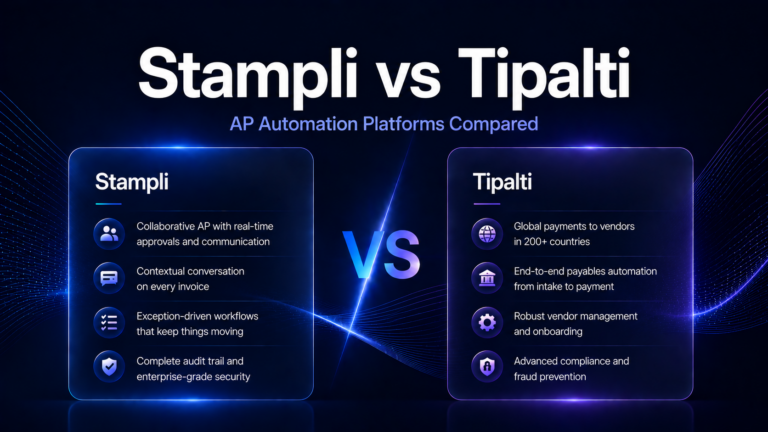
Tipalti provides outstanding liability reporting and payment scheduling data that can be fed into treasury management systems or cash forecast models, with multi-entity and multi-currency support. Particularly valuable for global treasury functions that need AP data across multiple currencies for cash position management. See our AP Automation Buyer Guide.
Limitation for this use case: Tipalti does not provide a native cash forecasting module — it provides the AP data inputs that feed into a separate treasury tool or spreadsheet model. Organizations wanting a fully integrated AP-to-cash-forecast workflow in a single platform will need to connect Tipalti to a treasury management system.
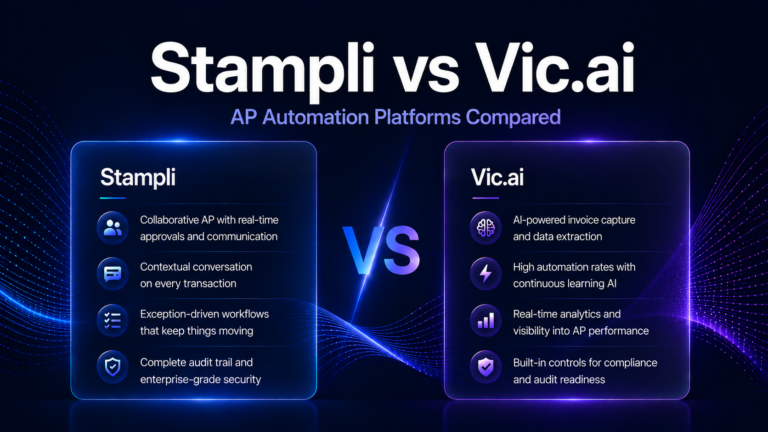
Stampli provides invoice aging and approval status reports that can be used as AP inputs to cash forecasting, with real-time ERP sync that ensures the data reflects current payment status.
Limitation for this use case: Stampli’s cash forecasting support is limited to AP data provision — the forecasting model itself must be built in a separate treasury tool or spreadsheet. For organizations wanting more integrated cash-AP analytics, Tipalti or Ramp offer more native connectivity.
Comparison Table
| Platform | Real-Time Payment Obligations | Cash Position Integration | Multi-Currency Support | Approval Timing Prediction | Treasury API / Export |
|---|---|---|---|---|---|
| Ramp | Yes | Native | Moderate | Moderate | Strong |
| Tipalti | Yes | Via integration | Best-in-class | Moderate | Strong |
| Stampli | Yes | Via ERP | Moderate | Basic | Moderate |
| BILL | Basic | Basic | Basic | None | Basic |
Implementation Considerations
Define the AP data fields required for cash forecasting before deployment — invoice amount, due date, payment terms, early payment discount deadline, payment method, currency, and current workflow status are the minimum set. Confirm that your AP platform captures and surfaces all of these fields in an exportable or API-accessible format. Data field gaps that are discovered after the forecasting model is built require platform reconfiguration that could have been avoided with upfront requirements definition.
Establish a data refresh cadence that matches your treasury management needs. For organizations managing cash positions daily, AP data must be refreshed at least once per business day — ideally in real time. For organizations managing cash weekly, daily refreshes may be sufficient. The refresh cadence determines the minimum acceptable ERP sync frequency for your AP platform configuration.
Which Companies Need This?
Organizations with tight cash management requirements — those with limited credit facilities, seasonal cash flow variation, or significant investment opportunities that depend on cash availability timing — benefit most directly. Companies with large payables balances relative to their cash position — where AP payment timing meaningfully affects short-term cash availability — have the highest forecasting accuracy improvement opportunity. Rapidly growing companies adding significant AP volume each month will see their cash forecasting accuracy improve most dramatically from AP data integration.
Frequently Asked Questions
How much does AP data integration improve cash forecast accuracy?
APQC benchmarks show that organizations with AP-data-integrated forecasting achieve 30-day forecast accuracy rates of 90%+ versus 70–80% for budget-based forecasting. The improvement is most pronounced in the 7–14 day window, where approved-but-unpaid invoices provide highly certain payment timing data that budget assumptions cannot match.
Can AP data be used for longer-term cash forecasting?
AP data is most accurate for near-term (7–30 day) forecasting, where actual invoice approval status and due dates are known. For 30–90 day forecasting, AP data is supplemented by contract-based recurring payment projections and budget-based estimates for yet-to-arrive invoices. Beyond 90 days, AP contributes primarily the recurring payment baseline with limited invoice-specific certainty.
Final Recommendation
Ramp provides the most accessible AP-to-cash-visibility integration for domestic-focused fast-growth companies. Tipalti provides the strongest global payment obligation reporting for treasury functions managing multi-currency positions. For most organizations, the first step is connecting existing AP platform payment obligation data to an existing treasury model or spreadsheet — the connectivity improvement alone delivers the majority of the forecasting accuracy benefit before any additional tooling investment is required. See our Best AP Automation Software guide for complete platform evaluations.