BILL vs Tipalti (2026): Which AP Automation Platform Is Best?
BILL vs Tipalti (2026): Which AP Automation Platform Is Best?
An independent, head-to-head evaluation of two leading AP automation platforms — reviewed across pricing, AI capabilities, global payments, integrations, and total cost of ownership.
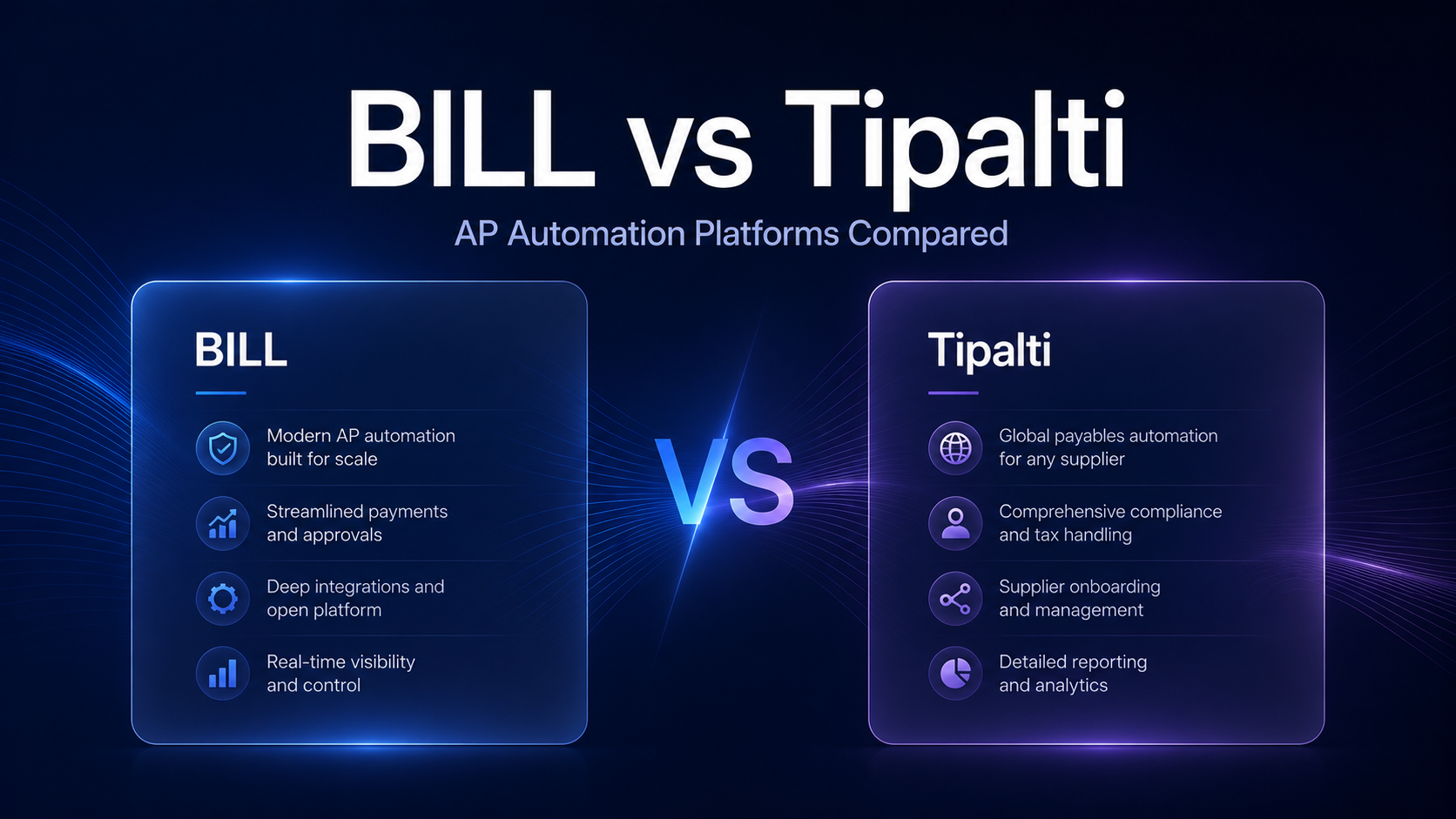
BILL and Tipalti are the two most commonly shortlisted AP automation platforms for growing businesses. Both automate invoice processing, approvals, and payments — but they serve fundamentally different market segments and use cases. This guide cuts through the marketing to tell you exactly which platform fits your business.
Quick Verdict
At a Glance: Which Platform Wins Each Category?
| Use Case | Winner | Why |
|---|---|---|
| Best for SMB | BILL | Per-user pricing from $45/month, fast setup, deep QuickBooks/Xero integration, and the largest SMB payment network in the US |
| Best for Mid-Market | Tipalti | Handles multi-entity structures, more sophisticated approval workflows, and scales cleanly from $50M to $500M+ in revenue |
| Best for Global AP | Tipalti | Supports 196 countries, 120+ currencies, 50+ payment methods, and built-in tax compliance (VAT, 1099, W-8/W-9) — BILL is primarily US-centric |
| Best for Ease of Use | BILL | Simpler UI, faster onboarding, lower implementation burden for teams without dedicated IT resources |
| Best Overall | Depends on size | BILL for businesses under $50M; Tipalti for $50M–$500M+ with international payments or compliance complexity |
Side-by-Side Comparison
BILL vs Tipalti: Full Feature Comparison
| Criteria | BILL | Tipalti |
|---|---|---|
| Company size | SMB to lower mid-market (5–500 employees) | Mid-market to enterprise (100–5,000+ employees) |
| Pricing model | Per-user/month ($45–$79 AP; free AR tier); transaction fees apply | Volume-based; starts ~$299/month; custom enterprise pricing |
| Core AP automation | Strong — invoice capture, approvals, ACH/check/wire payments | Strong — full procure-to-pay, multi-entity, advanced workflows |
| International payments | Limited — primarily US; basic international wire support | Excellent — 196 countries, 120+ currencies, 50+ payment methods |
| Tax compliance | Basic 1099 support; limited VAT handling | Built-in 1099/W-8/W-9, VAT, global tax compliance automation |
| ERP integrations | QuickBooks, Xero, Sage Intacct, NetSuite, MS Dynamics (native sync) | NetSuite, Sage Intacct, QuickBooks, Xero, SAP, Oracle, MS Dynamics |
| Approval workflows | Multi-level workflows; adequate for most SMB needs | Highly configurable; conditional routing, SOX-compliant controls |
| Supplier onboarding | 6M+ member network; faster onboarding for existing BILL vendors | Supplier self-service portal; W-8/W-9, bank details, tax forms collected automatically |
| AI capabilities | OCR + ML invoice capture, duplicate detection, intelligent routing | AI-driven GL coding suggestions, anomaly detection, payment risk scoring |
| Ease of implementation | 1–4 weeks typical; minimal IT resources required | 8–12 weeks typical; requires implementation partner for complex setups |
| Reporting | Standard AP/AR reporting; adequate for SMB; limited custom reporting | Advanced reporting; multi-entity consolidation; audit-ready dashboards |
| Strengths | Network scale, ease of use, SMB pricing, accountant ecosystem | Global payments, compliance depth, enterprise controls, scalability |
| Weaknesses | US-centric, limited enterprise features, per-transaction fees | Higher cost, longer implementation, complex pricing at scale |
BILL Deep Dive
BILL Strengths
BILL has built the largest business payments network in the US, with over 6 million members. This network effect is BILL’s most durable competitive advantage: paying a vendor already on the BILL network means same-day or next-day digital payment without manual bank setup. For SMBs with mostly domestic US suppliers, this is genuinely valuable.
BILL’s pricing is transparent and accessible. Starting at $45/user/month for AP-only functionality, it is the most affordable full-featured AP automation platform for small teams. The free AR tier adds further value for businesses that also want to automate receivables without additional cost.
Implementation speed is a key differentiator. Most small businesses are fully operational within one to four weeks, with minimal IT involvement. The platform’s deep native integration with QuickBooks — the most common accounting platform in the SMB market — means finance teams can be live quickly with automatic GL sync, removing the most painful part of AP implementation.
BILL’s accountant ecosystem is the other major strength. Thousands of accounting firms recommend and manage BILL on behalf of their clients, which creates a large installed base and strong word-of-mouth. For companies that work with an external accounting firm, BILL is often the path of least resistance.
BILL Weaknesses
BILL is primarily a US-focused platform. Its international wire capabilities are basic, and it lacks the multi-currency, multi-country payment infrastructure that Tipalti provides. For any company with 10%+ of spend going to international suppliers, BILL’s global payment limitations become a real operational problem.
The per-transaction fee model creates cost unpredictability at higher invoice volumes. A company processing 1,000+ invoices per month will find that transaction fees add materially to the per-user subscription cost. Model your total cost at volume before committing.
BILL’s enterprise capabilities lag behind Tipalti. Multi-entity consolidation, SOX-compliant approval controls, and advanced audit reporting are limited on BILL. Companies that have crossed $100M in revenue or operate in compliance-intensive industries will likely outgrow BILL’s control environment.
BILL’s user experience, while adequate, has not kept pace with newer fintech platforms. The interface carries legacy design decisions, and some workflows feel more complex than they should be. This is not a dealbreaker for most SMBs but is noticeable compared to newer platforms.
Tipalti Deep Dive
Tipalti Strengths
Tipalti’s global payment infrastructure is its defining strength. Support for 196 countries, 120+ currencies, and 50+ payment methods — including local ACH equivalents, wire transfers, PayPal, and prepaid cards — means finance teams can pay any supplier, anywhere, through a single platform. This eliminates the fragmented payment workflows (wire here, PayPal there, check for the rest) that plague mid-market AP teams.
The supplier self-service portal is genuinely differentiated. Rather than having AP teams collect bank details and tax forms manually, Tipalti’s portal has suppliers enter their own information: bank account details, W-8/W-9, VAT registration, and payment preferences. This shifts the data collection burden to suppliers and reduces AP team workload by an estimated 30–50% on supplier onboarding tasks.
Tipalti’s compliance automation is best-in-class for mid-market. Built-in 1099 and 1042-S filing, OFAC screening on every payment, VAT handling, and SOX-compliant dual-approval controls make Tipalti the default choice for Series C+ companies, public companies, and multi-entity businesses that need genuine governance over their AP function.
The platform’s scalability is a major advantage. Companies that start using Tipalti at $50M in revenue can continue using it through $500M and beyond without needing to re-platform. BILL users frequently re-platform to Tipalti as they cross $100M in revenue — choosing Tipalti from the start avoids that costly migration.
Tipalti Weaknesses
Tipalti’s implementation complexity is the most common buyer complaint. A full deployment for a mid-market company typically takes 8–12 weeks and often requires an implementation partner. For companies wanting to be live quickly, this timeline is a real disadvantage compared to BILL’s 1–4 week deployment.
Pricing scales with payment volume, which creates cost unpredictability for fast-growing companies. A business that triples its supplier payments in two years may find their Tipalti bill has grown significantly. Model your payment volume trajectory carefully and negotiate volume caps at signing.
Tipalti’s user interface, while functional, is not the most intuitive in the market. Finance teams without dedicated AP staff may find the platform’s depth becomes complexity rather than capability. Training and change management investment is higher than BILL requires.
For companies that do not have significant international payment volume or compliance complexity, Tipalti’s advanced features go unused while the higher price remains. BILL delivers better value for purely domestic, lower-complexity AP automation.
Pricing Comparison
BILL vs Tipalti: Pricing
| Pricing Factor | BILL | Tipalti |
|---|---|---|
| Starting price | $45/user/month (AP Essentials) | ~$299/month (base platform fee) |
| Pricing model | Per user + per transaction fees | Platform fee + volume-based payment fees |
| Free tier | Free AR tier available | No free tier |
| SMB cost (5 users, 200 invoices/mo) | ~$225–$400/month all-in | ~$500–$900/month all-in |
| Mid-market cost (20 users, 2,000 invoices/mo) | ~$900–$2,000/month all-in | ~$1,500–$3,500/month all-in |
| Enterprise pricing | Custom; per-transaction fees continue | Custom; volume discounts available |
| Implementation cost | Minimal; self-service or partner-assisted | $5,000–$25,000+ for full deployment |
| Hidden costs | Per-transaction fees add up at volume | Volume escalation, implementation services |
AI Capabilities
BILL vs Tipalti: AI Capabilities Compared
Both platforms have invested in AI but approach it differently. BILL focuses AI on the highest-leverage automation opportunities for SMBs: invoice data capture and approval routing. Tipalti applies AI more broadly across its enterprise workflow, including payment risk and compliance.
| AI Feature | BILL | Tipalti |
|---|---|---|
| Invoice OCR & data capture | ✅ AI-powered OCR + ML for line-item extraction | ✅ AI-powered OCR with high accuracy on complex invoices |
| Duplicate detection | ✅ Automated duplicate invoice flagging | ✅ Advanced duplicate and near-duplicate detection |
| GL coding suggestions | ✅ Learns from historical coding patterns | ✅ ML-based GL coding with confidence scores |
| Intelligent approval routing | ✅ Rules-based with ML optimization | ✅ Conditional routing with SOX-grade audit trail |
| Payment risk scoring | ❌ Not available | ✅ Real-time OFAC screening + payment anomaly detection |
| Anomaly detection | ⚠️ Basic fraud flags | ✅ Advanced anomaly detection across payment patterns |
| Supplier verification AI | ⚠️ Basic validation | ✅ AI-assisted W-8/W-9 validation, bank account verification |
| Touchless processing rate | ~60–70% on clean invoices | ~70–85% on structured invoices |
Integrations
BILL vs Tipalti: Integration Ecosystem
Integration quality — not just count — is one of the most important factors in AP automation platform selection. A broken or shallow ERP sync creates more work than it saves.
| Integration | BILL | Tipalti |
|---|---|---|
| QuickBooks Online | ✅ Native two-way sync (best-in-class) | ✅ Native sync; slightly less seamless than BILL |
| Xero | ✅ Native two-way sync | ✅ Native integration |
| Sage Intacct | ✅ Native integration | ✅ Native integration |
| NetSuite | ✅ Native integration | ✅ Native integration (strong) |
| SAP | ⚠️ Limited / via middleware | ✅ Native SAP connector |
| Oracle | ⚠️ Limited / via middleware | ✅ Native Oracle connector |
| Microsoft Dynamics 365 | ✅ Native integration | ✅ Native integration |
| Workday | ❌ Not supported natively | ✅ Native Workday integration |
| Total ERP connectors | ~50 integrations | 60+ integrations including enterprise ERPs |
| Open API | ✅ REST API available | ✅ REST API available |
| HRIS integrations | Gusto, Rippling | Workday, ADP, and others |
Decision Guide
Which Platform Should You Choose?
The right answer depends almost entirely on your company’s size, payment complexity, and growth trajectory. Here is the decision framework:
Choose BILL if you are a Small Business
If you are a business under $20M in revenue with a small AP team (1–3 people), primarily US-based suppliers, and an accounting platform that is QuickBooks or Xero, BILL is the right choice. The combination of transparent per-user pricing, fast implementation, and the 6M+ member network makes BILL the most practical AP automation platform for small businesses. Start with BILL and re-evaluate at the $50M–$100M revenue milestone.
Choose Tipalti if you are a Mid-Market Company
If you are a business between $50M and $500M in revenue, with a meaningful AP team (5+ people), multi-entity structure, or compliance requirements (SOX, VAT, global payroll), Tipalti is the right choice. The implementation investment pays back quickly in reduced AP headcount, eliminated payment errors, and compliance automation. Tipalti is also the more future-proof choice — you are unlikely to outgrow it.
Choose Tipalti for Global Operations
If you pay suppliers in more than five countries or in more than two currencies, Tipalti is the only practical choice between these two. BILL’s international payment capabilities are too limited for meaningful cross-border AP operations. Tipalti’s 196-country reach, local payment method support, and built-in tax compliance make it the default for any company with global supplier complexity.
Choose Tipalti for Multi-Entity Companies
If you operate multiple legal entities — subsidiaries, holding companies, or separate business units — Tipalti’s multi-entity architecture handles consolidated AP in a way BILL cannot. BILL is fundamentally a single-entity platform; multi-entity use on BILL requires workarounds. Tipalti was built for this use case from the ground up.
BILL vs Tipalti for High Invoice Volume
At high invoice volumes (2,000+ per month), the cost model matters. BILL’s per-transaction fees make it relatively expensive at scale. Tipalti’s platform fee model, while higher at low volumes, tends to deliver better cost-per-invoice economics at higher volumes. If you are above 1,500 invoices per month, model your 24-month total cost carefully before choosing.
Final Verdict
Final Verdict: BILL vs Tipalti
BILL and Tipalti are both excellent AP automation platforms — but they are not interchangeable. The wrong platform choice creates a painful re-platforming project 12–24 months later. Choose correctly the first time by being honest about where your business is going, not just where it is today.
Choose BILL if you are a US-focused small or lower-mid-market business that needs accessible, fast-to-deploy AP automation with transparent pricing and deep QuickBooks/Xero integration. BILL’s 6M+ network, accountant ecosystem, and free AR tier make it the most practical choice for businesses under $50M.
Choose Tipalti if you are a mid-market or growth-stage business with international payment complexity, multi-entity structure, or compliance requirements. Tipalti’s global payment infrastructure, supplier self-service portal, and SOX-grade controls make it the right long-term platform for companies that have outgrown, or will soon outgrow, BILL’s capabilities.
For a broader view of the full AP automation market — including Stampli, Vic.ai, Airbase, Yooz, and Ramp — see our Best AP Automation Software guide. Also compare Stampli vs Tipalti and Vic.ai vs Stampli for additional AP automation perspectives.