Workday vs NetSuite (2026): Which ERP Platform Is Best?
Workday vs NetSuite (2026): Which ERP Platform Is Best?
An independent, head-to-head evaluation of two leading ERP platforms — reviewed across financial management, planning, procurement, global operations, AI capabilities, and total cost of ownership.
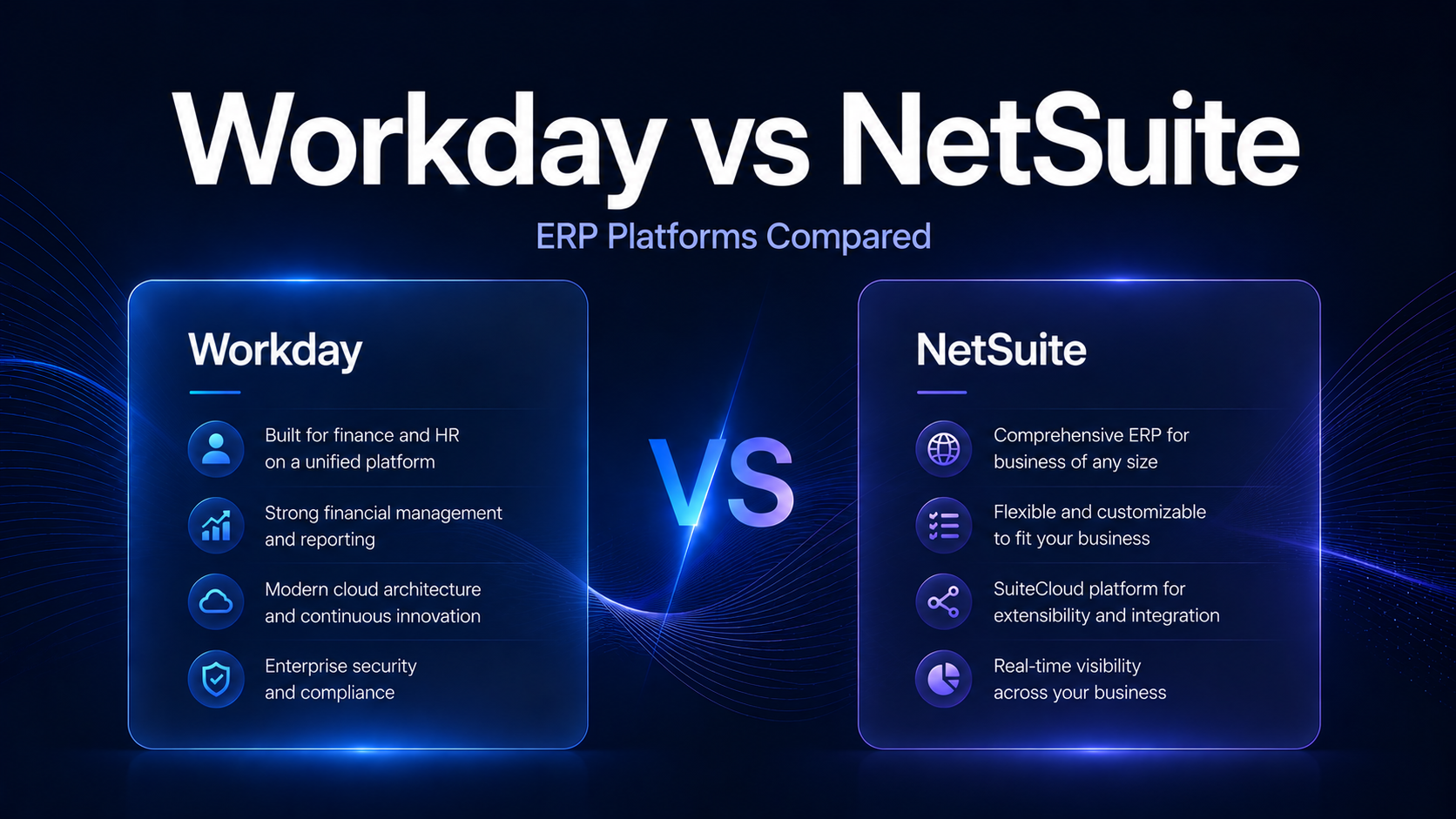
Workday and NetSuite are two of the most commonly shortlisted ERP platforms for companies that have outgrown entry-level accounting software or are replacing a legacy on-premise ERP. Both deliver cloud-native financial management — but they target different company sizes, have distinct implementation profiles, and excel in different parts of the ERP stack. This guide tells you exactly which platform fits your organization.
Quick Verdict
At a Glance: Which Platform Wins Each Category?
| Use Case | Winner | Why |
|---|---|---|
| Best for Enterprise | Workday | Purpose-built for large enterprise finance and HCM at global scale; unified data model across financial management, workforce planning, and reporting |
| Best for Mid-Market | NetSuite | Faster deployment, lower entry cost, and broader out-of-the-box ERP functionality make NetSuite the default choice for companies between $10M and $500M |
| Best for Ease of Deployment | NetSuite | SuiteSuccess methodology delivers faster go-live timelines; pre-configured industry editions reduce customization burden significantly |
| Best for Global Organizations | Workday | Multi-currency, multi-entity, and multi-legislative financial management with unified global workforce and financial data across hundreds of subsidiaries |
| Best Overall | Depends on size | NetSuite for companies under $500M seeking broad ERP coverage at lower TCO; Workday for enterprises requiring unified finance and HCM at global scale |
Side-by-Side Comparison
Workday vs NetSuite: Full Feature Comparison
| Criteria | Workday | NetSuite |
|---|---|---|
| Company size | Mid-market to large enterprise (500–100,000+ employees) | SMB to upper mid-market (10–5,000+ employees) |
| Pricing model | Subscription; user-based; custom enterprise contracts; typically $200K–$2M+/year | Subscription; user + module-based; more accessible mid-market pricing from $30K/year |
| Financial management | Comprehensive financial management: GL, AP, AR, fixed assets, banking, intercompany; built for complex global structures | Full financial management suite: GL, AP, AR, fixed assets, multi-currency; strong for mid-market to upper mid-market complexity |
| ERP capabilities | Finance and HCM unified; limited native inventory/manufacturing; relies on partners for supply chain | Broad ERP suite including inventory, order management, manufacturing, WMS, and ecommerce; more complete operational ERP |
| Planning and forecasting | Workday Adaptive Planning: best-in-class connected FP&A tightly integrated with financial actuals and HCM data | NetSuite Planning and Budgeting: solid mid-market planning module; less sophisticated than Workday Adaptive for complex modeling |
| Procurement | Workday Procurement: source-to-pay with contracts, requisitions, and supplier management; enterprise-grade | NetSuite Procurement: purchase order management, vendor management, and approval workflows; well-suited for mid-market |
| Human capital management | Full HCM suite: core HR, payroll, talent, recruiting, and workforce planning — a Workday core differentiator | SuitePeople HCM: covers core HR and basic payroll; significantly less capable than Workday HCM for enterprise complexity |
| Reporting | Workday Prism Analytics: unified financial and workforce reporting; real-time dashboards; powerful for enterprise data analysis | NetSuite SuiteAnalytics: flexible reporting and dashboards; strong for financial reporting; adequate for most mid-market needs |
| AI capabilities | Workday AI: predictive analytics, anomaly detection, worker retention insights, intelligent GL suggestions, and natural language queries | NetSuite AI: transaction matching, anomaly detection, cash flow forecasting, and intelligent GL coding |
| ERP integrations | Workday Integration Cloud: 600+ pre-built connectors; strong Salesforce, ServiceNow, and Coupa integrations | SuiteCloud platform: 500+ SuiteApp integrations; strong Salesforce, Shopify, and ecommerce connectors |
| Global operations support | Best-in-class: 180+ countries, 70+ currencies, multi-legislative payroll, and consolidated global financial reporting | Strong: 190+ countries, 190+ currencies, multi-subsidiary; slightly less depth for multi-legislative payroll than Workday |
| Ease of implementation | 9–18 months typical; requires certified implementation partner; significant change management investment | 3–6 months for SuiteSuccess editions; 6–12 months for full customized deployments; faster than Workday for most mid-market needs |
| Strengths | Unified finance + HCM, global scale, Adaptive Planning integration, enterprise reporting, best-in-class workforce data | Broad ERP coverage, faster deployment, lower TCO, operational ERP depth (inventory, manufacturing), accessible mid-market pricing |
| Weaknesses | Limited native operational ERP (inventory, manufacturing), high cost and complexity, slow implementation | HCM less capable at enterprise scale; planning less sophisticated than Workday Adaptive; UI more complex than modern SaaS competitors |
Workday Deep Dive
Workday Strengths
Workday‘s defining architectural advantage is its unified data model. Unlike traditional ERP platforms where financial, HR, and planning data live in separate modules with integration points between them, Workday stores all financial and workforce data in a single object model with a shared security and reporting layer. This means a CFO analyzing headcount cost by department is working from the same data as the CHRO analyzing attrition — eliminating the reconciliation problem that plagues enterprises that run finance and HR on separate systems.
Workday’s integration with Adaptive Planning is the strongest connected planning story in the enterprise ERP market. Workday Adaptive Planning pulls actuals directly from Workday Financials and headcount data directly from Workday HCM, enabling FP&A teams to build driver-based financial models that are directly connected to the operational data — not exports and manual refreshes. For CFOs who want financial plans that stay current with operational reality, this integration eliminates a category of reconciliation work that consumes significant FP&A time on other platforms.
Workday’s global operations support is among the strongest in the ERP market. The platform handles financial consolidation across 180+ countries, 70+ currencies, and multiple accounting standards (GAAP, IFRS) simultaneously. Workday’s multi-legislative payroll — supporting local payroll rules and compliance in dozens of countries — is a significant advantage for enterprises with substantial global headcount. For multinational organizations that have historically managed international payroll through a patchwork of local providers, Workday’s global HCM and payroll infrastructure is materially valuable.
Workday’s reporting and analytics capabilities are among the best in enterprise finance. Workday Prism Analytics provides a unified layer for financial, operational, and workforce reporting with real-time data, configurable dashboards, and powerful drill-down capabilities. For enterprise CFOs and FP&A teams that need to deliver management reporting, board reporting, and operational analytics from a single source of truth, Workday’s reporting infrastructure reduces the reliance on external BI tools and data warehousing.
Workday Weaknesses
Workday’s most significant limitation is its narrow operational ERP coverage. Unlike NetSuite, which provides a genuinely complete ERP suite covering inventory management, manufacturing, order management, and ecommerce, Workday’s native capabilities are concentrated in financial management and HCM. Companies that need supply chain management, warehouse management, or manufacturing execution alongside their financial system typically need to deploy a separate operational system and integrate it with Workday — adding cost and complexity that NetSuite’s unified platform avoids.
Workday’s total cost of ownership is high and often underestimated during procurement. Licensing fees for enterprise deployments typically start at $500K/year and scale to $2M+ for large organizations. Implementation costs from a certified partner — Accenture, Deloitte, IBM, or a specialized Workday SI — frequently range from $500K to $5M+ depending on scope and complexity. The combination of licensing and implementation often results in a 3-year TCO of $3M–$10M for large enterprise deployments, which is far above what mid-market companies can justify.
Workday’s implementation timeline creates real business risk. A standard Workday Financials deployment takes 9 to 12 months; a full Workday suite deployment (Financials + HCM + Adaptive) can take 12 to 18 months or longer. For organizations that need a new financial system live before a fiscal year end, an audit, or a major business event, Workday’s implementation runway requires careful planning and significant lead time. Any scope creep or organizational complexity can push timelines significantly.
Workday’s platform is optimized for organizations with dedicated IT and finance systems teams. Self-administration of Workday configurations, security models, and business processes requires trained Workday system administrators — a skill set that is expensive and competitive to hire. Unlike NetSuite, where mid-market finance teams can manage many configurations themselves, Workday typically requires ongoing partner engagement or internal specialist headcount to maintain effectively.
NetSuite Deep Dive
NetSuite Strengths
NetSuite‘s broadest competitive advantage is the completeness of its ERP suite. In a single platform, NetSuite covers financial management, inventory and supply chain, order management, manufacturing (light to mid-complexity), project management, ecommerce, and CRM. For mid-market companies that need their business systems to grow with them — from a 20-person company to a 2,000-person company — NetSuite’s breadth means they are unlikely to need to re-platform the core ERP as operations scale. This breadth is something Workday, which concentrates on finance and HCM, does not offer natively.
NetSuite’s SuiteSuccess implementation methodology is a genuine competitive advantage in time-to-value. Oracle has pre-configured SuiteSuccess editions for 20+ industries — including SaaS, manufacturing, retail, and professional services — that deliver a pre-built chart of accounts, KPI dashboards, and workflow configurations tailored to the target industry. Companies that adopt SuiteSuccess can go live in 3 to 4 months rather than 9 to 12, with a lower professional services investment. For mid-market companies that cannot afford a 12-month ERP implementation, SuiteSuccess is practically differentiated.
NetSuite’s installed base and ecosystem are substantial. With more than 40,000 customers globally — the largest installed base of any cloud ERP for mid-market companies — NetSuite has a mature support infrastructure, deep SuiteApp marketplace, and extensive pool of implementation partners. This means mid-market companies can find qualified NetSuite implementation and support resources more easily than for many competing platforms, and the SuiteApp marketplace provides pre-built integrations for hundreds of commonly used adjacent applications.
NetSuite’s multi-entity and multi-subsidiary capabilities are strong for mid-market and upper mid-market complexity. The OneWorld module enables consolidated reporting across dozens of subsidiaries, with multi-currency translation, intercompany eliminations, and local statutory reporting handled within the platform. For growing companies with multiple legal entities — through organic expansion or M&A — NetSuite OneWorld provides a scalable multi-entity financial architecture without the enterprise-grade cost and complexity of Workday.
NetSuite Weaknesses
NetSuite’s HCM offering — SuitePeople — is not competitive with Workday HCM for enterprise-scale workforce management. SuitePeople covers basic employee records, onboarding, time tracking, and payroll for US-based employees, but lacks the talent management, global payroll, workforce planning, and advanced HR analytics that Workday HCM provides. Companies above 500 employees or with complex global HR requirements almost always deploy a separate HCM platform alongside NetSuite, adding integration complexity that Workday’s unified model avoids.
NetSuite’s planning and budgeting module, while adequate for standard annual budgeting and basic rolling forecasts, does not match Workday Adaptive Planning for sophisticated FP&A teams. NetSuite Planning and Budgeting lacks the multi-dimensional modeling depth, driver-based planning sophistication, and what-if scenario capabilities that Adaptive Planning provides. FP&A teams that require a serious planning tool alongside NetSuite typically integrate a separate FP&A platform — Adaptive Planning, Pigment, or Mosaic — which adds licensing cost and integration overhead.
NetSuite’s user experience has improved over the years but remains more complex and less intuitive than modern SaaS platforms. The interface carries structural design decisions from its earlier architecture, and many common tasks require more clicks than comparable actions in newer ERP tools. This creates a higher training burden for new users and can drive lower adoption rates in organizations without a strong change management program. For finance teams that prioritize user experience as a factor in ERP selection, NetSuite is frequently outscored by competitors.
NetSuite’s pricing can escalate significantly as user counts grow and additional modules are added. The base license is accessible at the mid-market level, but the cumulative cost of user licenses plus OneWorld plus Planning and Budgeting plus manufacturing or ecommerce modules can push total licensing costs well above initial estimates. Companies that do not model their 3-year module and user expansion carefully at the time of procurement frequently encounter significant pricing surprises at renewal.
Pricing Comparison
Workday vs NetSuite: Pricing
| Pricing Factor | Workday | NetSuite |
|---|---|---|
| Pricing model | Subscription; user-based; custom enterprise contracts | Subscription; user + module-based; annual license |
| Starting price | $200,000–$400,000+/year for small enterprise deployments | $30,000–$60,000/year for small mid-market deployments |
| Mid-market cost (100 users) | Not typical; Workday is rarely deployed below $300K/year | $100,000–$250,000/year depending on modules |
| Enterprise cost (500+ users) | $500,000–$2M+/year; custom multi-year contracts | $300,000–$800,000+/year depending on modules and entities |
| Implementation cost | $500,000–$5M+ depending on scope and partner | $50,000–$500,000 for SuiteSuccess; $200K–$1M+ for full custom |
| Ongoing admin burden | High; requires dedicated Workday administrator or retained partner | Moderate; finance-led admin feasible for most mid-market configurations |
| 3-year TCO (200-person company) | $2M–$6M+ all-in (if applicable) | $400,000–$1M all-in |
| Free trial | Not available; enterprise demo-driven sales process | Demo available; guided evaluation supported |
AI Capabilities Comparison
Workday vs NetSuite: AI Capabilities Compared
Both platforms have made significant AI investments, but their AI capabilities reflect their respective strengths. Workday’s AI is deepest in workforce intelligence and financial anomaly detection. NetSuite’s AI focuses on transaction automation, cash flow forecasting, and operational ERP use cases.
| AI Feature | Workday | NetSuite |
|---|---|---|
| Transaction matching | AI-powered matching for bank reconciliations and intercompany transactions | AI-assisted transaction matching with configurable rules and confidence scoring |
| Anomaly detection | ML-based financial anomaly detection and spend pattern analysis | Anomaly detection on financial transactions and expense patterns |
| Cash flow forecasting | AI-assisted cash forecasting integrated with Workday Adaptive Planning | NetSuite AI cash flow forecasting based on AR, AP, and historical patterns |
| GL coding suggestions | Intelligent GL coding based on transaction history and vendor patterns | AI-assisted GL coding with historical pattern learning |
| Workforce AI | Workday AI: attrition risk scoring, skills gap analysis, compensation recommendations — no equivalent in NetSuite | Not available; SuitePeople lacks AI-driven workforce analytics |
| Planning AI | Workday Adaptive Planning: ML-based statistical forecasting, driver identification, scenario suggestions | Basic AI-assisted budgeting; limited compared to Adaptive Planning |
| Natural language interface | Workday People Experience: natural language queries for HR and financial data | Limited; primarily form-driven interaction with developing NL capabilities |
| Operational AI | Limited; Workday’s AI is concentrated in finance and workforce use cases | Demand planning AI, inventory optimization suggestions, and order management automation |
Integrations Comparison
Workday vs NetSuite: Integration Ecosystem
Integration breadth and quality are critical ERP selection factors. The cloud ERP that best connects to your existing technology stack — CRM, HRIS, procurement, banking, and operational systems — will deliver faster time-to-value and lower ongoing integration maintenance cost.
| Integration | Workday | NetSuite |
|---|---|---|
| Salesforce | Native Workday-Salesforce connector; widely deployed for revenue and quota planning | Native NetSuite-Salesforce integration; strong for quote-to-cash workflows |
| Coupa / Procurement | Native Coupa integration; strong source-to-pay connectivity | Available via SuiteApp or middleware; less native than Workday |
| Adaptive Planning | Native; Workday-owned; deepest financial planning integration in the market | Available via integration; not natively owned |
| Banking / Treasury | Bank connectivity via Workday Integration Cloud; strong for enterprise treasury | Bank feeds, electronic payments, and treasury management via SuiteApp ecosystem |
| ServiceNow | Native ServiceNow integration; widely used for IT financial management | Available via API; less established connector than Workday |
| Shopify / ecommerce | Not native; requires middleware | Native Shopify and ecommerce connectors; NetSuite’s SuiteCommerce is native |
| Logistics / 3PL | Not native; supply chain integration via partners | Native 3PL and logistics connectors via SuiteApp marketplace |
| Open API | REST API; well-documented; Workday Integration Cloud Studio for custom integrations | REST and SOAP APIs; SuiteTalk; well-documented with large developer community |
| Total connectors | 600+ via Workday Integration Cloud and partner marketplace | 500+ via SuiteApp marketplace; strong operational and ecommerce coverage |
Decision Guide
Which Platform Should You Choose?
The right platform depends on your company’s size, operational complexity, tech stack, implementation capacity, workforce management needs, and total cost tolerance. Here is the decision framework:
Choose NetSuite for Mid-Market Companies
If you are a company between $10M and $300M in revenue with a finance team of 2–15 people and operational needs that span financials, inventory, and order management, NetSuite is the stronger default. The SuiteSuccess methodology delivers a faster, more predictable implementation; the module breadth covers most mid-market operational needs in a single platform; and the pricing is accessible without a multi-year, multi-million-dollar commitment. Most mid-market companies that have outgrown QuickBooks or Xero will find NetSuite delivers the ERP capabilities they need without the enterprise complexity they do not.
Choose Workday for Enterprise Organizations
If you are a company above $500M in revenue with a large, distributed finance and HR function, global operations, and a strategic need for unified financial and workforce data, Workday is the right long-term investment. The unified finance and HCM data model, Adaptive Planning integration, and global payroll capabilities justify the higher TCO for organizations where the cost of disconnected finance and workforce systems is material. Engage a certified Workday implementation partner early and plan for a 12–18 month deployment timeline.
Choose Workday for Global Organizations
If you operate in more than 10 countries with meaningful headcount and financial operations in each, Workday’s global architecture — multi-legislative payroll, multi-currency financial consolidation, and local compliance automation — provides a level of global operational support that NetSuite, while capable internationally, does not fully match at the same scale. For multinationals with thousands of international employees across dozens of countries, Workday’s global HR and financial infrastructure eliminates the patchwork of local systems that typically drives up operational cost and compliance risk.
Choose NetSuite for Fast-Growing Companies
If you are a high-growth company — Series B+, PE-backed, or scaling through organic growth or acquisition — that needs a cloud ERP live quickly, NetSuite’s SuiteSuccess deployment methodology delivers faster time-to-value than Workday. A SuiteSuccess deployment can go live in 3 to 4 months; a comparable Workday deployment takes 9 to 12 months minimum. For companies that need financial infrastructure in place before the next fiscal year-end or investor reporting cycle, NetSuite’s implementation speed is a practical advantage that Workday cannot match.
Choose NetSuite for Multi-Entity Businesses
If you operate multiple legal entities through organic growth or M&A, NetSuite OneWorld provides a scalable multi-entity financial architecture at mid-market pricing. The platform handles consolidated reporting, intercompany eliminations, multi-currency translation, and local statutory reporting across dozens of subsidiaries within a single instance. For growing companies managing 5–50 entities, NetSuite OneWorld delivers the multi-entity capability they need without the enterprise-grade cost of Workday’s equivalent multi-entity framework.
Final Verdict
Final Verdict: Workday vs NetSuite
Workday and NetSuite are both excellent cloud ERP platforms — but they are built for different companies at different stages of complexity. The wrong choice creates either an over-engineered system that consumes budget and implementation capacity you cannot afford, or an under-powered platform that you outgrow before the implementation investment is recovered.
Choose Workday if you are a large enterprise that needs unified financial management and HCM at global scale, with a compelling need for the connected planning capabilities of Workday Adaptive Planning and the workforce intelligence that Workday’s unified data model provides. Workday’s total cost of ownership is high, but for organizations above $500M in revenue where the cost of disconnected finance and workforce systems is material, the investment is defensible and frequently delivers measurable ROI.
Choose NetSuite if you are a mid-market or growth-stage company that needs a complete, cloud-native ERP covering financials, operations, and optionally ecommerce — deployed faster and at lower total cost than enterprise alternatives. NetSuite’s breadth, SuiteSuccess implementation methodology, and 40,000+ customer installed base make it the default cloud ERP choice for growing companies that need operational and financial infrastructure in a single platform without enterprise-grade complexity.
Also evaluate Acumatica and Sage Intacct as strong mid-market ERP alternatives, and SAP S/4HANA for enterprise-grade ERP requirements.